RPL Childcare Application: The Complete Guide for Experienced Childcare Workers in Australia
You have spent months, maybe years, supporting young children through their earliest and most important stages of development. You know how to run a morning routine, manage a room of toddlers during transition, document observations, respond to a child in distress, and keep everything moving safely without missing a beat. You do this work well.
What you may not yet hold is the piece of paper that formally proves it.
A childcare RPL application allows experienced educators and childcare workers across Australia to convert genuine, hands-on experience into a nationally recognised early childhood qualification, without sitting through a course that repeats things they already know and already do every single day.
This matters more than ever right now. The Australian early childhood education and care sector is facing a persistent workforce shortage, and the regulatory requirements attached to working in a regulated service mean that formal qualifications are not simply nice to have. For many educators, a recognised qualification is required either to remain in their current role or to move into more senior positions.
In this guide, we walk through everything you need to know about the childcare RPL application process. We cover who is eligible, which qualifications are available, what evidence you need to gather, the most common mistakes that slow applications down, and how long the process realistically takes from your first conversation to a qualification in hand.
Can I Qualify?
Who Is Eligible for a Childcare RPL Application
This is the real question behind almost every enquiry about childcare RPL. Not what it is. Not how it works in theory. But whether your specific background, your specific role, your specific hours and documentation, is actually enough to get you across the line.
The answer, for most experienced childcare workers, is yes.
Here is a direct breakdown of the types of workers who regularly qualify for a childcare RPL application in Australia.
Roles That Regularly Qualify:
If you work or have worked in any of the following roles, you are likely eligible:
Long day care educator or assistant
Family day care educator
Preschool or kindergarten assistant
Outside school hours care worker
In-home care educator
Childcare room leader or senior educator
Childcare centre manager with direct contact hours
Nanny or au pair in a structured, consistent arrangement
Service Types That Count
Long day care centres
Family day care services
Preschools and kindergartens
Before and after school care programs
Vacation care programs
Occasional care services
Community based childcare programs
Work Arrangements That Count
Full time employment
Part time employment
Casual rostered work
Volunteer work in a regulated service
Paid work experience placements
Experience That Counts
Overseas childcare or early childhood experience
Aged care or disability work involving children
Informal caregiving experience where it is recent and can be documented
A Note on Minimum Experience
For most RTOs offering childcare RPL, the minimum expectation is around twelve months of genuine experience working with children in a recognised childcare setting. For the Diploma, most providers expect two or more years, with some of that time involving lead educator responsibilities.
Experience does not need to be continuous. Gaps are common in a casual workforce and do not automatically disqualify an application. What matters is the quality and consistency of your experience within those periods of work, and your ability to provide supporting documentation.
The fastest way to confirm your specific eligibility is a free skills assessment. A consultant reviews your background in detail and tells you clearly which qualification level is realistic, what evidence you need to gather, and roughly how long the process will take given your individual circumstances.
Why So Many Experienced Childcare Workers Are Still Without a Formal Qualification
Before covering the process itself, it is worth understanding why this gap exists at all. The question is not why a worker lacks ambition or motivation. More often, there are straightforward structural reasons that have kept formal qualifications out of reach for a large share of the people actually doing this work.
The Size and Shape of the Childcare Workforce
The 2024 National Early Childhood Education and Care Workforce Census, commissioned by the Australian Department of Education, counted 268,050 workers across ECEC services in Australia. Of those, 173,738 paid contact staff held a qualification in an early childhood education and care field. That leaves a substantial number of contact staff either working toward a qualification, holding older qualifications that require updating, or operating without one at all.
The sector has also grown quickly. According to the federal government, more than 14,000 workers were added to the ECEC workforce between May 2022 and the time of recent reporting, with a further 123,000 educators and teachers in the training pipeline. Jobs and Skills Australia has consistently flagged early childhood workers as being in shortage, with both a long training gap for early childhood teachers and a retention gap for child carers identified as persistent structural problems in the sector.
Meanwhile, 91.2 percent of the ECEC workforce is female, and a high proportion work part time or casually, which creates real practical barriers to attending block release study programs or weekly evening classes.
Why the Gap Builds Up
The early childhood sector draws workers through a wide range of entry points, many of which do not come with a formal qualification attached. Family day carers, in-home care educators, assistants in long day care centres, and workers who moved into regulated childcare from nannying, school age care, or community volunteering have often built genuine competency over time without ever completing a formally structured course.
Others entered the sector years ago when qualification requirements were less stringent, gained significant experience, and have since found themselves needing to formalise that experience to meet updated ACECQA approved qualification requirements under the Education and Care Services National Law.
For every one of these workers, the underlying skill is real. The RPL childcare application process exists specifically to verify and recognise that skill formally.
What Is a Childcare RPL Application?
A childcare RPL application is a formal request for Recognition of Prior Learning submitted to a Registered Training Organisation. Through this process, your existing childcare experience is assessed against the competency requirements of a nationally recognised early childhood qualification.
Rather than completing classroom modules on topics you already apply daily, such as implementing the Early Years Learning Framework, planning age appropriate learning experiences, or supporting children's emotional wellbeing and safety, an assessor from an RTO reviews the evidence you provide. If that evidence demonstrates you have already met the required competencies, the qualification is issued.
This process sits within the Australian Qualifications Framework, which means a qualification gained through RPL carries exactly the same recognition as one completed through traditional study. The certificate looks the same, is listed the same way on your formal record, and is recognised by ACECQA, by employers, and by regulatory authorities across every Australian state and territory.
What Qualifications Can You Target Through a Childcare RPL Application?
CHC30125 Certificate III in Early Childhood Education and Care
This is the most commonly pursued qualification through the childcare RPL application process, and it is also the most urgently needed credential across the sector.
The CHC30125 is the current ACECQA approved Certificate III level qualification, having superseded CHC30121 on 23 December 2025. Under the Education and Care Services National Law, educators working in regulated children's education and care services in Australia are required to hold, or in most circumstances be actively working towards, this qualification or higher.
From 1 July 2023, new family day care educators must hold an approved Certificate III level qualification or higher prior to commencing their role. They can no longer rely on the actively working towards provision that applies in centre based services.
Typical Certificate III RPL candidates include:
Long day care assistants who have worked in regulated services for twelve months or more Family day care educators who entered the sector before stricter entry requirements took effect In-home care workers providing care to young children in a domestic setting School age care workers who are transitioning into early childhood settings with children aged birth to five Educators who held older qualifications that are no longer on the ACECQA approved list
Core competency areas covered by the Certificate III include supporting children's wellbeing and social development, implementing curriculum and programming using the Early Years Learning Framework, providing a safe environment for children, supporting children with additional needs, communicating effectively with families, and maintaining compliance with relevant legislation and regulations.
CHC50125 Diploma of Early Childhood Education and Care
This qualification suits experienced educators who have taken on broader responsibilities, including room leadership, mentoring of junior staff, contributing to service programming and curriculum planning, or managing a team of educators within a regulated service.
Typical Diploma RPL candidates include:
Room leaders or lead educators overseeing a group room and guiding other staff Senior educators who contribute to operational decisions within a service Directors moving from management into a qualified educator role alongside their administrative function Experienced educators who have informally held Diploma level responsibilities without the credential to match
Core competency areas at Diploma level include leading curriculum development, supporting critical reflection and professional practice, leading teams in early childhood settings, implementing assessment for learning and development, and complying with regulatory and legislative requirements at a service leadership level.
How Recognition of Prior Learning Works
Recognition of Prior Learning measures what you've learned outside a traditional classroom. Learning may have occurred through:
Paid employment
Volunteer positions
Workplace mentoring
Professional development
Industry workshops
Previous study
Community programs
Leadership responsibilities
Daily workplace practice
For example, an educator who has spent six years supervising children's learning, maintaining documentation, communicating with families, following the National Quality Framework, and supporting children's wellbeing has likely developed extensive practical competencies.
Rather than asking that educator to repeat learning they've already demonstrated in practice, an assessor compares their evidence against nationally recognised competency requirements.
Why RPL Is Popular in Australia's Childcare Industry
Australia's early childhood education sector continues to require skilled and qualified educators. Many experienced workers entered the industry years ago when qualification requirements differed or when opportunities for formal study were limited.
An RPL childcare application helps bridge that gap by recognising existing capability.
Common reasons people apply include:
Meeting qualification requirements for promotion.
Improving employment opportunities.
Meeting regulatory expectations.
Increasing earning potential.
Applying for leadership positions.
Demonstrating professional credibility.
Supporting migration or skills recognition where applicable.
Building confidence through formal recognition.
Instead of starting from the beginning, eligible workers can receive recognition for skills they've developed over many years.
Expert Tip: Keep copies of workplace documents throughout your career. Even routine records can become valuable evidence during an RPL assessment.
Who Can Apply for Childcare RPL in Australia?
One of the biggest misconceptions is that only long-term childcare centre managers qualify for Recognition of Prior Learning. In reality, applicants come from many different roles across the early childhood education sector.
Eligibility depends less on your job title and more on whether your experience demonstrates the required competencies.
Common Applicants
You may be suitable for childcare RPL Australia if you've worked as:
Early childhood educator
Childcare assistant
Room leader
Centre supervisor
Family day care educator
Outside school hours care educator
Nanny with substantial professional experience
Preschool educator
Kindergarten assistant
Early learning coordinator
Experience gained across multiple employers can also contribute towards eligibility.
Quick Comparison
-
CHC30125 Certificate III in Early Childhood Education and Care
Frontline educator or assistant
Direct care, programming, safety, family communication
-
CHC50125 Diploma of Early Childhood Education and Care
Senior educator or room leader
Curriculum leadership, team mentoring, compliance oversight
Typical Experience That Supports an Application
Assessors usually consider the breadth and depth of your responsibilities rather than simply counting years of employment.
Relevant experience often includes:
Planning educational programs
Observing children's development
Communicating with parents and carers
Following health and safety procedures
Managing routines
Supporting inclusion
Maintaining learning documentation
Working collaboratively with colleagues
Applying child protection procedures
Implementing approved learning frameworks
Someone with three years of varied, hands-on experience may present stronger evidence than another applicant with five years performing only limited duties.
Can Casual and Part-Time Workers Apply?
Yes. Employment doesn't have to be full-time.
Many successful applicants have accumulated experience through:
Casual employment
Permanent part-time positions
Contract work
Family day care
Relief educator roles
Multiple childcare centres
Community organisations
The key requirement is being able to demonstrate competency consistently across the qualification requirements.
Volunteering and Community Experience
Certain volunteer roles may also contribute towards your childcare work experience recognition if they involve responsibilities that align with nationally recognised competencies.
Examples may include:
Community childcare programs
Early learning initiatives
Supported playgroups
Children's disability services
Indigenous community education programs
Volunteer work alone isn't always sufficient, but it can strengthen an application when combined with professional experience.
Did You Know?
Many applicants underestimate how much valuable evidence they already possess. Performance reviews, lesson plans, photographs of learning environments, professional development certificates, and supervisor references often provide strong supporting documentation when combined with workplace records.
Childcare RPL for Skilled Migrants and International Educators
A significant proportion of Australia's childcare workforce has come from overseas, bringing genuine early childhood experience from other countries. The 2024 National Workforce Census found that 19.3 percent of all children attending CCS approved childcare services spoke a language other than English at home, reflecting the multicultural character of both the families being served and the communities from which the workforce is drawn.
For skilled migrants with genuine overseas childcare or early childhood education experience, the RPL childcare application process offers a structured way to convert that experience into an Australian recognised qualification.
What Overseas Experience Counts
Experience working in regulated or government approved early childhood settings overseas Evidence of working with children aged birth to twelve in structured care or educational environments Documentation such as employment records, supervisor references, or child development portfolios from overseas services
What You May Need to Supplement
While overseas experience is considered, assessors will look for evidence that you understand Australian specific requirements. This typically includes:
Familiarity with the Early Years Learning Framework or My Time, Our Place framework Understanding of the National Quality Standard and the Education and Care Services National Law Awareness of Australian child protection legislation relevant to your state or territory Current first aid certification obtained in Australia
It is also worth noting that ACECQA's guidelines for individual applicants confirm that on the job experience can contribute toward RPL or credit transfer for part of an approved qualification, even where an overseas qualification has not been assessed as fully equivalent. This means that even if your overseas credential does not transfer directly, your practical experience in early childhood settings still has formal value within the Australian qualification system. Your RPL consultant will help you map your specific background against the relevant competency units before any application is submitted.
Best Practice: If you have overseas childcare experience, gather as much formal employment documentation as possible from your previous employer before starting your RPL application. Even documents in another language can often be submitted with a certified translation. Your RPL consultant will advise you on what is workable.
The RPL Childcare Application Process: Step-by-Step
Understanding each stage of the RPL childcare application process can help you prepare more effectively and avoid unnecessary delays. While every Registered Training Organisation (RTO) may have slightly different procedures, the overall assessment framework follows nationally recognised standards. The process is designed to evaluate whether your existing skills and knowledge meet the competency requirements of the qualification.
Many applicants expect the process to involve only submitting a few employment documents. In reality, assessors need evidence that demonstrates your ability to perform consistently in a real childcare environment. This means gathering a combination of workplace documents, references, practical examples, and supporting evidence that reflects your experience.
Step 1: Initial Eligibility Assessment
The first stage is usually an informal consultation or pre-assessment. During this conversation, an RPL adviser or assessor discusses your employment history, current role, previous training, and career goals.
Topics commonly covered include:
Length of childcare experience
Types of childcare settings you've worked in
Current responsibilities
Previous qualifications
Professional development completed
Desired qualification
Availability of workplace evidence
This initial review helps determine whether Recognition of Prior Learning is likely to be suitable or whether additional training may be required.
Expert Tip: Be honest about your experience during the initial consultation. Overstating responsibilities can create inconsistencies later in the assessment.
Step 2: Qualification Mapping
Once your eligibility is confirmed, your experience is compared against the units of competency within the qualification.
Rather than assessing your job title, assessors map your workplace duties to nationally recognised competency standards.
For example, an educator responsible for planning educational experiences may demonstrate competency in curriculum planning, while someone regularly supervising children during meals, rest periods, and outdoor play may provide evidence across multiple health and safety units.
Some competencies overlap naturally, allowing one workplace activity to satisfy several assessment requirements.
Step 3: Evidence Collection
Evidence gathering is usually the longest stage of an RPL childcare application.
Applicants often discover they already possess much of the required documentation without realising it.
Instead of collecting documents randomly, organise your evidence into logical categories that reflect different competency areas.
Common evidence categories include:
Employment verification
Workplace documentation
Professional development
Third-party reports
Practical demonstrations
Compliance documentation
Planning and programming records
Reflective practice
A well-organised portfolio is easier for assessors to review and often reduces requests for additional information.
Understanding Childcare RPL Evidence Requirements
One of the most common questions applicants ask is, "What evidence do I actually need?"
The answer depends on your experience and the qualification you're seeking. However, assessors generally look for evidence that is valid, authentic, current, sufficient, and directly related to the required competencies.
Providing hundreds of pages of unrelated documents rarely improves your application. Quality matters far more than quantity.
Employment Evidence
Employment records establish your practical experience within the childcare sector.
Examples include:
Employment contracts
Position descriptions
Payslips
Employment verification letters
Service statements
Rosters showing regular duties
These documents help confirm where you've worked and the responsibilities you've undertaken.
Workplace Evidence
This category demonstrates how you perform your daily responsibilities.
Examples include:
Learning programs
Weekly curriculum plans
Children's observations
Developmental records
Learning stories
Daily reflections
Room schedules
Indoor and outdoor environment plans
Why Evidence Matters in a Childcare RPL Assessment
An assessor cannot observe your practice directly. They were not in the room when you supported a child through separation anxiety, adapted an activity for a child with additional needs, or managed a situation where a child needed urgent first aid. The evidence portfolio you submit is how you allow them to see into your daily practice and verify that it meets the competency standard.
The goal is not a perfect document archive. It is a consistent, coherent picture of real experience. A strong portfolio shows a clear pattern: you worked in a regulated setting, you exercised professional judgement in real situations involving real children, and you can point to specific examples and documents that reflect each competency area.
Direct Evidence for Your Childcare RPL Application
Employment records confirming your role title, service type, and length of employment. Position descriptions detailing your specific duties and responsibilities. Observation and planning documentation, including EYLF based learning stories, program planning records, or developmental progress notes you have contributed to. Risk assessments, incident reports, or health and safety documentation you have completed or contributed to. Attendance and scheduling records confirming your regular contact hours with children
Supporting Evidence That Strengthens Your Application
Written references from directors, room leaders, or supervisors that speak specifically to your observable practice, not just your general character.Current first aid, emergency asthma management, and anaphylaxis response certificates, all of which are required under the National Regulations and demonstrate active compliance.Child protection training records.Records of any professional development sessions, internal training, or sector specific programs you have completed. Photographs of environments or resources you have set up, where no children are identifiable. Family communication examples such as templates, written notes, or newsletter contributions
But What If My Evidence Is Not Straightforward?
This is where many experienced workers give up before they even start. They assume their situation is too complicated, their paperwork too incomplete, or their circumstances too unusual for an RPL application to work. Most of the time, that assumption is wrong.
I Lost My First Aid or Child Protection Certificates
This is one of the most common concerns and one of the easiest to resolve. Most first aid certificates and child protection training can be reprinted or reissued by the training provider that originally delivered them. If you have completed the training but cannot locate the certificate, contact the provider directly with your name and approximate date of completion. In most cases, a replacement copy can be issued within a few business days.
If you genuinely cannot recover a certificate, completing a fresh, current course before submitting your RPL application is a straightforward solution and has the added benefit of ensuring your compliance certificates are up to date.
My Previous Employer Closed Down or I Changed Employers Multiple Times
A closed employer cannot provide a written reference, but that does not remove your work history from your application. Employment can often be verified through payslips, superannuation records, Centrelink employment history, or a reference from a colleague who worked alongside you at the same service, even if that colleague has also since moved on. An RPL consultant will help you identify which of these alternatives is most practical given your specific employment history.
For workers who have moved through multiple employers, multi employer experience is not a weakness in an RPL application. It often demonstrates broad exposure across different service types and team structures, which can actually strengthen a portfolio.
I Only Have Photos and Rosters, Not Formal Documents
Photos and rosters both count as RPL evidence. Rosters confirm that you were rostered to work with specific age groups, on specific shift types, in specific service contexts. Photos, provided no children are identifiable, demonstrate the environments and resources you set up, which speaks to your curriculum planning and health and safety competencies.
Photos of art activities you facilitated, outdoor learning spaces you prepared, sensory play setups, or room layouts you contributed to all tell an assessor something real about your practice. They are not as strong in isolation as a reference or employment record, but they contribute meaningfully to a portfolio that is being built from multiple angles.
My Reference Left the Service or Is Hard to Contact
A reference from a former supervisor is ideal, but it does not have to come from someone still working at the same service. As long as the person writing the reference worked alongside you and can speak to specific aspects of your practice, their current employment status is irrelevant. A reference from a former director who has since retired, a room leader who has moved to another centre, or a coordinator who has changed careers entirely is still valid.
If a reference is genuinely unreachable, a statutory declaration from another person who directly observed your work, such as a co-educator or parent who regularly interacted with you in a professional capacity, can sometimes be used to supplement the portfolio.
Can WhatsApp Messages, Lesson Plans, or Payslips Count?
Yes. Each of these can contribute to your evidence portfolio in different ways.Payslips are among the strongest forms of direct employment evidence because they confirm your employer, your role classification, and your hours of work across a specific period. Lesson plans and programming documents you created or contributed to demonstrate your ability to plan and implement learning experiences, which is a core competency across both Certificate III and Diploma level qualifications.
WhatsApp messages or email threads between you and families, colleagues, or supervisors can serve as supporting evidence of professional communication, provided personal information is redacted appropriately. They are not typically used as primary evidence, but they can fill contextual gaps that a portfolio might otherwise leave open.
I Only Worked as a Volunteer
Genuine, consistent volunteering in a regulated childcare service can count toward RPL eligibility. The key conditions are that the experience was recent, that it involved direct work with children in a structured setting, and that someone in a supervisory role can provide a written reference confirming the nature and duration of your involvement. A volunteer log, rosters, or a letter from the service director will typically be the primary evidence sources in this scenario.
Compliance Documentation
Compliance is a significant part of working in Australian early childhood education.
Evidence may include documentation relating to:
Health and safety procedures
Emergency evacuation practices
Incident reporting
Risk assessments
Infection control
Food safety
Child protection procedures
Supervision plans
These documents demonstrate your understanding of regulatory responsibilities rather than simply showing attendance at work.
Professional Development
Professional learning supports continuous improvement and demonstrates commitment to industry standards.
Useful evidence includes:
Workshop certificates
First Aid qualifications
CPR certification
Child Protection training
Professional development attendance records
Webinars
Internal workplace training
Conference participation
Even short professional development activities can strengthen an application when combined with workplace evidence.
RPL Documentation Checklist
Preparing documents systematically reduces stress and minimises delays.

Not every applicant will require every document, but this checklist provides a useful starting point when preparing an RPL portfolio.
Building a Strong Childcare RPL Portfolio
Think of your portfolio as evidence telling the story of your professional capability.
Rather than presenting unrelated documents, organise information into sections that correspond with the qualification requirements.
A structured portfolio might include:
Personal information
Employment history
Qualification documents
Professional development
Workplace evidence
Third-party reports
Practical examples
Supporting documentation
Clear labelling allows assessors to locate evidence quickly and demonstrates professionalism.
Common Mistakes That Slow Down a Childcare RPL Application
Submitting Documentation Without Matching It to Units
One of the most common delays in a childcare RPL assessment comes from candidates submitting a pile of documents without explaining how each one connects to a specific competency unit. An assessor working through an unstructured portfolio has to do the interpretive work themselves, which takes longer and increases the risk of a gap being flagged that did not actually exist.
A good RPL provider will structure your portfolio clearly before it is submitted, so every piece of evidence is explicitly connected to the unit it supports.
Using References That Are Too General
A reference letter that says the candidate is a dedicated and caring educator does not help an assessor much. What assessors look for is specific, observable behaviour. A reference that says the candidate consistently implemented EYLF based planning documentation, facilitated smooth routines across the toddler room, and communicated developmental concerns to families in a professional and timely manner is far more useful.
Spend time briefing your referees on what the assessor actually needs before they write the letter.
Common Mistake: Many candidates ask a referee to write something general and flattering rather than briefing them on the specific competency areas the reference needs to address. This results in a reference that creates more work for the assessor rather than less.
Overlooking Compliance Certificates
Current first aid, emergency asthma management, and anaphylaxis training certificates are required under the Education and Care Services National Regulations for all regulated childcare services. These certificates are also strong RPL evidence because they demonstrate that you are actively meeting compliance requirements. Many candidates forget to include them simply because they seem routine.
Submitting Observation Samples With Children's Names Visible
Privacy compliance is taken seriously in any documentation involving children. Assessors expect to see observation and planning samples, but these should have children's names and any identifying information removed before submission. Submitting samples with full names visible does not necessarily disqualify a portfolio, but it raises questions about the candidate's understanding of privacy obligations, which is itself a competency area being assessed.
Quick Tip: Before submitting any documentation involving children, go through and redact or replace all names with codes such as Child A, Child B, or initials only. This protects the children and signals professionalism to your assessor.
Waiting for a Perfect Portfolio
Some experienced childcare workers delay starting their application because they want their documentation to be flawless before they submit anything. In reality, a competent RPL consultant will identify gaps early and suggest appropriate supplementary evidence. Gaps do not disqualify an application. They trigger a conversation about how to address them, and most gaps can be filled through a professional discussion or an additional reference without restarting the entire process.
A smaller, well-organised portfolio often performs better than an oversized collection of unrelated documents.
How Assessors Evaluate Your Competency
Assessors don't simply check whether documents exist.
Instead, they evaluate evidence against nationally recognised assessment principles.
Evidence should generally be:
Authentic
Current
Valid
Reliable
Sufficient
For example, a lesson plan alone doesn't prove competency. However, when combined with observations, supervisor feedback, photographs of learning experiences, and reflective notes, it creates a stronger picture of your professional practice.
Assessors may also identify evidence gaps requiring additional documentation or workplace verification.
Third-Party Reports
Supervisor reports often provide valuable independent confirmation of your skills.
A third-party report may comment on your ability to:
Supervise children safely
Plan educational experiences
Communicate with families
Work collaboratively
Support inclusion
Maintain compliance
Follow policies
Mentor junior staff
These reports are particularly valuable because they verify performance from someone familiar with your workplace responsibilities.
Workplace Observation and Competency Conversations
Some RTOs include workplace observations or competency conversations as part of the childcare qualification assessment.
During these activities, assessors may ask you to explain:
Why you planned a particular learning experience
How you manage challenging behaviour
How you promote inclusion
How you communicate with families
How you ensure children's health and safety
How documentation supports children's learning
These conversations aren't designed to catch applicants out. Instead, they help confirm that your practical knowledge aligns with the evidence submitted.
Australian Childcare Sector Snapshot
According to Jobs and Skills Australia, demand for qualified early childhood educators is expected to remain strong over the coming years as workforce shortages continue across many regions.
The Australian Bureau of Statistics also reports continued growth in the use of early childhood education and care services, increasing the need for qualified educators capable of delivering high-quality learning experiences.
These trends reinforce the importance of obtaining a nationally recognised childcare qualification, particularly for experienced workers seeking leadership opportunities or greater career stability.
Did You Know?
Many experienced educators already perform work equivalent to nationally recognised competency standards every day. The purpose of Recognition of Prior Learning isn't to test whether you can memorise theory, it's to determine whether your workplace practice consistently demonstrates the required skills and knowledge.
Case Study: From Experience to Qualification
Sarah had worked as a room leader in a long day care centre for eight years. She regularly planned educational programs, mentored junior educators, communicated with families, and contributed to quality improvement initiatives. Despite her extensive experience, she lacked a nationally recognised qualification.
Initially, Sarah believed she would need to enrol in a full-length course. After discussing her employment history with an RPL adviser, she discovered much of her daily work already aligned with the required competencies.
Over several weeks, she gathered lesson plans, observations, professional development certificates, performance reviews, photographs of learning environments, and supervisor references. Her assessor identified only a small evidence gap relating to one competency, which Sarah addressed by providing additional workplace documentation and participating in a professional discussion.
Rather than repeating years of learning she had already demonstrated in practice, Sarah successfully converted her experience into a nationally recognised qualification through the RPL assessment process. The qualification strengthened her confidence, supported her application for a leadership position, and provided formal recognition of skills she had developed throughout her career.
How Long Does an RPL Childcare Application Take?
Most candidates who work with an experienced RPL provider complete the full process from initial skills assessment to qualification issued within four to eight weeks.
Compare this to completing the Certificate III through traditional classroom delivery or online study, which generally takes six to twelve months when studied alongside full time or part time shift work in a childcare centre.
For workers in family day care who need to meet the new mandatory qualification requirement before they can continue in their role, the speed of a well managed RPL application is not just convenient. It can be the difference between keeping a service running and having to pause operations while a qualification is completed through a traditional pathway.
Here is a realistic timeline:
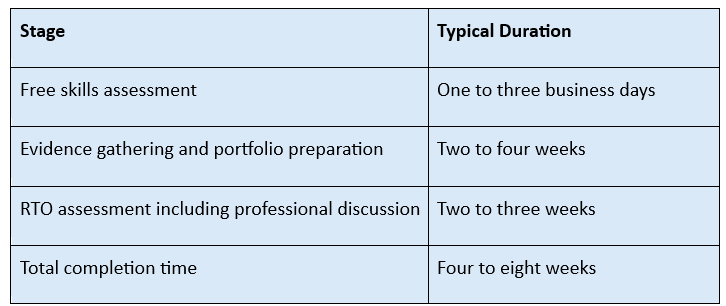
Applicants who respond promptly to assessor requests and provide organised documentation usually move through the process more efficiently than those who submit incomplete evidence.
What Affects the Cost of Childcare RPL?
RPL fees vary between providers because every assessment requires individual evaluation by qualified assessors.
Factors that may influence cost include:
The qualification being assessed
The number of units requiring assessment
The amount of evidence already available
Whether additional assessment activities are required
The complexity of your employment history
Whether gap training is needed
Common Cost Factors
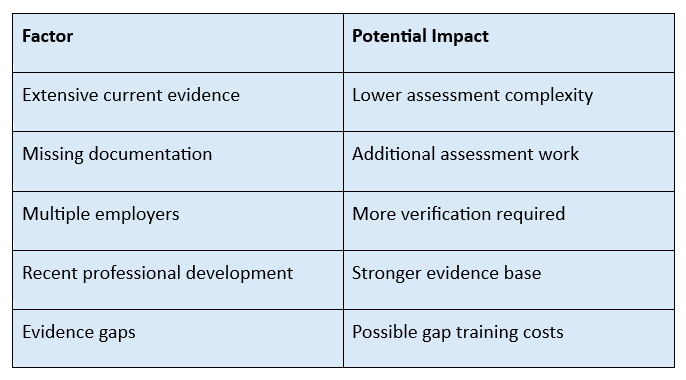
When comparing providers, look beyond the headline fee. Ask what is included, whether assessor support is provided, and how evidence gaps are handled.
How to Maximise Your Chances of Approval
While no assessor can guarantee an outcome before reviewing evidence, applicants can significantly improve their chances by preparing thoroughly.
Best Practices
Recommended
Use a clear and organised portfolio structure.
Include evidence from recent employment where possible.
Provide supervisor references.
Match documents to competency areas.
Remove confidential child information.
Ensure scans and photos are clear and readable.
Respond quickly to assessor questions.
Include evidence that demonstrates both practical skills and knowledge.
Common Reasons Applications Are Delayed
Avoid
Missing employment verification
Outdated First Aid certification
Unclear or illegible documents
Evidence that doesn't match claimed duties
Incomplete third-party reports
Large amounts of irrelevant documentation
Failure to address assessor feedback
Signs Your Evidence Is Strong
A strong childcare RPL portfolio usually demonstrates:
Consistent responsibilities across multiple documents
Recent examples of educational planning
Evidence of communication with families
Health and safety compliance records
Professional development participation
Independent verification from supervisors
Examples covering a broad range of childcare competencies
How RPL Institute Australia Supports Your Childcare RPL Application
RPL Institute Australia works with Registered Training Organisations across the country to guide experienced childcare educators through the full RPL process, from the initial skills check to the qualification itself.
Our team begins with a free, no obligation skills assessment to confirm whether Certificate III or Diploma level is the right fit for your experience and your current service context. We then help you gather and organise the evidence you already have, shifting records, observation samples, first aid certificates, and references, into a structured portfolio that gives an assessor exactly what they need.
Once your portfolio is ready, we coordinate with our RTO partners to move your application through assessment efficiently. Our fee structure is based on eligibility and qualification level, which means you are paying for an assessment of what you already know, not for a course that teaches you what you already practise.
Given the documented workforce shortage in Australian early childhood education, and the genuine stakes involved for educators who need to meet regulatory requirements, our goal is to get experienced childcare workers formally recognised as quickly and clearly as the evidence supports.
Final Thoughts
For experienced childcare workers, an RPL childcare application can be a practical pathway to gaining formal recognition for skills already demonstrated in the workplace. The strongest applications are built on organised evidence, clear documentation, and a genuine understanding of how everyday childcare responsibilities align with nationally recognised competency standards.
Whether you're aiming for career progression, meeting employer requirements, or seeking a nationally recognised childcare qualification, taking the time to prepare a comprehensive RPL portfolio can significantly improve the assessment process. By understanding the evidence requirements, avoiding common mistakes, and presenting your experience clearly, you give assessors the information they need to evaluate your competency fairly and efficiently.
Many childcare professionals spend years developing valuable practical expertise. Recognition of Prior Learning provides an opportunity to have that experience formally acknowledged and converted into a qualification that supports future career opportunities across Australia's early childhood education sector.
Frequently Asked Questions
-
An RPL childcare application is a formal request to have your existing childcare skills and experience assessed against the requirements of a nationally recognised qualification. Instead of completing all training from the beginning, eligible applicants provide evidence of their workplace competency. The assessment may include employment records, learning programs, observations, references, professional development certificates, and competency conversations with an assessor.
-
There is no single minimum number of years that guarantees approval. Assessors look at the quality and breadth of your experience rather than just the length of time worked. Applicants with substantial hands-on responsibilities such as planning learning experiences, supervising children, communicating with families, and following compliance procedures are generally in a stronger position than those with limited duties.
-
Possibly. If your evidence demonstrates competency across all required units, you may receive the qualification through Recognition of Prior Learning. However, if gaps are identified, you may need to complete additional training, workplace tasks, or assessments before the qualification can be awarded.
-
Common evidence includes employment references, position descriptions, payslips, learning programs, child observations, risk assessments, First Aid certificates, professional development records, performance reviews, and third-party reports from supervisors. Assessors may also request workplace observations or professional discussions.
-
Timeframes vary depending on the provider and the quality of the evidence submitted. Well-prepared applications may be completed within several weeks, while applications requiring additional evidence or gap training can take longer. Many applicants complete the process within one to three months.
-
Yes. Casual and part-time experience can contribute towards RPL eligibility. Assessors focus on the competencies demonstrated through your work rather than your employment status. Experience gained across multiple childcare centres or employers may be combined.
-
Volunteer experience may be considered if it involves responsibilities relevant to the qualification requirements. Examples include community childcare programs, supported playgroups, and early learning initiatives. Volunteer work is often most effective when combined with professional childcare experience.
-
The qualification available depends on your experience and the units of competency you can demonstrate. Many experienced educators seek nationally recognised early childhood education and care qualifications that align with their workplace responsibilities.
-
Some RTOs include workplace observation as part of the assessment process, while others rely on documented evidence and competency conversations. Whether a workplace visit is required depends on the provider's assessment methods and any evidence gaps identified during the review.
-
Common mistakes include submitting irrelevant documents, providing unclear scans, failing to include employment verification, omitting supervisor references, and not explaining how evidence relates to specific competencies. Organisation and relevance are often more important than the volume of documents submitted.
-
Overseas experience may be considered if it can be verified and demonstrates competencies equivalent to Australian qualification requirements. Assessors may request additional evidence to confirm the scope of your duties and your understanding of Australian childcare standards and compliance expectations.
-
No. Recognition of Prior Learning is an assessment process, not an automatic approval process. A qualification is awarded only when the assessor determines that sufficient evidence has been provided for all required competencies. If gaps remain, additional assessment or training may be required.
-
A third-party report is a statement completed by a supervisor, manager, or other qualified workplace representative who has observed your performance. It provides independent verification of your skills, responsibilities, and competency in areas such as supervision, educational planning, compliance, and communication with families.
-
Yes. Family day care educators often develop strong competencies in supervision, educational programming, communication with families, health and safety, and documentation. Evidence from family day care settings can contribute towards an RPL assessment if it aligns with the qualification requirements.
-
If gaps are identified, the assessor will usually explain which competencies still require evidence. You may be asked to provide additional workplace documents, participate in a professional discussion, complete practical tasks, or undertake targeted gap training. Addressing gaps promptly can help keep the assessment process moving efficiently.