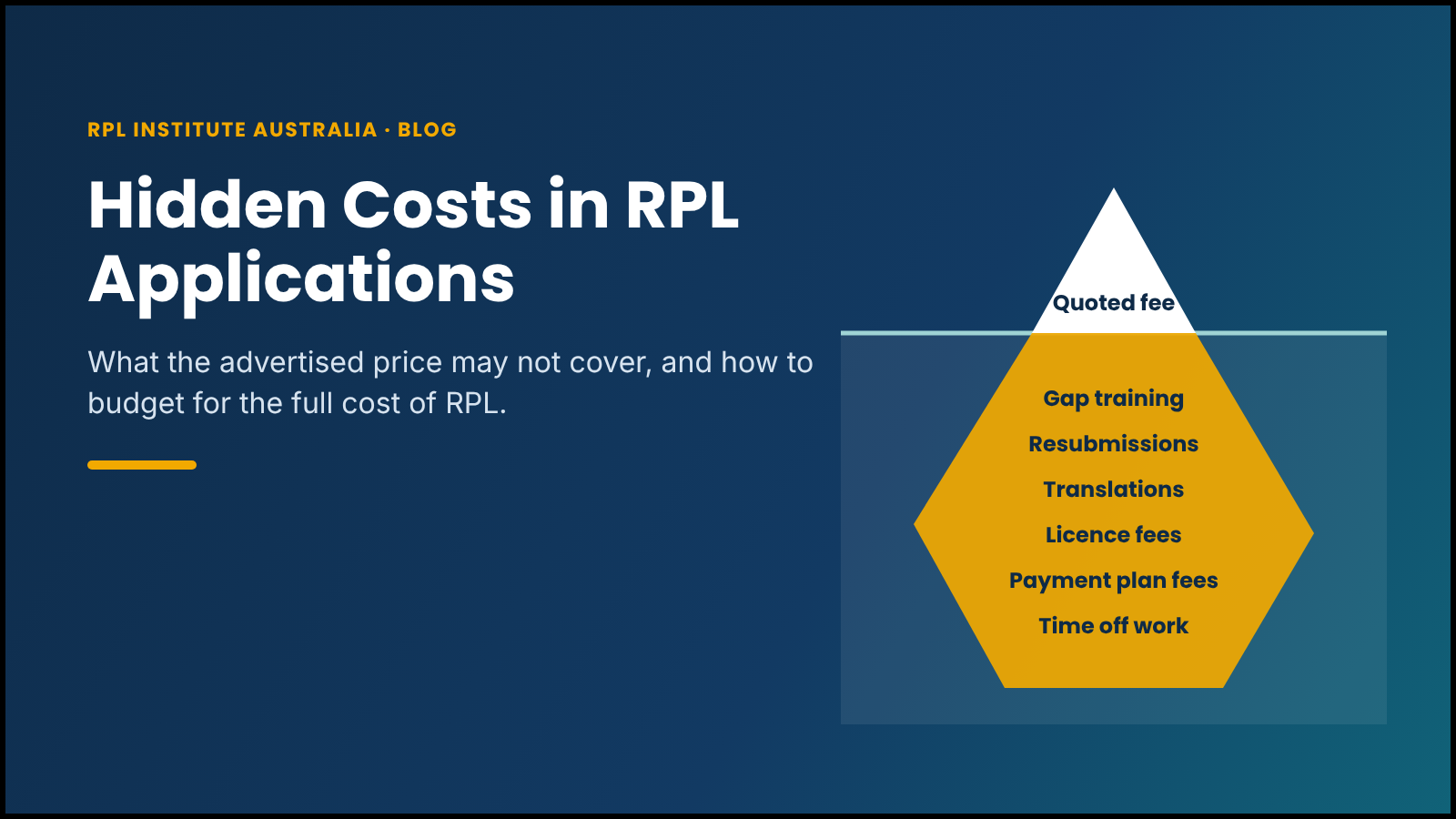
The advertised price of recognition of prior learning (RPL) is not always the full price. Many quotes cover the core assessment only. Extra costs can come from gap training, re-assessment, practical assessments, certified documents, translations, payment plans, licence fees and time away from work. The biggest cost of all comes from choosing a provider that is not genuine, because a cancelled qualification means paying twice.
None of this means RPL is poor value. For most experienced workers, it is still far cheaper and faster than a full course. But understanding the true RPL cost in Australia before you sign up helps you compare quotes fairly and avoid unpleasant surprises halfway through your assessment.
This guide explains what the advertised price usually covers, the costs that often sit outside it, the costs that should always be free and the questions to ask before you pay.
Key takeaways
Most RPL quotes cover assessment of your evidence, not every possible extra step.
Gap training is the most common extra cost and depends on how well your evidence covers each unit.
A Unique Student Identifier (USI) is always free. Never pay anyone to create one.
Licensed trades often have licence or registration fees on top of the qualification.
A cheap qualification from a non-genuine provider can be cancelled, which is the most expensive outcome of all.
What Does the Advertised RPL Price Usually Include?
Every provider structures its fees differently, so the same qualification can have very different quotes. Our guide to RPL certificate cost explains typical price ranges. This guide focuses on what sits around that price.
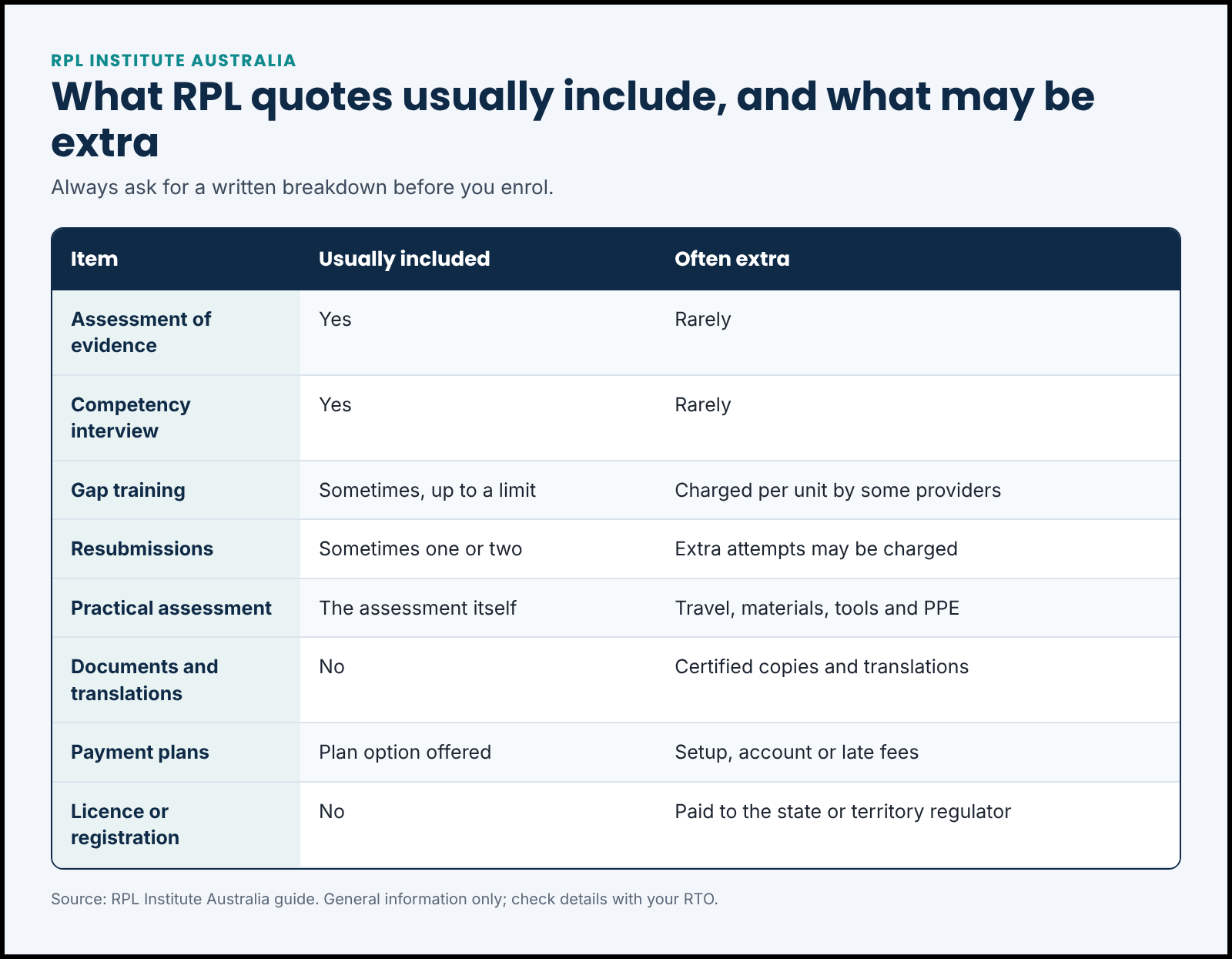
A clear quote lists what is included in writing. If a provider gives you a single number with no breakdown, ask for one. A low headline price with several extras can end up costing more than a higher price that includes everything.
The Hidden Costs in RPL Applications
These are the costs applicants most often say they did not expect. Not every applicant will face all of them, but each is worth asking about before you enrol.
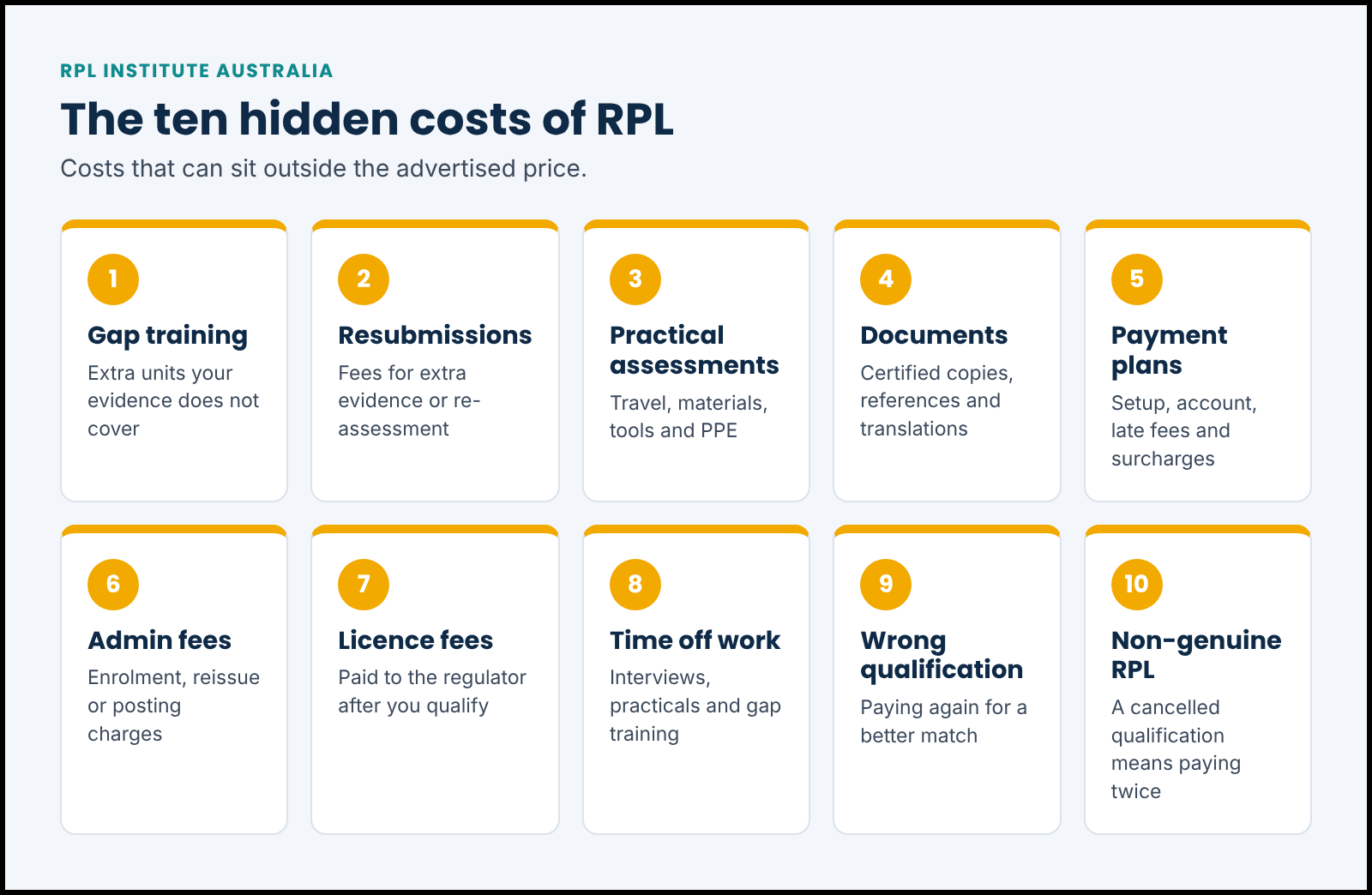
1. Gap training
Gap training is required when your evidence does not fully cover one or more units of competency. It might be a short online module, a workshop or supervised practical work. Some providers include a set amount of gap training in their fee. Others charge for it per unit.
Gap training is normal and is not a sign that something has gone wrong. It is, however, the most common reason the final price ends up higher than the quote. Ask how gap training is charged and whether there is a cap.
2. Re-assessment and resubmission fees
If an assessor finds your evidence is not yet sufficient, you may need to submit more evidence or be re-assessed. Some providers include one or two resubmissions. Others charge each time. Find out how many attempts are included and what happens after that.
3. Practical assessment costs
Many qualifications, particularly in trades, hospitality and care, need a practical assessment. That can involve travel to an assessment site, hiring a workshop, buying materials or using your own tools and personal protective equipment (PPE). If you are assessed at your workplace, your employer may need to agree to it.
4. Document costs
Your evidence often needs work before it is ready. You may need certified copies of documents, new references from former employers, or professional photos and videos of your work. If any documents are in a language other than English, certified translations usually add to the bill. These costs are rarely included in an RPL fee.
5. Payment plan fees and surcharges
Many providers offer payment plans or buy now, pay later options, which can help with cash flow. Check whether the plan carries setup fees, account fees or late payment fees, and whether card payments attract a surcharge. Paying in instalments may cost more overall than paying upfront.
6. Enrolment, administration and reissue fees
Some providers charge a separate enrolment or administration fee. Others charge to reissue a lost certificate, post a printed copy or provide an extra statement of attainment. These fees are usually small, but they add up if you do not know about them.
7. Licence and registration fees
A qualification is not a licence. In regulated trades and occupations, you may need to pay the state or territory regulator for a licence, registration or card once you qualify. Some roles also need checks, such as a working with children check, a police check or a construction induction card. These are separate from your RPL fee.
8. Time away from work
RPL usually lets you keep working, but it still takes some of your time. You may need to attend an interview, complete a practical assessment or finish gap training during business hours. If you are self-employed or paid by the hour, that time has a real cost.
9. Choosing the wrong qualification
Enrolling in a qualification that does not match your experience can lead to heavy gap training or a failed assessment. You might then pay again for a better-matched qualification. A proper initial skills check helps avoid this.
10. Non-genuine RPL
The biggest hidden cost is a qualification that is later cancelled. The Australian Skills Quality Authority (ASQA) has cancelled thousands of qualifications issued by providers that did not assess students properly. In one case, ASQA notified more than 18,750 former students of a single provider that their qualifications were at risk of cancellation.
ASQA has also described a tribunal case where a student paid $1,150 for a Certificate IV in Kitchen Management through RPL after being approached by an agent. The qualification was cancelled, even though the tribunal found the student had not acted inappropriately. When that happens, students may need to retrain and pay again with a genuine provider.
Hidden Costs by Industry
Extra costs vary depending on the field you work in. Knowing what is common in your industry helps you budget more accurately.
Building, construction and trades. Practical assessments are common, so expect to need your own tools and PPE. Many site roles also require a general construction induction card, commonly called a White Card, which is separate from RPL. Licensed trades add licence application and renewal fees once you qualify.
Aged care, disability and community services. These roles often require a police check, a working with children check or an NDIS worker screening check, depending on the job and the state. Some qualifications also need current first aid or CPR certificates, which are usually separate short courses.
Hospitality and commercial cookery. A practical cooking assessment may need a commercial kitchen, ingredients and your own knives or uniform. Some roles also need a food safety supervisor certificate or responsible service of alcohol training, which are often charged separately.
Early childhood education. Working with children checks and first aid training are standard requirements. If your evidence does not cover enough supervised practice, gap training may involve placement hours.
Business, management and IT. These qualifications usually have fewer practical costs. The main extras tend to be gap training for units your evidence does not cover and the time needed to prepare written evidence, such as reports or project documents.
A Simple Example: Two Quotes, Two Totals
Here is an illustrative example of how hidden costs can change the real price of RPL. The figures are hypothetical and are only used to show how quotes compare.
Imagine two providers offering the same qualification. Provider A quotes a lower price, but it covers assessment only. Gap training is charged per unit, each resubmission costs extra, and the payment plan has an account fee. Provider B quotes a higher price, but it includes up to three gap training units, two resubmissions and no payment plan fees.
Now imagine the applicant needs two units of gap training and one resubmission. With Provider A, those extras are added to the bill one by one. With Provider B, they are already covered. Depending on the amounts, Provider B can easily end up cheaper, even though its headline price looked higher.
The lesson is simple. Before you choose, estimate what you are likely to need based on your evidence, then calculate the total for each quote. An honest provider will help you do this during the initial skills check.
Red Flags in RPL Pricing
Some pricing practices should make you stop and think before paying.
A price far below every other quote. Genuine assessment takes time and skilled assessors, which costs money.
Pressure to pay today. Limited-time discounts and countdown offers push you to commit before asking questions.
Payment requested in cash or to a personal account. Legitimate RTOs issue proper invoices from the business.
A guaranteed result before anyone sees your evidence. No genuine provider can promise an outcome in advance.
An agent who will not name the RTO. You should always know which registered provider will issue your qualification.
Costs That Should Always Be Free
Some steps in the RPL process should never cost you anything. If someone asks you to pay for these, treat it as a warning sign.
Your Unique Student Identifier. Everyone undertaking nationally recognised training needs a USI. According to the USI Registry, creating a USI is quick, easy and free, and you only need to do it once. If you have done nationally recognised training since 2015, you may already have one.
Checking a provider's registration. You can search any RTO and its approved qualifications for free on training.gov.au. If a provider is not listed, or the qualification is not on its scope of registration, do not enrol.
Initial information about fees and refunds. RTOs must give you information about fees, payment terms and refunds before you enrol. You should not have to pay to find out what you will be charged.
Many providers also offer a free initial skills check to match your experience to a qualification. It is a useful way to understand likely costs before you commit.
When Extra Costs Usually Appear
Hidden costs tend to show up at predictable points in the RPL process. Knowing when they are likely helps you set money aside at the right time.
Before enrolment. Most early costs come from preparing evidence. You may pay for certified copies, translations or postage for overseas references. This is also the stage to confirm what the quoted fee includes.
At enrolment. Some providers charge an enrolment or administration fee, or require a deposit before the assessment starts. If you choose a payment plan, any setup fee usually applies here.
During assessment. This is where gap training and resubmission fees most often appear. If the assessor needs more evidence or identifies units your experience does not cover, the cost depends on what your quote includes. Practical assessments, along with travel, materials and time off work, also fall in this stage.
After the qualification is issued. Licence applications, registration fees, checks and inductions usually come after you qualify. Requests for extra printed copies or a replacement certificate can also carry a fee later on.
Planning for each stage separately makes the total easier to manage. It also helps you spot an unexpected charge quickly, so you can question it with the provider before paying. If a fee appears that was not mentioned at enrolment, ask the provider to point to where it appears in your written agreement.
Questions to Ask Before You Pay
The easiest way to avoid hidden costs is to ask the right questions upfront and get the answers in writing.
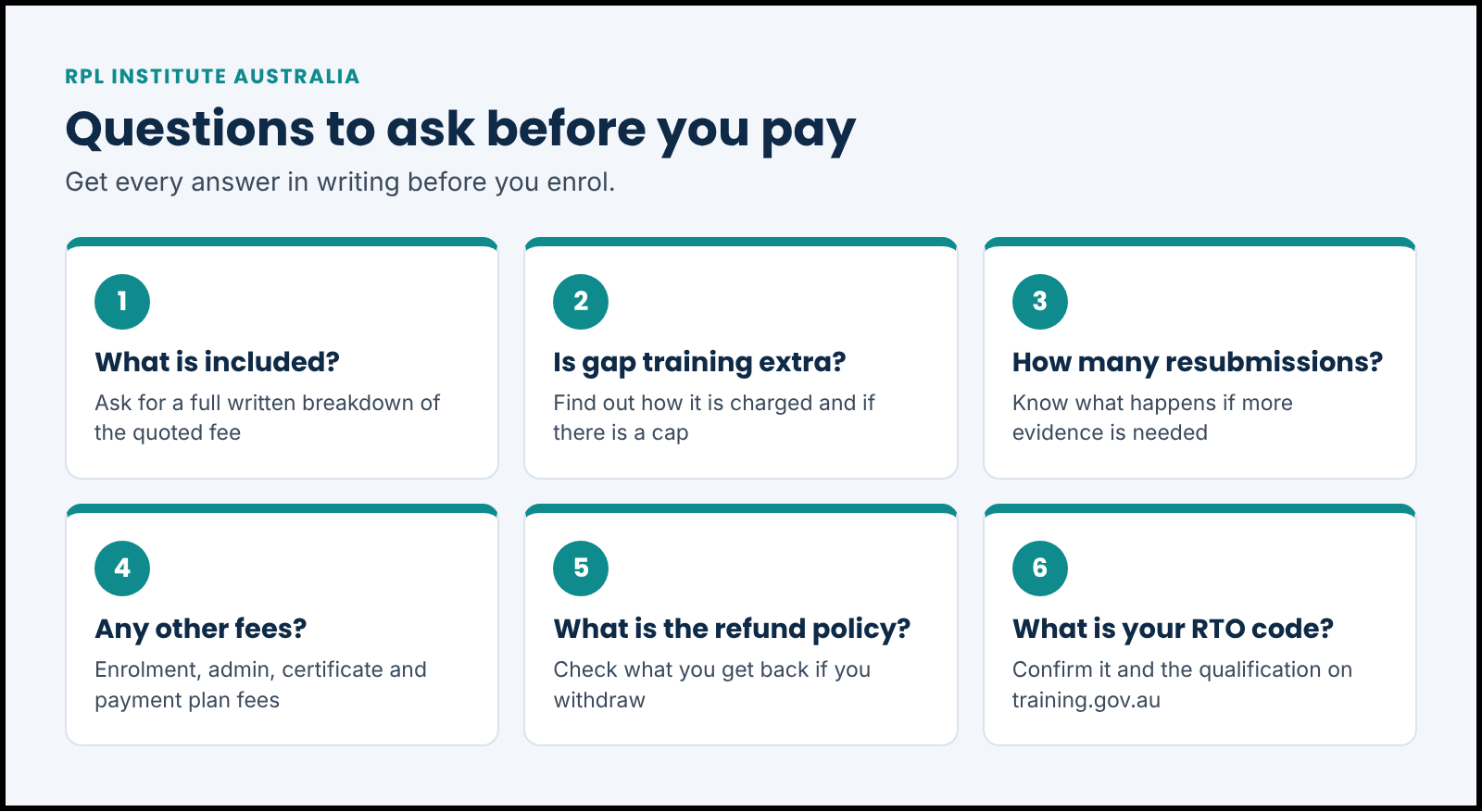
What exactly does the quoted fee include?
Is gap training included? If not, how is it charged?
How many resubmissions are included in the price?
Will I need a practical assessment, and where will it happen?
Are there enrolment, administration or certificate fees?
Does the payment plan have any fees or surcharges?
What is your refund policy if I withdraw or cannot provide enough evidence?
Will this qualification meet any licensing requirements for my trade?
What is your RTO code, and is this qualification on your scope?
How long does the assessment usually take for someone with my experience?
A genuine provider will answer these questions clearly. Vague answers, pressure to pay quickly or reluctance to put fees in writing are all reasons to keep looking.
How to Compare RPL Quotes Fairly
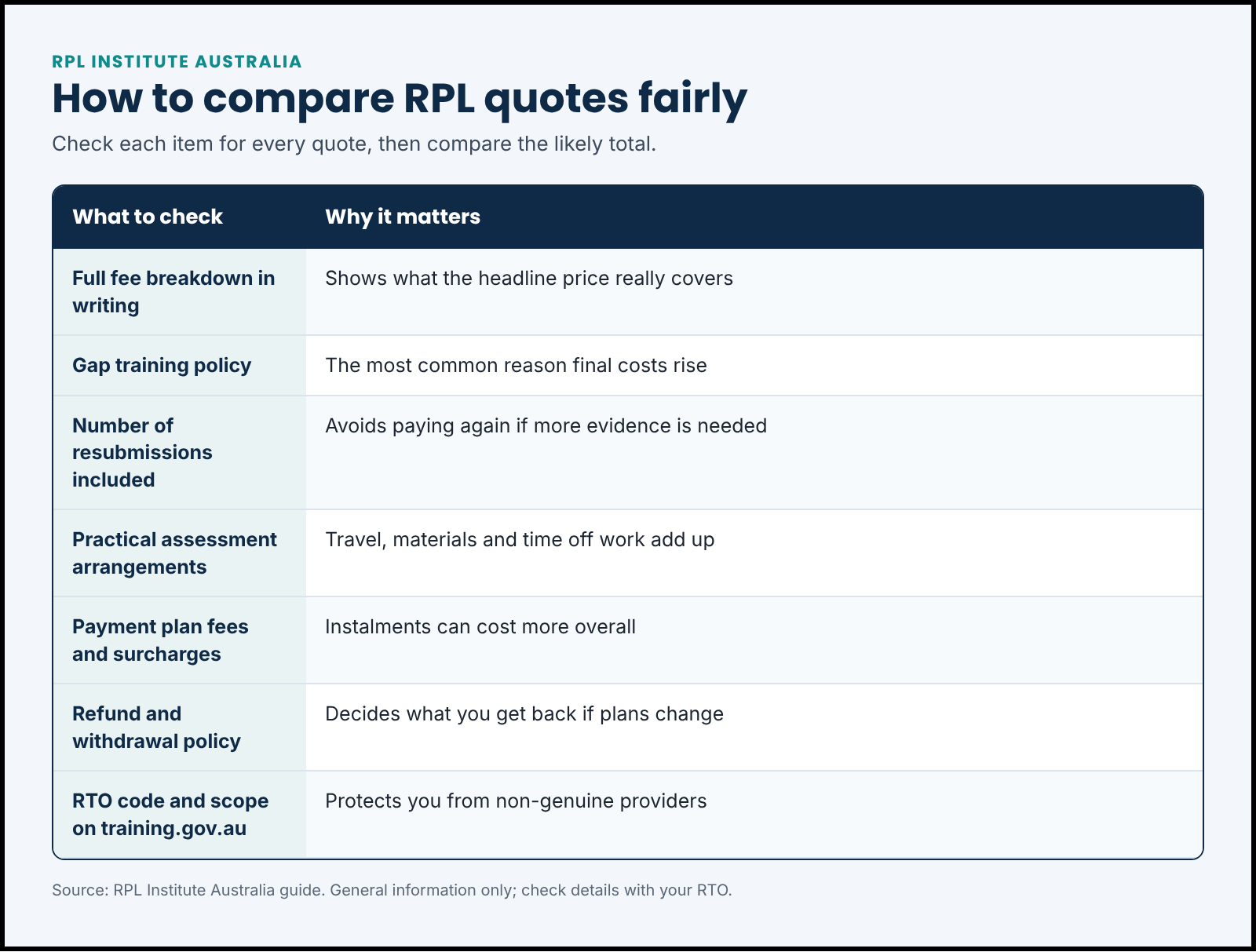
Comparing headline prices alone can be misleading. Two quotes for the same qualification can include very different services. Use a simple side-by-side comparison to see the full picture.
When you compare quotes, add up the likely total cost for your situation, not just the starting price. If your evidence is strong and well organised, a quote with fewer inclusions might suit you. If you expect gaps, a quote that includes gap training and resubmissions may be better value.
Refunds and Withdrawals
Refund policies matter more than most applicants realise. If your circumstances change or you cannot gather enough evidence, the refund policy decides how much you get back.
Read the policy before you pay, and look for answers to these points:
Is there a cooling-off period after enrolment?
Is any part of the fee non-refundable?
What happens if the assessor finds you are not suitable for RPL?
Can you transfer to a different qualification instead of withdrawing?
What happens to your fees if the provider closes or loses its registration?
Keep copies of your enrolment agreement, invoices and receipts. They will help if you ever need to make a complaint or request a refund.
Is RPL Worth It? Weighing Cost Against Value
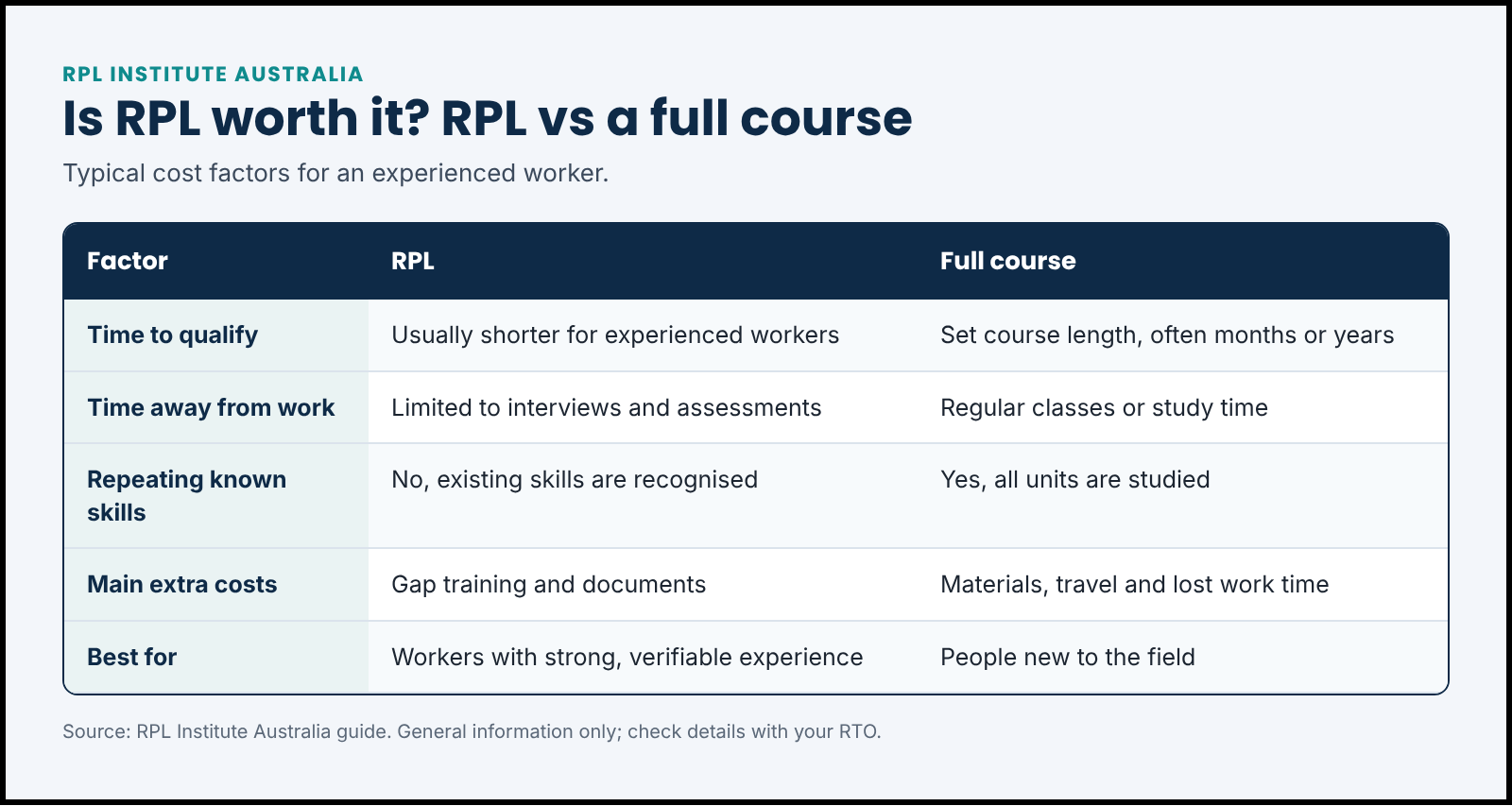
For most experienced workers, RPL is still the most cost-effective way to gain a qualification. The value is less about the fee itself and more about what you avoid: months or years of study, time away from work and the cost of repeating training you do not need.
RPL is worth it when your experience genuinely matches the qualification and you choose a registered provider that assesses you properly. It is not worth it if you have little relevant experience, because heavy gap training can erase the savings. In that case, a full course or traineeship may be better.
Research by NCVER has found that RPL can save individuals and businesses time and money, although it can also be costly and difficult for providers to deliver well. That is one reason genuine RPL is rarely the cheapest offer on the market. A proper assessment takes skilled assessors and real time.
How to Keep Your RPL Costs Down
You cannot control every fee, but you can control how prepared you are. Well-prepared applicants usually spend less.
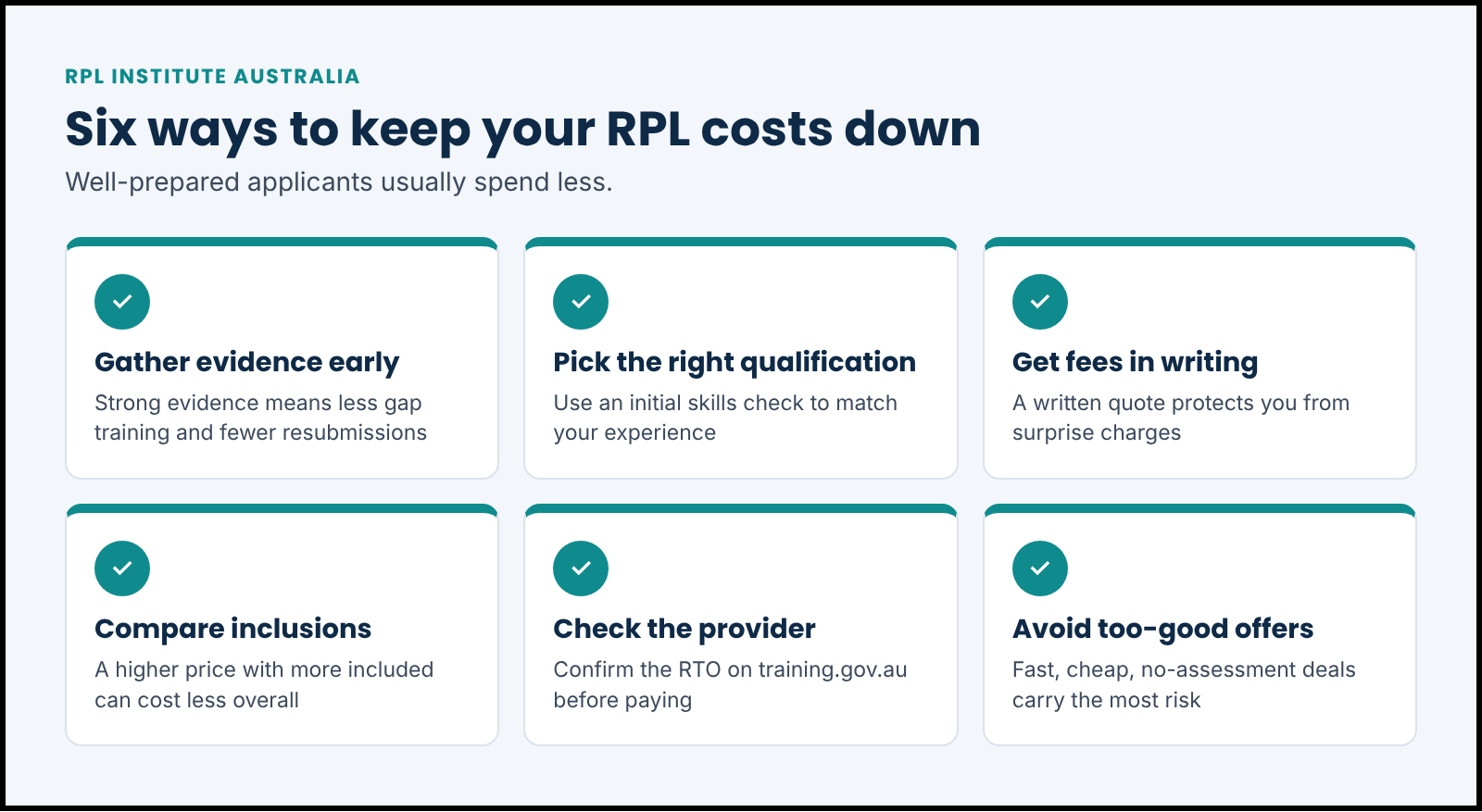
Gather evidence before you enrol. Collect references, photos, payslips and training records early. Strong evidence reduces gap training and resubmissions.
Choose the right qualification. Ask for an initial skills check and choose a qualification that matches the work you actually do.
Get everything in writing. A written quote and fee schedule protects you from surprise charges later.
Ask about inclusions, not just price. A slightly higher price that includes gap training and resubmissions may cost less in the end.
Check the provider first. Confirm the RTO and qualification on training.gov.au before paying anything.
Avoid offers that seem too good to be true. Very fast, very cheap and no-assessment offers carry the highest risk of cancellation.
Understanding recognition of prior learning before you start makes every one of these steps easier, because you know what a genuine process looks like.
Plan Your RPL Budget With Confidence
Hidden costs are only hidden when nobody tells you about them. Once you know where extra fees can appear, you can plan for them, compare quotes fairly and choose a provider that is open about pricing. Our step-by-step guide to the RPL assessment explains each stage, so you know where costs might arise. Set aside a small but realistic buffer for extras, keep every receipt, and review your written agreement whenever a new fee appears so nothing catches you off guard during your assessment.
If you would like to understand which qualification suits your experience before talking about price, start with a free skills assessment.
Frequently Asked Questions
What are the hidden costs of RPL in Australia?
Common hidden costs include gap training, resubmission fees, practical assessment expenses, certified documents and translations, payment plan fees, licence fees and time away from work.
Does the RPL fee include gap training?
It depends on the provider. Some include a set amount of gap training, while others charge per unit. Ask how gap training is priced before you enrol.
Is there a fee for a Unique Student Identifier?
No. Creating a USI is free through the official USI website. Never pay an agent or provider to create one for you.
Can I pay for RPL in instalments?
Many providers offer payment plans or buy now, pay later options. Check for setup fees, late fees or surcharges, as instalments can cost more overall.
Will I get a refund if I cannot finish my RPL?
That depends on the provider's refund policy, which RTOs must share before you enrol. Read it carefully and keep copies of all invoices and agreements.
Does an RPL qualification include a trade licence?
No. A qualification is not a licence. Licensed trades need a separate licence or registration from the state or territory regulator, which usually has its own fee.
Why are some RPL offers so cheap?
Very cheap offers may cut corners on assessment. Qualifications from non-genuine providers can be cancelled by ASQA, which means paying again elsewhere.
Is RPL cheaper than a full course?
For experienced workers, RPL is usually cheaper and faster than a full course because it avoids repeating training. Heavy gap training can reduce those savings.
How can I check if an RPL provider is genuine?
Search the provider and qualification on training.gov.au, confirm the RTO code and scope of registration, and avoid anyone offering a qualification without assessment.
How can I reduce my RPL costs?
Gather strong evidence early, choose a qualification that matches your experience, get fees in writing and compare quotes based on what is included.