
Australia’s software and information technology workforce includes many capable professionals who developed their skills outside university. Some learned through vendor training and bootcamps. Others moved from technical support into cloud engineering, cybersecurity, development, testing or systems administration through years of workplace problem-solving. Freelancers and founders may have built production systems without ever completing a formal ICT qualification.
That experience can be valuable evidence for Recognition of Prior Learning. Through RPL, an assessor compares a person’s existing skills and knowledge with the requirements of a nationally recognised vocational qualification. Where competence is demonstrated, the candidate may receive recognition for applicable units instead of repeating learning already mastered.
The important phrase is where competence is demonstrated. A GitHub profile, job title or decade in IT is not automatically equivalent to an entire qualification. Software and ICT qualifications can require technical performance, documentation, security, communication, ethics, project work and knowledge across particular conditions. A strong application connects real evidence to those requirements.
This guide explains RPL for software and IT professionals as a non-degree pathway in Australia. It covers current ICT qualification levels, candidate profiles, evidence examples, Australian workforce statistics, the assessment process and the limits of what an RPL qualification can do.
If RPL is new to you, begin with what Recognition of Prior Learning means. Understanding the difference between assessment and training prevents unrealistic expectations later.
Quick answer: Can IT professionals gain a qualification through RPL?
Experienced IT professionals may be able to gain full or partial recognition toward an Australian VET qualification when their evidence demonstrates the required units of competency. Potential pathways include ICT30120 Certificate III in Information Technology, ICT40120 Certificate IV in Information Technology, ICT50220 Diploma of Information Technology and ICT60220 Advanced Diploma of Information Technology.
The correct outcome depends on the candidate’s actual responsibilities, breadth, autonomy and evidence. A junior support technician, software developer, security analyst and IT manager will not necessarily suit the same qualification or electives. An RTO must assess the person individually and may require documents, professional questioning, third-party verification and practical demonstration.
What does “non-degree pathway” mean?
In this context, non-degree means the pathway sits within vocational education and training rather than a university bachelor’s or master’s degree. Certificates III and IV, diplomas and advanced diplomas are recognised Australian Qualifications Framework qualification types, but they are not university degrees.
RPL may reduce unnecessary training within an eligible VET qualification because it assesses what you already know and can do. It does not simply convert commercial experience into a Bachelor of Information Technology, Bachelor of Computer Science or postgraduate degree. Universities have their own admission, credit and RPL policies.
The distinction matters because different goals require different credentials:
An employer may value demonstrable skills, experience and a VET qualification.
A role may specifically require a bachelor’s degree.
A migration pathway may require a particular skills assessment by the relevant assessing authority.
Government procurement or a client contract may specify vendor certifications.
A cybersecurity role may require a security clearance or product-specific competence.
Entry to another course may depend on formal prerequisites set by the provider.
Before applying, define the outcome you need. A recognised ICT qualification can formalise substantial experience, but it should not be marketed as a universal replacement for every degree, certification or regulatory process.
Australian IT workforce: why formal recognition can matter
Australia’s digital workforce is large, well paid and still changing quickly. Jobs and Skills Australia reported a median full-time weekly income of $2,537 for Software and Applications Programmers using May 2025 earnings data. For Database and Systems Administrators and ICT Security Specialists, the reported median was $2,461 per week, with annual employment growth of 3,300.
Jobs and Skills Australia also reported that around 70,900 people were employed as Database and Systems Administrators and ICT Security Specialists in August 2025, up by 3,300 over the year. Employment for that group was projected to grow 14.2% from May 2024 to May 2029, more than twice the national projection of 6.6% cited in the same analysis.
More detailed occupation profiles show the diversity within the field. JSA listed approximately 55,200 Software Engineers, 14,700 Systems Administrators, 13,300 ICT Security Specialists, 9,100 Software Testers and 5,900 Database Administrators. These categories overlap with a broad technology ecosystem and should not be added together as though they were one clean population; they are useful indicators of scale and specialisation.
The numbers do not prove that every ICT worker needs RPL. They show why portable evidence and clear qualification alignment can matter in a competitive, specialised market. Formal recognition may support career progression, procurement eligibility, internal HR requirements or entry into further vocational study. It does not guarantee a job, promotion or salary.
Current ICT qualifications that may be considered
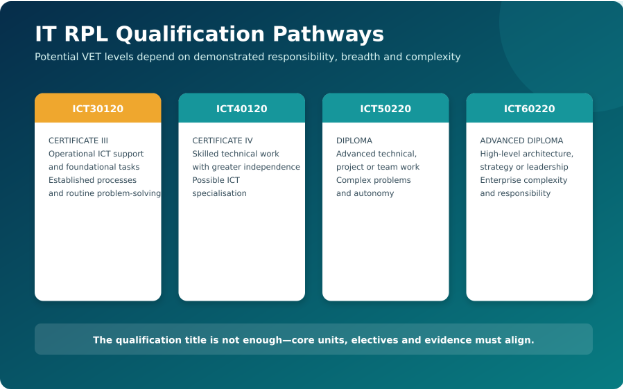
The ICT Training Package contains broad information technology qualifications with elective structures that can reflect different areas of work. Whether an RTO offers RPL for a qualification and which electives it can assess depends on its scope, resources and assessment strategy.
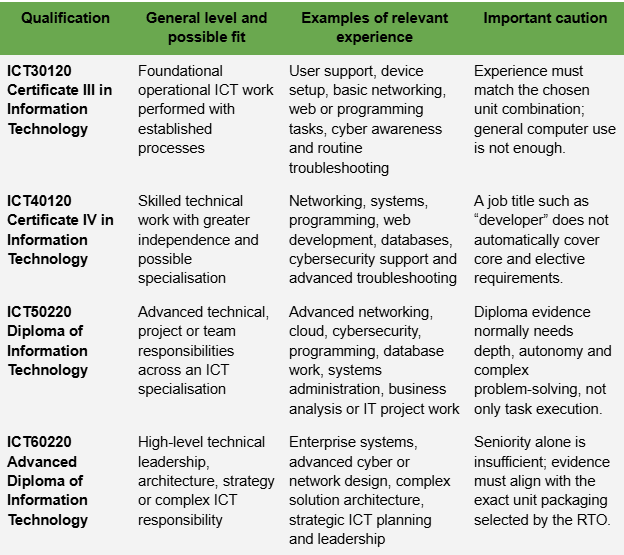
These descriptions are orientation, not formal eligibility decisions. Training.gov.au is the authoritative national register for current qualification and unit details. Ask the provider to identify the proposed qualification, core units and electives before paying.
Which IT professionals may be suitable for RPL?
RPL may be worth exploring when you have substantial, current and documentable experience. Relevant profiles can include:
software developers and software engineers;
web and application developers;
quality assurance analysts and software testers;
DevOps, platform and site-reliability professionals;
cloud engineers and cloud administrators;
network engineers and network administrators;
systems administrators;
database administrators and data-platform professionals;
cybersecurity analysts and security operations staff;
ICT support, service desk and desktop support professionals;
IT project coordinators and technical project managers;
ICT business analysts;
technical team leaders and ICT managers;
freelancers, consultants, founders and self-employed technology specialists;
skilled migrants with verifiable overseas ICT experience.
Suitability depends on what you have done, not merely the occupation label. A front-end developer may have deep software engineering evidence but little networking or systems administration work. A security analyst may demonstrate incident response and monitoring but not application development. The qualification and electives must reflect the evidence available.
You can use a free skills assessment to explore a possible pathway before gathering a complete portfolio. The initial review is not the final competency decision.
How RPL differs from a university degree, vendor certification and migration assessment
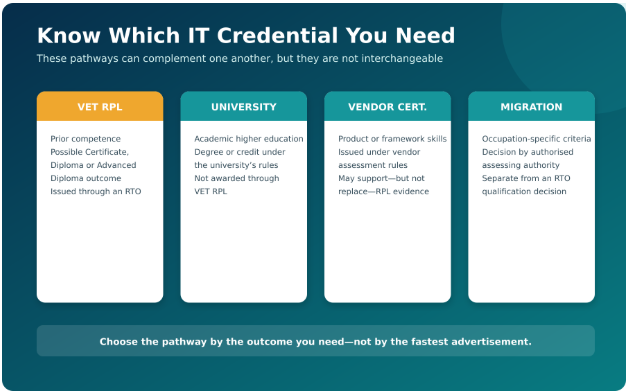
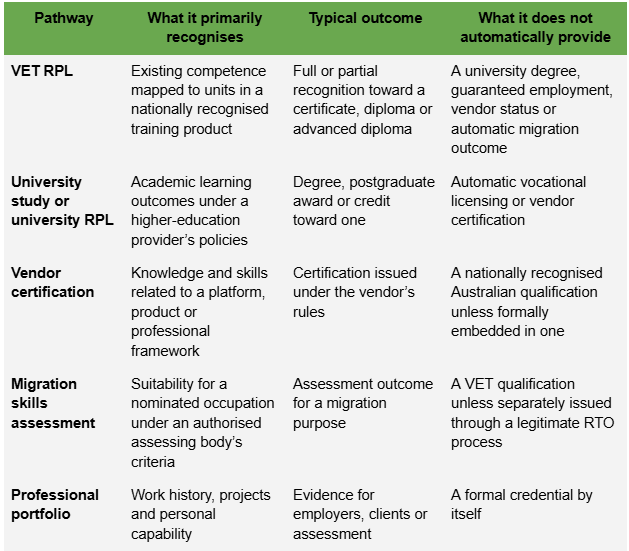
One pathway can support another, but they are not interchangeable. For example, vendor certificates may strengthen the evidence portfolio while still requiring workplace performance evidence. A VET qualification may support a résumé but not satisfy an employer that explicitly requires a bachelor’s degree. For migration, always check the current rules and authorised assessing body rather than assuming that an RPL qualification guarantees eligibility.
How does RPL work for software and IT professionals?
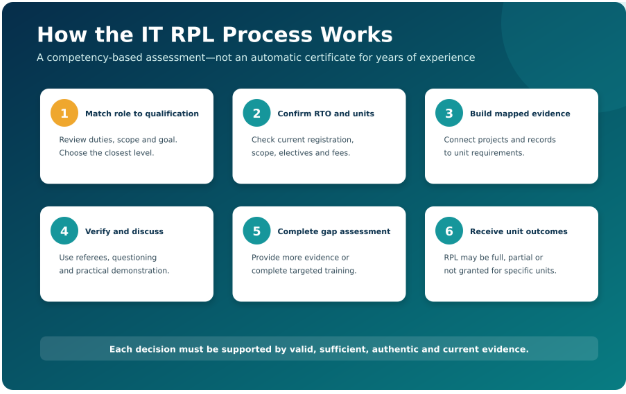
The process normally starts with qualification matching, followed by enrolment, evidence collection, competency mapping, verification and any supplementary assessment required. The assessor compares evidence with the relevant units and decides whether competence has been demonstrated.
A typical workflow is:
Review your role, experience and goal.
Identify a potentially suitable ICT qualification and elective combination.
Confirm the RTO, scope, fees and assessment process.
Build an evidence portfolio aligned to the units.
Participate in professional discussion and verification.
Complete practical tasks or gap assessment if documents are insufficient.
Receive results for the assessed units.
Complete any required gap training and remaining assessment.
For a broader explanation, read how the RPL assessment process works.
What evidence can software developers provide?
Software work produces abundant digital records, but quantity is not the same as usable assessment evidence. A repository can contain thousands of commits without explaining the candidate’s role, architecture decisions or testing responsibilities.
Useful developer evidence may include:
project summaries describing users, requirements, constraints and outcomes;
system or solution architecture diagrams;
source-control history showing attributable work;
selected code samples with confidential details removed;
pull requests and code-review records;
requirements, user stories and acceptance criteria;
test plans, automated test results and defect records;
CI/CD configurations and deployment documentation;
release notes and change records;
API specifications and technical documentation;
database designs and migration plans;
performance, reliability or security improvement records;
incident reports and post-incident reviews;
stakeholder feedback;
supervisor or client verification;
a live demonstration or technical interview.
Do not submit an entire proprietary codebase. Select representative material, obtain permission and explain what you personally designed, implemented, tested or reviewed. The assessor may ask why a technical decision was made, how security risks were controlled or how the solution was validated.
Evidence for infrastructure, cloud and networking professionals
Infrastructure work can be difficult to present because production environments are confidential and screenshots alone prove little. Build evidence around planning, implementation, monitoring and verified outcomes.
Examples include:
redacted network or cloud architecture diagrams;
implementation and migration plans;
configuration standards and approved templates;
change requests and change-review records;
system build documentation;
backup, restoration and disaster-recovery procedures;
monitoring dashboards with sensitive identifiers removed;
capacity, availability and performance reports;
incident tickets and root-cause analyses;
firewall, identity or access-control documentation;
patch and vulnerability-management records;
runbooks and operational procedures;
service-level reports;
manager or client statements;
observed troubleshooting or practical demonstrations.
Cloud-console screenshots may support an application, but the assessor still needs context, authenticity and evidence of knowledge. Explain the environment, objective, your permissions, actions, checks and outcome.
Evidence for cybersecurity professionals
Cybersecurity evidence must be handled carefully because it can reveal vulnerabilities, personal information or security controls. Never expose credentials, secrets, customer data, exploit details or active weaknesses for the sake of a portfolio.
Potential evidence includes de-identified:
risk assessments and security treatment plans;
incident-response records and lessons learned;
security monitoring and investigation workflows;
vulnerability-management reports;
access-control reviews;
security awareness or training materials;
policy and procedure documents;
audit findings and remediation records;
secure configuration standards;
threat modelling or security-design documentation;
third-party attestations from authorised managers;
controlled practical tasks or scenario-based questioning.
Security candidates should be prepared to explain legal, ethical and organisational boundaries. Evidence obtained without authorisation can undermine authenticity and professional judgement even if it appears technically sophisticated.
Evidence for ICT support and service management
Service desk and support work can demonstrate far more than ticket closure counts. Depending on the qualification, relevant evidence may include:
de-identified ticket histories showing diagnosis and resolution;
escalation procedures;
knowledge-base articles;
device deployment or configuration records;
service-level reports;
customer satisfaction feedback;
asset records;
user access and onboarding workflows;
problem and incident-management documentation;
coaching or team-support records;
examples of communication with non-technical users;
supervisor verification of independence and consistency.
Select tickets that demonstrate varied problems and decision-making. Remove names, addresses, account details, device identifiers and other sensitive information.
Evidence for IT leaders, project professionals and business analysts
Candidates pursuing a higher-level pathway may need evidence of complexity, responsibility and organisational impact. Examples include:
business cases and options analyses;
project charters, schedules and governance records;
budgets and resource plans;
risk and issue registers;
requirements and process models;
stakeholder consultation records;
vendor evaluation and procurement evidence;
technical strategy or roadmap documents;
service-improvement plans;
team leadership and performance records;
benefits-realisation reports;
change-management documentation;
executive reporting;
referee statements explaining decision authority.
A senior title does not prove strategic competence. Show which decisions you owned, which constraints you managed and how results were evaluated.
Building an IT RPL Evidence Portfolio
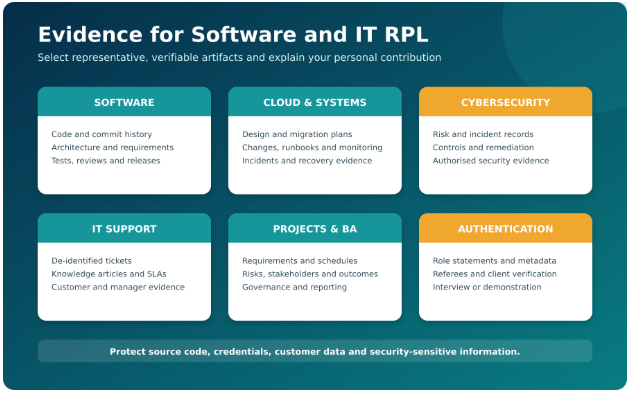
Use a structured portfolio rather than a large document dump.
1. Create a role and project inventory
List employment, contracts, major projects, systems, technologies and responsibilities. Separate tasks you performed from those you only observed or supported.
2. Map work to proposed units
Ask the RTO for unit-level guidance. Create a matrix connecting requirements to evidence IDs, personal contribution and verification. Flag gaps rather than forcing irrelevant documents into them.
3. Select representative projects
Choose projects that jointly demonstrate breadth, complexity and current practice. One project may show design and development; another may show deployment, troubleshooting or stakeholder engagement.
4. Explain every artifact
For each major item, record:
evidence ID and filename;
project and date;
business or technical objective;
your role;
technologies and methods used;
personal actions and decisions;
validation or quality controls;
outcome;
verifier;
units or evidence areas supported.
5. Protect intellectual property and privacy
Obtain permission. Redact secrets, personal data and commercially sensitive details. Where documents cannot be shared, discuss controlled viewing, third-party verification, a recreated example or practical demonstration.
6. Establish authenticity
Use source-control attribution, ticket history, document metadata, emails, approvals and referee statements where appropriate. Team evidence is acceptable when your personal contribution is clear.
7. Demonstrate current competence
Technology changes rapidly. Older projects may show valuable depth, but support them with recent work, current professional development, technical questioning or demonstration. A ten-year-old configuration alone may not demonstrate present-day cloud or security practice.
8. Prepare for professional discussion
Be ready to explain architecture, trade-offs, security, testing, deployment, incident handling and lessons learned. Assessors may use questioning to confirm that you understand submitted material rather than merely possessing it.
The four rules of evidence applied to IT work
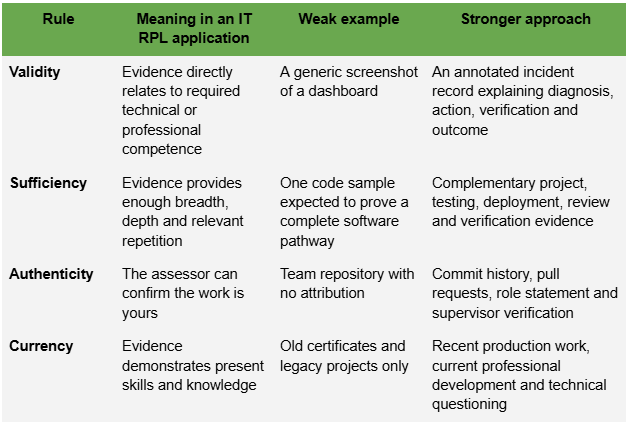
ASQA’s current guidance requires RPL evidence to be assessed with the same rigour as other assessment. Flexibility allows competence to be shown in different ways; it does not allow required knowledge or performance to be skipped.
What if your code and systems are confidential?
Confidentiality does not prevent RPL, but it requires an agreed evidence strategy. Do not upload proprietary source code, credentials, production datasets or client architecture without permission.
Possible alternatives include:
short redacted code extracts;
architecture diagrams with sensitive names removed;
a recreated demonstration using synthetic data;
controlled screen sharing;
workplace observation;
a detailed third-party report;
de-identified project documentation;
technical questioning based on the project;
system metadata or audit trails that establish contribution without exposing content.
Agree on the method before submission. Excessive redaction can make evidence unusable, so preserve the technical features needed for assessment.
Can freelancers and self-taught developers use RPL?
Yes, self-employment and self-directed learning may contribute when the candidate can demonstrate relevant, current and verifiable competence. The challenge is often verification rather than skill.
Freelancers can use contracts, invoices, statements of work, client references, repository activity, release records, project documentation and live demonstrations. Founders may use product roadmaps, architecture, customer requirements, incident records and business outcomes. Open-source contributions can support authenticity when the account and contribution are clearly attributable.
Tutorial projects alone may demonstrate learning but not necessarily workplace-level breadth, independence or operating conditions. Use them as supporting evidence rather than assuming a public repository proves an entire qualification.
Can overseas IT experience be recognised?
Overseas ICT experience may be considered when it is relevant, current and verifiable. Provide employment context, accurate translations where needed, employer contacts, project evidence and an explanation of your responsibilities.
Be prepared to address Australian workplace expectations, privacy, cybersecurity, safety and legal requirements where the units require them. Overseas RPL for a VET qualification is separate from a migration skills assessment. Confirm migration requirements directly with the relevant authority.
What if experience does not cover every unit?
A candidate may receive recognition for units that are demonstrated and complete training or assessment for the remaining gaps, subject to the provider’s process and qualification packaging rules. Partial RPL is not failure. It can prevent repeated study while preserving the qualification standard.
Ask for a written pathway identifying granted units, outstanding requirements, gap-training options, fees and likely assessment methods. If the proposed qualification is a poor match, a different level or elective combination may be more appropriate.
How long does IT RPL take?
There is no universal duration. Time depends on the qualification, portfolio readiness, verification, assessor availability, practical tasks and genuine competency gaps. A candidate with organised current evidence may progress faster than someone who must retrieve records from multiple employers.
Avoid providers promising an identical completion time for every candidate. Ask for stages and responsibilities rather than a guaranteed date. Delays often come from unclear evidence, unavailable referees, confidentiality issues and requests for supplementary assessment.
How much does an IT RPL qualification cost?
Fees vary by qualification, complexity, evidence needs, assessment arrangements and provider. Request a written quote explaining what is included: eligibility review, enrolment, assessment, support, practical assessment, gap training, reassessment and certification.
Use the published guide to RPL assessment costs in Australia for general context, but obtain current qualification-specific pricing. The lowest advertised amount is not necessarily the lowest final cost.
How to choose a legitimate pathway
Verify the RTO and training product on training.gov.au. Understand whether a support service or partner is involved and who makes the assessment decision. Review RPL Institute Australia for general service information, but independently confirm the issuing RTO and qualification before enrolment.
Warning signs include:
guaranteed certification before assessment;
promises that a résumé is the only evidence required;
refusal to identify the issuing RTO;
requests to fabricate projects or exaggerate responsibilities;
no explanation of units, assessment or verification;
claims that the qualification automatically replaces a degree;
claims of guaranteed migration, employment or salary outcomes;
no written fee, refund, complaint or appeal information.
ASQA has highlighted risks relating to inadequate RPL assessment and misleading marketing. Genuine RPL protects the candidate by ensuring the qualification reflects demonstrated competence.
A practical IT RPL readiness checklist
Before applying, confirm that:
your goal can realistically be supported by a VET qualification;
your role matches a proposed ICT qualification and elective area;
you have substantial current experience, not only course participation;
projects demonstrate real requirements, delivery and outcomes;
technical evidence can be legally and securely shared or demonstrated;
your individual contribution is identifiable;
suitable supervisors, clients or colleagues can verify your work;
you can explain decisions, risks, security and quality controls;
you have examples of troubleshooting and problem-solving;
leadership claims are supported by authority and outcomes;
overseas evidence has context and verification;
you understand that vendor certification and migration assessment are separate;
the RTO is registered and the qualification is within scope;
all fees and possible gap-training costs are documented;
you have read reassessment, complaint and appeal policies.
Frequently Asked Questions
-
It is a competency-based assessment of existing software and ICT skills against units in an Australian VET qualification. Candidates use workplace evidence, verification, questioning and sometimes practical demonstration to show what they can already do.
-
Potentially. Australia’s VET system includes Certificate III, Certificate IV, Diploma and Advanced Diploma ICT qualifications. RPL may recognise existing competence toward them. These are nationally recognised qualifications but are not university degrees.
-
Not through an RTO’s VET assessment. Universities control degree admission and credit under their own policies. A VET RPL outcome may support further study, but the university decides whether any credit or admission pathway applies.
-
Choose based on actual duties, breadth, autonomy and evidence rather than title or desired status. Ask a provider to compare your experience with the current core units, electives and qualification level before enrolment.
-
It may suit candidates whose evidence aligns with the selected Certificate III units, including applicable operational support and foundational ICT tasks. More advanced or independent responsibilities may align better elsewhere, subject to assessment.
-
They may explore these pathways where their development, testing, documentation, security, deployment and professional evidence aligns with the chosen units. Coding experience alone may not cover every core and elective requirement.
-
Useful evidence can include selected code, commit history, pull requests, architecture, requirements, tests, deployment records, technical documentation, incident records and supervisor verification. Protect intellectual property and explain your contribution.
-
Usually not. It can support authenticity and technical evidence, but it may not demonstrate workplace conditions, stakeholder communication, security, breadth or all unit requirements. Combine it with project context and verification.
-
Yes, they may support knowledge, currency or training history. They do not automatically prove competent workplace performance or guarantee credit. The assessor determines their relevance to the units.
-
Only through an authorised and secure method. Redaction, controlled viewing, third-party reports, synthetic demonstrations and scenario-based assessment may be used. Never disclose active vulnerabilities, credentials or personal information.
-
Yes, when it is relevant, current and verifiable. Provide translations where needed, employer or client contacts, project evidence and context. Australian-specific requirements may need additional evidence.
-
No. A VET RPL assessment and a migration skills assessment are different processes with different decision-makers and criteria. Check current migration requirements with the relevant assessing authority and qualified advisers.
-
They may use client references, contracts, invoices, repository records, release evidence and demonstrations. One invoice does not prove competency, so combine business proof with technical and outcome evidence.
-
There is no universal age limit, but technology changes quickly. Prioritise current projects and support older work with recent practice, professional development, questioning or demonstration.
-
Possibly. Professional discussion helps the assessor confirm authenticity, knowledge and decision-making. Be prepared to explain your own systems, trade-offs, testing, security controls and lessons learned.
-
Yes, if the project genuinely covers them. Map specific artifacts and actions to each requirement. Other evidence may still be needed for breadth, repeated performance or different assessment conditions.
-
The assessor may request more evidence, questioning or a practical task. If a real competency gap remains, the provider may recommend targeted training and assessment for those units.
-
No. It can formally recognise competence and strengthen a career profile, but hiring depends on the employer, role, experience, portfolio, communication, market conditions and other requirements.
-
Search the RTO and qualification on training.gov.au, review its scope and confirm who conducts assessment. Read written fees, evidence requirements, refund terms and appeals policies before paying.
-
Define the outcome you need, inventory your current responsibilities and projects, and compare them with potential ICT qualifications. Then complete an initial skills review before assembling a full evidence portfolio.
Conclusion
RPL can provide a credible non-degree pathway for software and IT professionals whose competence was developed through real projects, workplace learning, vendor training, contracting or self-directed practice. It can support recognition toward an Australian VET certificate, diploma or advanced diploma without requiring candidates to repeat learning they can already demonstrate.
The strongest applications begin with the right qualification. They present current, relevant and verifiable evidence across technical performance, documentation, security, quality, problem-solving and professional communication. They also respect intellectual property and make the candidate’s individual contribution clear.
RPL is not a shortcut around competency standards, a bachelor’s degree, a vendor certification or a migration assessment. It is a structured assessment of prior learning. When evidence fully meets the selected units, recognition may be granted. When only part is demonstrated, supplementary evidence or focused gap training can complete the pathway.