If you have spent years receiving goods, controlling inventory, picking orders, coordinating despatch, supervising warehouse teams or managing logistics operations, you may already have skills that align with an Australian supply chain qualification. What you may be missing is the formal credential that clearly demonstrates those capabilities.
Warehouse and logistics RPL is an assessment pathway that compares skills gained through employment, training and experience with the requirements of an Australian qualification. A Registered Training Organisation (RTO) reviews evidence of what you can do. When the evidence meets the relevant units of competency, the RTO may grant full or partial recognition.
Recognition of Prior Learning does not mean receiving a certificate simply because you have held a warehouse job for several years. It is a formal assessment. You must demonstrate relevant, current and verifiable competence through workplace documents, references, professional conversations, practical demonstrations or other suitable evidence.
For warehouse and logistics professionals, that evidence may include inventory reports, receival and despatch records, stocktake results, picking documentation, safety records, standard operating procedures, roster information, chain-of-responsibility documents, warehouse management system reports and supervisor references.
This guide explains who may qualify, which current supply chain qualifications may fit different levels of responsibility, what evidence to prepare, how overseas experience may be assessed, and where licences such as a forklift high-risk work licence sit outside the RPL qualification process.
Warehouse and Logistics RPL at a Glance
-
Experienced warehouse workers, storepersons, inventory controllers, logistics coordinators, team leaders, supervisors and supply chain professionals
-
Common possibilities include TLI30325 Certificate III in Supply Chain Operations and TLI40324 Certificate IV in Supply Chain Operations
-
Yes, when the experience is relevant, current, verifiable and supported by suitable evidence
-
Employment records, warehouse documents, safety records, system reports, references, training certificates and assessor verification
-
No. Operating a forklift requires the correct high-risk work licence, which is regulated separately
-
No. A qualified assessor must determine whether the evidence satisfies each required competency
-
Complete an initial skills assessment to identify the most suitable qualification and likely evidence requirements
What Is Warehouse and Logistics RPL?
Warehouse and logistics RPL assesses the skills and knowledge you have developed through work and prior learning against an Australian supply chain qualification. An authorised RTO makes the formal competency decision and issues the qualification when all requirements are met.
RPL may consider learning gained through:
Paid warehouse, distribution or logistics employment
Full-time, part-time, casual or contract work
Supervisory or management responsibilities
Employer training and workplace inductions
Previous vocational education or accredited units
Non-accredited industry courses
Self-employment or business operations
Overseas warehousing and logistics experience
Related defence, transport, retail, manufacturing or procurement roles
The focus is not simply on where you learned a skill. The assessor considers whether you can demonstrate competence to the standard required by the qualification.
For a broader explanation, see RPL Institute Australia’s guide to how Recognition of Prior Learning works.
RPL, Credit Transfer and Training Are Different
RPL assesses competence gained through experience and different forms of learning. Credit transfer generally recognises an equivalent unit of competency that you previously completed through formal training. Traditional training teaches and assesses skills that have not already been demonstrated.
One candidate may use all three pathways. For example, a logistics coordinator could receive credit transfer for a previously completed safety unit, RPL for inventory and despatch competencies, and targeted training for a planning skill they have not performed at work.
This combined approach prevents unnecessary repetition while maintaining the integrity of the qualification.
Why Formal Recognition Matters in Warehousing and Logistics
Warehouse work can appear straightforward from the outside, but modern supply chains depend on accurate systems, safe practices, efficient movement and reliable decisions. A stock error can delay production. A poorly secured load can create serious risk. Incorrect despatch documentation can affect customers, carriers and compliance. Supervisors must balance productivity, safety, staffing and changing priorities.
The workforce is also substantial. Jobs and Skills Australia reported approximately 166,600 storepersons in April 2026. The occupation had a median age of 35, a 32% part-time share and annual employment growth of approximately 2,400. The broader Transport, Postal and Warehousing industry employed approximately 754,500 people, representing 5.1% of Australia’s workforce.
Demand indicators also show the importance of the occupation. Jobs and Skills Australia reported that Storeperson job advertisements in February 2026 were more than 60% above their 2019 average, compared with about 25% across all occupations. These figures do not guarantee an individual job or promotion, but they demonstrate the continuing role of warehouse workers in Australia’s freight, retail, manufacturing and distribution networks.
Formal recognition may help experienced workers:
Present clearer evidence of their capabilities to employers
Compete for team leader or supervisory opportunities
Meet an employer’s qualification expectations
Plan progression from operational to coordination roles
Document skills gained across several employers
Translate overseas experience into an Australian VET context
Identify genuine skill gaps before pursuing higher responsibility
Build a pathway toward further supply chain education
RPL does not replace experience. It gives experienced workers a structured opportunity to have that experience assessed against nationally defined competency requirements.
Am I Eligible for Warehouse and Logistics RPL?
You may be a suitable candidate when you have recent, substantial and verifiable experience related to the proposed qualification. There is no universal number of years that guarantees approval. The breadth and quality of your experience matter as much as its duration.
You may have a strong starting case if you:
Regularly receive, store, pick, pack and despatch goods
Use inventory, barcode, scanning or warehouse management systems
Maintain warehouse or transport records
Conduct stocktakes and investigate discrepancies
Apply manual-handling and work health and safety procedures
Check loads, documentation or product condition
Coordinate deliveries, carriers or transport activity
Work with chain-of-responsibility requirements where relevant
Train, allocate or supervise team members
Resolve operational problems and maintain service standards
Can provide workplace evidence or reliable referees
Eligibility is weaker when a person has only observed tasks, has very limited evidence, has experience that is no longer current or is seeking a qualification unrelated to their actual duties.
Roles That May Have Relevant Experience
Relevant job titles can include:
Warehouse worker
Storeperson
Warehouse assistant
Pick packer
Despatch officer
Receival officer
Inventory controller
Stock controller
Forklift operator
Freight handler
Distribution centre operator
Logistics assistant
Logistics coordinator
Transport coordinator
Warehouse team leader
Warehouse supervisor
Supply chain supervisor
Procurement or purchasing officer
Warehouse manager
Logistics manager
Job titles vary between employers. An assessor looks at the work performed, not the title alone. A “storeperson” in one organisation may have basic operational duties, while another may coordinate complex inventory, train staff and manage exceptions.
Which Warehouse or Logistics Qualification May Suit You?
The correct qualification depends on the depth of your responsibilities, the specialisation required, available evidence and the qualification currently offered by the partner RTO.
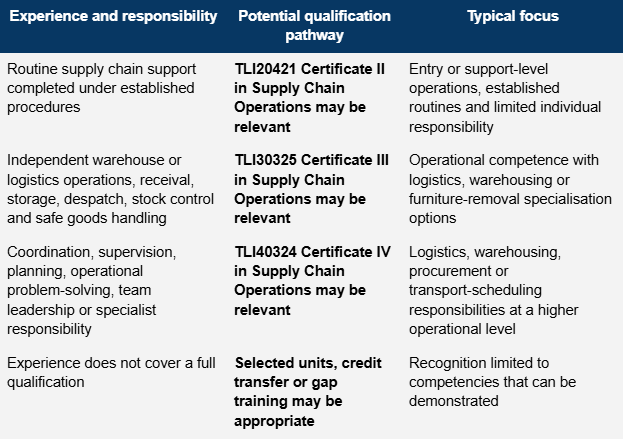
This comparison is general guidance. The formal recommendation depends on the candidate’s evidence, current training-product requirements, partner RTO scope and assessment.
TLI30325 Certificate III in Supply Chain Operations
TLI30325 is the current Certificate III identified on the national training register. It is designed for people working in supply chain operations and includes specialisations in logistics, warehousing operations and furniture removals.
The qualification requires 14 units of competency, including two core units and 12 electives selected according to the packaging rules. The exact elective combination determines whether a specialisation appears on the qualification and whether it reflects the candidate’s job role.
Experience potentially relevant to a Certificate III pathway can include:
Receiving and checking incoming goods
Preparing and processing despatches
Picking, packing and consolidating orders
Applying stock-control procedures
Using inventory or warehouse management systems
Completing workplace and transport documentation
Moving, storing and handling goods safely
Checking products, quantities and locations
Participating in cycle counts and stocktakes
Responding to discrepancies, damage or shortages
Applying WHS and manual-handling procedures
Communicating with colleagues, customers, drivers and supervisors
The former code TLI30321 may still appear in older course pages, résumés and search results. Because qualifications change, candidates should confirm the current code, transition arrangements and RTO availability before applying. This article uses TLI30325 as the current qualification.
TLI40324 Certificate IV in Supply Chain Operations
TLI40324 is designed for people engaged in supply chain operations with broader coordination, specialist or supervisory responsibilities. The national register describes specialisations including logistics, purchasing and procurement, transport scheduling and warehousing.
It may be relevant when your role involves:
Coordinating supply chain or warehouse operations
Monitoring workflow and service performance
Allocating staff, equipment or resources
Supervising teams and supporting workplace training
Investigating recurring inventory or despatch problems
Coordinating transport schedules or service providers
Managing purchasing or procurement activity
Reviewing operational records and performance data
Applying risk, safety and compliance processes
Improving warehouse procedures
Communicating with customers, suppliers and internal stakeholders
Making operational decisions beyond routine instructions
A long period in an operational role does not automatically demonstrate Certificate IV competence. The assessor needs evidence of higher-level responsibilities. A person who has spent eight years picking and packing may be highly capable at that work but may not yet have evidence of supervision, planning or coordination.
Why the Highest Qualification Is Not Always the Best Choice
Candidates sometimes assume that a Certificate IV is automatically better than a Certificate III. The better qualification is the one that matches actual competence and career goals.
Choosing a level that is too high can lead to large evidence gaps. Choosing one that is too low can fail to recognise leadership and coordination skills. A careful initial assessment should consider:
The tasks you perform independently
Decisions you are authorised to make
People or processes you supervise
Systems and records you control
Problems you are expected to resolve
The qualification level your goal requires
What Warehouse and Logistics Experience Can Count?
RPL can consider experience across many operational environments. What matters is the relationship between the work and the relevant units of competency.
Goods Receival and Despatch
Relevant activities may include checking deliveries against purchase orders, inspecting condition, recording shortages, labelling items, assigning locations, preparing despatch documentation and coordinating collection with carriers.
Evidence should demonstrate more than physical handling. It may need to show that you followed workplace procedures, completed documentation accurately, managed exceptions and communicated with relevant people.
Inventory and Stock Control
Inventory experience may include cycle counts, full stocktakes, location control, batch or serial tracking, discrepancy investigation, expiry monitoring, stock rotation and reporting.
System-generated reports can be useful, particularly when supported by an explanation of your role. An inventory report bearing your username does not automatically show how you identified and resolved a discrepancy. A complete evidence set might include the report, an investigation record, corrective action and supervisor verification.
Picking, Packing and Order Fulfilment
Picking and packing can demonstrate order interpretation, product identification, quantity checking, packaging selection, labelling, consolidation, documentation and safe handling.
Evidence could include de-identified pick lists, packing records, accuracy reports, standard operating procedures, quality checks and workplace observation.
Warehouse Systems and Records
Modern warehouse work often involves warehouse management systems, enterprise resource planning platforms, radio-frequency scanners, barcode systems and electronic proof of delivery.
RPL does not usually assess competence in one brand of software. It considers the underlying ability to enter, retrieve, verify and use operational information according to workplace requirements.
Safety, Manual Handling and Risk Control
Warehouse candidates may demonstrate hazard reporting, correct manual-handling methods, use of personal protective equipment, traffic-management procedures, load checking, incident reporting and emergency processes.
Safety evidence must be authentic. An induction certificate shows that training occurred, but it may not prove that the candidate consistently applies safe procedures. Assessors may seek workplace observation, supervisor confirmation, incident records or responses to safety scenarios.
Team Leadership and Supervision
Supervisors may allocate shifts, conduct pre-start meetings, monitor productivity, coach workers, address performance issues, manage fatigue or escalate incidents.
Relevant evidence may include de-identified rosters, toolbox-talk records, team reports, training checklists, performance data and references confirming decision-making authority.
Logistics Coordination and Transport Support
Logistics professionals may arrange collections, coordinate carriers, prepare freight documentation, monitor deliveries, communicate delays, manage scheduling changes and maintain customer updates.
Evidence should show how the candidate planned and responded, not merely that they forwarded information between parties.
Purchasing and Procurement Support
Depending on the selected Certificate IV specialisation and units, experience may include supplier communication, purchase-order processes, stock replenishment, delivery monitoring, evaluating service performance and resolving order issues.
What Evidence Is Required for Warehouse and Logistics RPL?
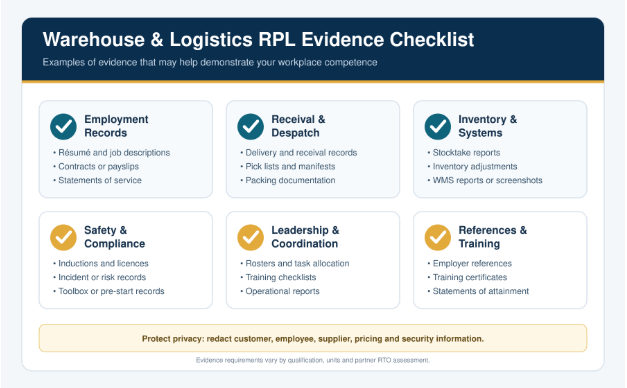
Warehouse and logistics RPL evidence may include employment records, operational documents, inventory reports, safety records, system outputs, references and assessment activities. The exact evidence depends on the qualification and units being assessed.
ASQA identifies work samples, training records and employer references as common RPL evidence. Assessors evaluate whether evidence is valid, sufficient, authentic and current.
Evidence Checklist
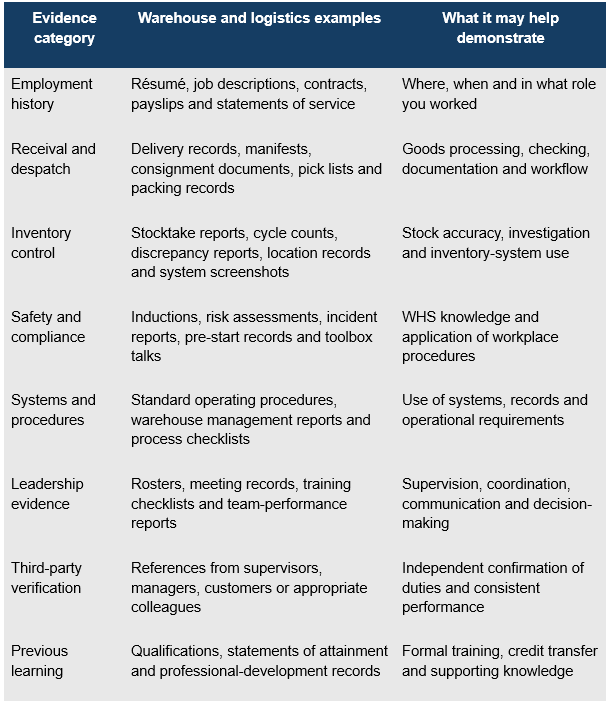
Employment Records
Employment documents establish context but do not prove every competency. A job description states what the organisation expected. It does not prove how consistently the person performed each task.
Combine employment records with operational work samples and third-party verification.
Workplace Documents
Strong work samples are closely connected with real tasks. Examples include:
De-identified goods-receival records
Pick and pack documentation
Despatch records and manifests
Inventory adjustments
Stocktake or cycle-count reports
Damaged-goods reports
Replenishment records
Warehouse location plans
Transport schedules
Carrier communication
Safety or incident documentation
Standard operating procedures you applied or helped improve
Do not send confidential records without considering privacy, commercial sensitivity and employer ownership. Redact names, addresses, customer details, pricing, account information and other identifiers that are not needed for assessment.
Photographs and Video
Images can support evidence of workplace layout, equipment, load handling or task performance, but they require context. The assessor needs to know when and where the image was taken, what the candidate personally did and whether the work reflects current practice.
Follow workplace photography rules and do not expose customer information, restricted areas or colleagues without permission.
Employer and Supervisor References
A detailed reference can verify duties that documents alone cannot explain. It should identify:
The referee’s role and relationship to the candidate
How long they observed the candidate’s work
The tasks they personally witnessed
The candidate’s level of independence
The systems and environment involved
The consistency and recency of performance
A generic statement that someone is hardworking or punctual provides limited competency evidence.
Competency Conversations and Practical Demonstrations
An assessor may use interviews, knowledge questions, workplace observations, practical demonstrations or scenarios to confirm authenticity and fill evidence gaps.
For example, the assessor may ask you to explain how you would respond to damaged stock, a location discrepancy, a missed carrier collection or a safety hazard. A practical demonstration might cover a task that cannot be adequately established through documents.
The Warehouse and Logistics RPL Process
The precise process varies between RTOs, but applicants can generally expect the following stages.
1. Initial Skills Assessment
You provide a summary of your roles, responsibilities, experience, previous training and intended outcome. This helps identify whether RPL is likely to be appropriate and which qualification may fit.
The initial discussion is not a final competency decision.
2. Qualification and Unit Selection
The proposed qualification, specialisation and units are compared with your actual job functions. Current codes and RTO scope must be confirmed.
This stage is particularly important because the Certificate III and Certificate IV supply chain qualifications include several possible specialisations.
3. Evidence Planning
You receive guidance about documents and verification needed. A focused evidence plan is more effective than uploading every file you can access.
4. Evidence Collection
You gather, label and redact workplace materials. Organise the evidence by task or competency rather than submitting an unstructured folder.
5. Formal RTO Assessment
A qualified assessor reviews the evidence against the units of competency. The assessor may contact referees, conduct professional conversations or request additional assessment.
6. Gap Identification
When evidence does not satisfy all requirements, the assessor identifies what is missing. The gap may be a missing document, knowledge that needs verification or a skill that requires training.
7. Outcome
The RTO records the competency result. The candidate may receive full recognition, recognition for selected units or a plan for gap training and further assessment.
For more detail, read the step-by-step RPL assessment process.
RPL Institute Australia provides pathway support and evidence guidance. The partner RTO is responsible for formal assessment and issuing any nationally recognised qualification.
Can Forklift Experience Count Towards RPL?
Forklift experience may support relevant competency evidence when it forms part of the selected qualification and unit requirements. However, a supply chain qualification obtained through RPL does not replace a high-risk work licence.
Safe Work Australia identifies forklift operation as high-risk work. A person must hold the correct high-risk work licence and be at least 18 to perform that work. Safe Work Australia develops national policy, while Commonwealth, state and territory regulators administer and enforce WHS laws and licensing.
This means:
Forklift experience can be relevant evidence for particular competencies.
A Certificate III or Certificate IV does not automatically authorise forklift operation.
The candidate must meet separate high-risk work licensing requirements.
Existing licences and training records can support the evidence portfolio.
Current licence validity should be checked with the applicable regulator.
The same principle applies to any separately licensed or regulated activity. RPL for a qualification and approval to undertake regulated work are different outcomes.
Can Overseas Warehouse and Logistics Experience Be Recognised?
Relevant overseas warehouse and logistics experience may be assessed through RPL when it is current, authentic, verifiable and aligned with the Australian qualification requirements. Australian knowledge or licensing gaps may still need to be addressed.
Overseas applicants may provide:
Employer letters and statements of service
Contracts, payslips or tax records
Job descriptions and organisation charts
Warehouse records and system reports
Inventory, despatch and logistics documentation
Overseas qualifications and transcripts
Training and safety records
References with verifiable contact details
Business records for self-employed applicants
If documents are not in English, ask the assessor whether certified translations are required before arranging them.
Overseas experience can demonstrate transferable capabilities such as inventory control, receival, despatch, planning and supervision. However, Australian WHS arrangements, chain-of-responsibility requirements, terminology, licensing and workplace procedures may differ. The assessor must determine whether further evidence or gap training is required.
RPL is also not automatically the same as a migration skills assessment. A qualification, a migration assessment and a workplace licence can be administered by different organisations for different purposes.
How Long Does Warehouse and Logistics RPL Take?
There is no single guaranteed timeframe. The duration depends on the qualification, evidence quality, referee response, assessor availability and any gaps requiring further assessment or training.
RPL Institute Australia states that many clients complete its broader process in approximately four to eight weeks. This is a general indication, not a guaranteed timeframe for every warehouse or logistics applicant.
The process can move more efficiently when you:
Confirm the correct qualification before collecting evidence
Provide a detailed and current résumé
Submit organised, labelled and redacted documents
Choose referees who understand your work
Respond quickly to assessor questions
Explain your personal role in team-created documents
Separate current evidence from outdated material
Common causes of delay include missing employment verification, documents without context, overseas translation needs, unavailable referees, confidential records that cannot be used and a qualification that does not match the candidate’s responsibilities.
How Much Does Warehouse and Logistics RPL Cost?
Warehouse and logistics RPL fees vary according to qualification level, number of units, assessment complexity, available evidence, support services and any gap training required. A personalised quote should identify exactly what is included.
Before paying, ask for written confirmation of:
Qualification code and title
Proposed specialisation and unit selection
Partner RTO conducting the assessment
Evidence and assessment requirements
Support included in the fee
Additional assessment costs
Gap-training charges
Payment stages and refund terms
Costs for licences that sit outside the qualification
The RPL Institute Australia article on RPL qualification costs in Australia provides broader pricing context. Confirm a current individual quote rather than assuming a general range applies to your pathway.
Be cautious of guaranteed certificates, “no evidence required” advertising and promises of instant qualification issuance. RPL is an assessment process. An ethical provider should explain evidence requirements, the partner RTO’s role and what happens when gaps are identified.
What Happens If I Have Skills Gaps?
If your evidence does not meet every unit requirement, the assessor may request additional evidence, conduct further assessment, grant recognition for selected units or recommend gap training.
Common warehouse and logistics gaps can include:
Strong operational experience but limited safety documentation
Forklift experience without a current required licence
Stock handling experience without inventory-system evidence
Warehouse experience without logistics-planning responsibilities
Supervisory title without evidence of actual leadership decisions
Overseas experience without Australian compliance knowledge
Old experience that does not demonstrate current competence
Work completed by a team without proof of the candidate’s role
A gap is not necessarily a failed application. It identifies what still needs to be demonstrated or learned. Candidates should never fabricate evidence or claim responsibility for work they did not perform.
RPL for Different Types of Applicants
Currently Employed Warehouse Workers
Current employment often provides recent documents, workplace observation opportunities and accessible referees. Ask permission before using employer records and remove confidential information.
Casual and Labour-Hire Workers
Casual workers can still have strong experience, especially when they have worked across multiple warehouses. Evidence may need to be gathered from labour-hire records, host employers, timesheets, site inductions, role descriptions and supervisors from different placements.
Team Leaders and Supervisors
Leadership claims need evidence of authority. Useful materials include rosters, task allocation records, pre-start notes, training checklists, performance reports and references confirming how decisions were made.
Self-Employed Logistics Professionals
Business owners and contractors may use customer contracts, invoices, process records, business registrations, client references, service reports and operational documents. The assessor must still establish what the applicant personally did.
Former Workers Returning to the Industry
Past experience may contribute, but competence must be current. Changes in systems, safety requirements and qualification content may create a need for recent evidence or gap training.
Skilled Migrants
Skilled migrants may have extensive overseas experience but limited Australian documentation. Early referee verification, translation planning and an honest review of Australian-context knowledge can make the process clearer.
Common Application Mistakes
Selecting a Qualification Based Only on Its Title
Compare the units and specialisation with your actual duties. “Supply chain” covers a wide range of work.
Relying Only on a Résumé
A résumé describes experience. It does not prove competence against every unit.
Uploading Too Much Irrelevant Evidence
Quality, relevance and context matter more than file volume. Create an evidence index.
Using Confidential Documents Without Redaction
Remove customer, employee, supplier, pricing and security information that is not needed.
Providing Generic References
References should describe observed tasks, independence, systems, context and consistency.
Confusing a Qualification With a Licence
A supply chain qualification does not automatically provide a forklift or other regulated licence.
Claiming Team Work as Individual Evidence
Explain your personal contribution to shared documents and processes.
Choosing Certificate IV Without Higher-Level Evidence
Years of operational experience do not automatically establish planning, coordination or supervision competencies.
Using Outdated Qualification Codes
The Certificate III supply chain qualification has moved from TLI30321 to TLI30325. Confirm current codes and RTO scope before proceeding.
Trusting Guaranteed Outcomes
No responsible service can guarantee competency before the formal evidence-based assessment is completed.
How RPL May Support Career Progression
A qualification does not guarantee promotion or employment, but it can make an experienced worker’s capability easier to understand. Warehouse careers often develop informally. A worker may begin in picking and packing, learn receival and despatch, become the person who resolves inventory problems, train new staff and eventually coordinate a shift without receiving formal recognition for that progression.
RPL can organise that experience against a defined qualification. The appropriate outcome depends on what the candidate can demonstrate.
From Warehouse Operator to Team Leader
An experienced operator seeking a team-leader opportunity should document more than productivity. Employers and assessors may need evidence of safety communication, work allocation, training, problem-solving and responsibility for team outcomes. A Certificate III pathway may recognise broad operational competence, while higher-level supervisory evidence may support consideration of Certificate IV requirements.
From Storeperson to Inventory Controller
Inventory-focused progression requires accuracy and analytical judgement. Useful evidence can include stocktake planning, cycle-count results, discrepancy investigations, location corrections, root-cause analysis and improvements that reduced recurring errors. System reports become more persuasive when they show the candidate’s decisions and follow-up actions.
From Warehouse Work to Logistics Coordination
Workers moving into logistics coordination may need to demonstrate communication beyond the warehouse floor. Evidence could cover carrier bookings, delivery monitoring, schedule changes, freight documentation, customer updates and escalation of service failures.
From Supervisor to Broader Supply Chain Roles
Certificate IV consideration may be appropriate when the candidate coordinates resources, monitors performance, manages operational risks, supports procurement or transport scheduling, and improves systems. A supervisory title alone is insufficient. The evidence should show the scope of authority, the complexity of decisions and the impact of those decisions.
RPL can also identify where a proposed career move requires new learning. A strong warehouse supervisor may have excellent team and inventory skills but little exposure to procurement or transport scheduling. Recognising existing competencies while completing focused gap training can create a more credible pathway than claiming experience that is not yet present.
How to Prepare a Strong Evidence Portfolio
Start With Your Career Goal
Identify why you want the qualification. Is it for a promotion, new employer, progression into supervision or formal recognition of overseas experience?
Map Your Work History
List employers, dates, warehouse types, systems used and responsibilities. Distinguish between tasks you performed independently and those completed under close supervision.
Create Evidence Sets
Group documents around real processes. For a stock discrepancy, an evidence set might contain:
The stocktake or system report
Your investigation notes
Communication with a supervisor or supplier
The inventory adjustment or corrective action
A reference confirming your responsibility
Connected evidence shows how you applied knowledge from problem to outcome.
Label Every File
Include the document title, approximate date, workplace context, your role and the capability demonstrated.
Protect Sensitive Information
Use copies, redact unnecessary identifiers and follow secure submission instructions. Ask the employer before using documents they own.
Prepare Your Referees
Ask permission before naming a referee. Confirm that they remember your work and can respond to verification questions.
Be Ready to Explain Decisions
Assessors may ask why you selected a process, how you managed risk, how you verified accuracy and what you would do differently in another scenario.
Is Warehouse and Logistics RPL Right for You?
RPL may be appropriate when you already perform the work, can provide reliable evidence and want formal recognition without repeating training for competencies you can demonstrate.
It may not be the best immediate pathway when you are new to the industry, have very narrow experience, cannot verify your employment or need substantial training in the target role.
A useful self-check is:
Do my daily duties align with the qualification level?
Can I show recent examples of my work?
Can a supervisor or client verify what I did?
Can I explain the safety and operational reasoning behind my actions?
Am I willing to complete gap training if required?
If most answers are yes, an initial assessment can clarify the next step. You can request a free warehouse and logistics skills assessment to discuss your experience and potential pathway.
Frequently Asked Questions
-
Experienced warehouse workers may be assessed against a relevant nationally recognised qualification. Approval depends on the duties performed, the selected units and sufficient current, authentic evidence. The partner RTO makes the formal decision.
-
There is no universal number of years that guarantees eligibility. Assessors consider the relevance, breadth, recency and evidence of your experience. A shorter period with broad responsibility may align better than many years of narrow duties.
-
Yes. RPL exists to assess skills gained outside formal education. However, you must provide suitable workplace evidence and complete any verification or assessment required by the RTO.
-
The current qualification identified on the national register is TLI30325 Certificate III in Supply Chain Operations. Older materials may refer to TLI30321. Confirm current transition arrangements with the assessing RTO.
-
TLI40324 is a higher-level supply chain qualification with specialisation options including logistics, warehousing, purchasing and procurement, and transport scheduling. It may suit candidates with coordination, specialist or supervisory responsibilities.
-
Yes, when it helps demonstrate relevant units. Evidence may cover interpreting orders, identifying products, checking quantities, packaging, labelling, system use, documentation and safe handling.
-
Yes. Stocktakes, cycle counts, discrepancy investigation, location control, replenishment, reporting and inventory-system use can be relevant when supported by appropriate evidence.
-
Forklift experience may support relevant competency evidence. It does not replace the separate high-risk work licence required to operate a forklift in Australia.
-
No. A supply chain qualification and a high-risk work forklift licence are separate. Check the requirements of the relevant state or territory WHS regulator.
-
Yes, relevant overseas experience may be considered when it is current, verifiable and aligned with Australian competency requirements. Translation, local knowledge assessment or gap training may be required.
-
Possibly, depending on the RTO, qualification, assessment method and ability to verify evidence. Ask whether remote assessment is available and whether any practical or licensing components require attendance in Australia.
-
Tell the assessor early. Alternative evidence may include contracts, payslips, tax records, former supervisor references, customer documents, system reports and other verifiable records. Acceptance depends on the assessment requirements.
-
Yes. Timesheets, placement records, host-employer inductions, job descriptions and references from labour-hire or site supervisors can help establish your duties across placements.
-
Usually not on their own. Photos require context and may need supporting documents, questioning, observation or third-party verification to demonstrate knowledge and consistent performance.
-
Potentially, but protect privacy and commercial information. Redact unnecessary details, obtain permission where required and follow secure assessor instructions.
-
Evidence collection and interviews may be completed remotely in some pathways. Practical demonstrations, workplace observations or separate licensing requirements may require in-person participation. Confirm delivery with the RTO.
-
Timeframes vary with qualification level, evidence readiness, referee response and assessment requirements. RPL Institute Australia provides a broader estimate of four to eight weeks for many clients, but individual cases may take more or less time.
-
Fees depend on the qualification, units assessed, evidence complexity, support and gap training. Request a written quote that identifies the RTO, qualification, inclusions and possible additional charges.
-
You may receive recognition for units you can demonstrate and complete additional evidence, assessment or gap training for the remainder. The RTO may also recommend a more suitable qualification.
-
The partner Registered Training Organisation responsible for the formal assessment issues the qualification when competency requirements are met. RPL Institute Australia provides pathway and evidence support but is not the qualification-issuing RTO.
Turn Your Warehouse Experience Into Recognised Evidence
Warehouse and logistics professionals develop valuable capabilities through real operational pressure. They keep stock accurate, products moving, workers safe and customers informed. Yet those skills are not always visible on paper.
RPL provides a formal way to test whether that experience meets the requirements of a current Australian qualification. The strongest applications do not simply contain more documents. They contain connected, verifiable evidence showing what the candidate personally did, how they made decisions and how their work met operational and safety requirements.
Start by identifying the right qualification level. Confirm the current code and specialisation. Gather evidence that demonstrates complete work processes rather than isolated documents. Protect confidential information and prepare referees who can explain your responsibilities.
Most importantly, treat RPL as an assessment, not a guaranteed certificate. When your experience aligns, RPL can prevent unnecessary repetition and create a clearer pathway to formal recognition. When gaps exist, the process can show precisely what needs to be learned next.