Management RPL: Which Qualification Fits Your Work Experience?
If you have spent years running teams, managing projects, supervising staff, or making operational decisions, you already possess the skills behind a formal management qualification. What you may not have is the nationally recognised credential that validates those skills.
This is where RPL management can help.
Recognition of Prior Learning (RPL) allows experienced managers, supervisors, team leaders, and business owners to convert their workplace experience into a nationally recognised qualification without repeating training they already use every day.
For many professionals, a formal qualification is increasingly important for promotions, leadership opportunities, tender requirements, and career advancement. While experience demonstrates capability, employers often look for recognised credentials when assessing candidates for senior roles.
In this guide, we explain how management RPL works, which qualifications may suit your experience, the evidence required, eligibility requirements, and the steps involved in obtaining a nationally recognised management qualification through RPL.
Understanding Management RPL
Recognition of Prior Learning (RPL) is a competency-based assessment pathway that allows experienced professionals to convert their work experience into a nationally recognised management qualification without completing full-time study.
Instead of classroom learning, candidates demonstrate their existing management skills, leadership experience, and workplace competencies gained through:
Employment experience in supervisory or leadership roles
Workplace training and on-the-job learning
Professional development programs
Industry certifications and short courses
Volunteer leadership or committee roles
Business ownership or operational management experience
This RPL Process is designed for individuals who already function in management, leadership, or supervisory roles, but do not yet hold a formal qualification under the Australian Qualifications Framework (AQF).

Why Management Experience Often Goes Unrecognised in Australia
Australia has one of the most experience rich management workforces in the world, yet a large share of that experience was never converted into a formal credential.
According to the Australian Bureau of Statistics, managers recorded the highest hourly earnings of any major occupation group in the country, sitting at 69.20 dollars an hour, ahead of professionals at 64.50 dollars an hour. Despite commanding the top pay bracket nationally, a significant proportion of people working in management roles moved into those positions through promotion, internal progression, or small business ownership rather than through a completed diploma or degree.
Job mobility data from the ABS also shows that managers made up 11.1 percent of all people who changed jobs in the year ending February 2025, a meaningful share of Australia's total job movement. Every one of those transitions is a moment where a formal qualification can be the difference between being shortlisted for a leadership role or being passed over for someone with a piece of paper, even if that person has less real world capability.
Census data also shows that managers represent 13.6 percent of the employed population in Australia's greater capital cities, placing management as one of the three largest occupation groups in the country alongside professionals and technicians and trades workers.
The pattern across these figures is consistent. Management is one of the largest, highest paid, and most mobile occupation categories in Australia, yet formal qualification rates inside that group lag behind the seniority and pay those roles command. RPL management exists to correct that imbalance, one experienced professional at a time.
Why This Gap Exists in the First Place
There are a few clear reasons this gap has built up over time across Australian workplaces.
The first is that management roles are frequently filled through internal promotion rather than external hiring. Someone performs well in a technical or operational role, demonstrates leadership qualities, and is moved into a supervisory or management position without ever being asked to complete formal training. Their skills develop entirely on the job, through mentoring, trial and error, and accumulated experience, rather than through structured coursework.
The second reason is that many small and medium businesses across Australia are owner operated. A tradesperson, retailer, or service provider who starts their own business effectively becomes a manager overnight, responsible for staff, budgets, compliance, and strategic decisions, without ever undertaking formal management education.
The third reason is migration. Australia receives a steady flow of skilled migrants who held genuine management responsibility overseas, sometimes for many years, but whose qualifications either did not transfer directly or were never formally recognised by Australian institutions and employers.
In each of these cases, the underlying skill is real and proven. What is missing is the formal mechanism to translate that skill into a credential employers, regulators, and clients can verify at a glance. That is the exact role RPL management plays.
What This Means for the Australian Labour Market
The broader implication of this gap reaches beyond individual careers. Jobs and Skills Australia data shows that managers and professionals together make up a substantial share of the national workforce, and the proportion of employees working from home or under flexible arrangements is notably higher among managers and professionals than among other occupation groups, sitting at 59 percent compared with 21 percent for all other occupations as at August 2025. This points to a workforce that is increasingly trusted with autonomy and flexibility, which in turn places greater weight on demonstrated competency rather than physical presence or supervision.
As organisations continue to formalise their hiring and promotion criteria, often in response to compliance, insurance, or tender requirements, the absence of an Australian recognised qualification becomes a more visible barrier even for managers who are clearly capable in practice. RPL for managers is one of the few mechanisms available that closes this gap without requiring a career pause, and it is increasingly used by businesses as a structured part of internal professional development rather than a last resort.
What Is RPL Management?
RPL management is the process of using recognition of prior learning to assess your real world leadership, supervisory, or operational experience against the competency units of a nationally recognised management qualification. It is sometimes described simply as business management RPL when applied to commercial or operational roles, or leadership and management RPL when the focus is on people leadership and organisational direction.
Rather than completing classroom modules on topics you already apply daily, such as leading a team, managing budgets, resolving workplace conflict, or driving operational improvement, your experience is reviewed by an assessor from a Registered Training Organisation as part of a structured RPL assessment process. If your evidence demonstrates that you meet the required competencies, you are issued the qualification.
This sits within the broader RPL framework used across Australian vocational education. Recognition of prior learning is formally recognised under the Australian Qualifications Framework, meaning a management diploma through RPL carries the same national standing, and the same management accreditation, as one obtained through a classroom based course or a registered training provider.
Who Can Apply for RPL for Managers?
RPL for managers is suitable for professionals who have developed leadership and management skills through real workplace experience.
Typical applicants include:
Team Leaders
Individuals responsible for:
Supervising staff
Managing daily operations
Delegating tasks
Monitoring performance
Coordinating teams
Operations Managers
Professionals managing:
Business operations management
Resource allocation
Process improvement
Staff supervision
Operational performance
Project Managers
Individuals with experience in:
Project planning
Team coordination
Budget management
Stakeholder communication
Risk management
Business Owners
Business owners often demonstrate:
Organisational leadership
Strategic management skills
Financial oversight
Team leadership
Business development
Department Managers
Professionals responsible for:
People management experience
Performance management
Workforce planning
Business strategy implementation
Team development
Signs You May Be Eligible for Management RPL
You may qualify if you have experience in areas such as:
Managing employees
Leading teams
Conducting staff meetings
Performance reviews
Workforce planning
Project coordination
Business operations oversight
Strategic decision making
Budget management
Customer service management
Workplace compliance
Organisational leadership
The more extensive your workplace management skills, the stronger your management experience assessment is likely to be.
Which Management Qualification Fits Your Experience?
This is the central question most candidates ask, and the answer depends almost entirely on the scope of responsibility you currently hold or have held in your career. Below is a breakdown of the main pathways, along with the kind of day to day reality that typically sits behind each one.
Certificate IV in Leadership and Management
This is the most common entry point for a team leader qualification and suits people who supervise a small team, coordinate day to day operations, or have recently stepped into a first line leadership role.
Typical candidates include:
Team leaders responsible for rostering, performance, and daily output Supervisors in retail, hospitality, construction, or logistics settings Coordinators who manage a small number of direct reports Workers stepping up from a technical or trade role into a leadership position
Core competency areas usually include leading workplace teams, managing operational plans, communicating with influence, implementing workplace health and safety responsibilities, and managing performance.
In practice, this is the right level for someone who spends most of their day managing people directly, rather than setting broader strategy. If your responsibilities centre on rostering staff, running daily briefings, handling performance conversations, escalating issues to a manager above you, and keeping a team productive and safe, the Certificate IV is usually the correct starting point. Many candidates at this level have been performing these duties for several years without ever holding a formal title that reflects it.
Diploma of Leadership and Management
This is the most commonly pursued operations manager qualification and the most requested management diploma RPL pathway overall, suiting people who manage broader functions, multiple teams, or significant operational responsibility.
Typical candidates include:
Operations managers overseeing several departments or sites Project managers running budgets, timelines, and cross functional teams, drawing on genuine project management experience rather than theory Business owners managing staff, suppliers, and day to day commercial decisions Senior coordinators with responsibility for planning and resourcing
Core competency areas usually include leading and managing effective workplace relationships, developing and implementing strategic plans, managing operational plans, leading change, managing budgets and financial plans, and managing recruitment and onboarding.
This level reflects a step up in scope rather than simply a step up in years of service. If you are setting departmental targets, contributing to budgets, managing more than one team or function, negotiating with suppliers, or being consulted on broader business decisions, your experience is likely already operating at Diploma level even if your job title does not say so. This is the single most requested qualification among RPL management candidates, largely because it matches the responsibilities held by a very large share of Australia's operational and department level managers.
Advanced Diploma of Leadership and Management
This is the senior level qualification and suits people operating at a strategic or executive layer of a business.
Typical candidates include:
General managers and senior executives Business owners running larger enterprises with multiple layers of staff Regional or multi site managers Senior professionals responsible for organisational strategy and direction
Core competency areas usually include developing and implementing strategic plans, leading and managing organisational change, managing innovation and continuous improvement, managing the business, and developing and cultivating collaborative partnerships.
Candidates at this level are typically responsible for outcomes that affect an entire business or a significant part of one, rather than a single team or department. This includes setting direction for the organisation, owning profit and loss responsibility, leading change across multiple sites or divisions, and representing the business in high level partnerships or negotiations. This level draws heavily on organisational leadership, strategic management skills, and broad business operations management rather than day to day supervision. Many business owners and senior executives are surprised to learn their experience sits comfortably at this level, particularly those who built a business from the ground up without ever pausing to complete formal qualifications along the way.
Quick Comparison Table
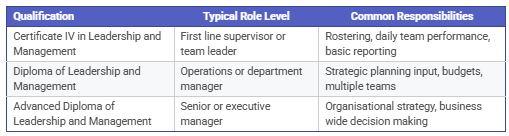
If you are unsure which level matches your background, a free skills assessment with an RPL consultant is the fastest way to find out. Most people underestimate how senior their experience actually sits within the qualification framework.
Management RPL Across Different Industries
Management experience looks different depending on the industry it was built in, and RPL assessors are accustomed to evaluating evidence from a wide variety of sectors. The underlying competencies are the same, but the way they show up day to day varies considerably.
Construction and Trades
Site supervisors, project managers, and construction business owners frequently carry significant management responsibility, including subcontractor coordination, safety compliance, budget tracking, and client communication, without ever holding a formal leadership qualification. Many of these same professionals are equally strong candidates for trade based RPL opportunities in their core trade, alongside a management qualification. Evidence in this sector often includes project plans, safety records, subcontractor agreements, and client correspondence.
Hospitality and Retail
Venue managers, store managers, and area managers in hospitality and retail typically manage rostering, stock control, customer service standards, and staff development across high turnover environments. Evidence often includes rosters, sales or performance reports, staff training records, and references from regional or area managers.
Transport and Logistics
Fleet managers, warehouse supervisors, and logistics coordinators manage compliance, scheduling, safety, and large operational teams, often across multiple shifts or sites. Evidence in this sector frequently includes compliance documentation, incident reports, scheduling systems, and operational KPIs.
Healthcare and Community Services
Team leaders and service managers in aged care, disability support, and community services manage rostering, compliance with care standards, staff supervision, and client outcomes. Evidence often includes care plans, audit results, staff supervision records, and incident management documentation.
Engineering and Manufacturing
Production managers, plant supervisors, and engineering team leads manage output targets, safety compliance, equipment maintenance schedules, and cross functional coordination with technical teams. Evidence often includes production reports, maintenance schedules, safety audits, and continuous improvement initiatives.
Regardless of industry, the assessment process looks for the same underlying pattern: clear evidence that you held genuine management responsibility, exercised judgement within that responsibility, and produced a measurable outcome as a result.
How RPL Management Works Step by Step
Step One: Free Skills Assessment
Your journey starts with a conversation, not a classroom. An RPL consultant reviews your current role, your years of management experience, and the scope of your responsibilities to determine which qualification level realistically fits your background. This step is free and carries no obligation. Most conversations take no more than twenty to thirty minutes and cover your employment history, the size and structure of the teams or budgets you have managed, and any qualifications or training you already hold.
By the end of this step, you should have a clear answer to three questions: which qualification level fits your experience, what evidence you will likely need to gather, and roughly how long the process is expected to take given your circumstances.
Step Two: Evidence Collection and Portfolio Preparation
This is the most important phase of the entire process. You will work with your consultant to gather a portfolio of evidence that demonstrates your management competencies. This typically includes employment records, position descriptions, references from supervisors or direct reports, examples of plans or reports you have authored, and any relevant training records.
You do not need to have kept a perfectly organised archive across your career. Most candidates are surprised by how much usable evidence already exists in old emails, performance reviews, and project files once a consultant helps them look properly. A good consultant will work through your career history with you, role by role, and identify exactly which documents or contacts are likely to produce strong evidence for each competency unit.
Where direct documentation is thin, your consultant will usually suggest supplementary evidence such as a written reference from a former manager, a short written statement describing a specific project or decision, or simply flagging the gap for discussion during the assessment stage.
Step Three: Assessment by a Registered Training Organisation
A qualified assessor reviews your portfolio against the units of competency required for your target qualification. In many cases this also includes a structured conversation, sometimes called a professional discussion, where the assessor asks you to talk through specific examples of how you managed a team, resolved a workplace issue, or delivered a project outcome.
This conversation is not designed to catch you out. It exists because some competencies, particularly around judgement, communication, and decision making under pressure, are difficult to demonstrate through paperwork alone. Assessors are looking for clear, specific, real examples rather than general statements about leadership philosophy.
Step Four: Qualification Issued
Once your evidence and discussion demonstrate competency across the required units, the RTO issues your nationally recognised management qualification. This RPL Certificate is valid across every state and territory in Australia and is recognised by employers, licensing bodies, and further education providers nationwide. From this point, the qualification appears on your formal record exactly as it would if you had completed it through classroom study, with no distinction noted between the two pathways.
What Evidence Counts Toward Management RPL?
Strong evidence portfolios for management RPL typically draw from the following categories.
Direct Evidence of Management Responsibility
Employment contracts or letters confirming your management title and scope Organisational charts showing your position and direct reports Position descriptions outlining your management duties Performance review documents you have completed for staff Budget reports, project plans, or operational plans you have authored or contributed to
Supporting Evidence
Written references from supervisors, business owners, or senior colleagues Examples of policies, procedures, or training materials you developed Records of recruitment, onboarding, or staff development activities you led Evidence of workplace health and safety responsibilities you managed Project outcomes, KPIs, or business results tied to your leadership
Work Experience to Qualification Conversion
The strongest portfolios connect a clear narrative of work experience to qualification competencies. Rather than submitting a stack of disconnected documents, the goal is to show a consistent pattern: you were responsible for a function, you exercised judgement and leadership within that function, and you produced a measurable outcome. This is how genuine people management experience and business leadership skills get translated into the formal language an assessor needs to see. An experienced RPL consultant will help you frame your evidence this way rather than leaving you to guess what an assessor is looking for.
How Long Does Management RPL Take?
Most candidates complete the full RPL management process within four to ten weeks, depending on the qualification level and how quickly evidence can be gathered. For candidates seeking a fast track qualification, this timeline is one of the strongest reasons to choose RPL over a traditional course.
Skills assessment Australia wide typically takes one to three business days Evidence preparation typically takes two to five weeks RTO assessment process and review typically takes two to four weeks
This is dramatically faster than completing a Diploma or Advanced Diploma through traditional classroom delivery, which commonly takes twelve months or longer when studied part time alongside full time work. For many candidates, the appeal of a qualification without studying classroom content they have already mastered is the single biggest factor in choosing this pathway.
What Assessors Actually Look For
Understanding how an assessor evaluates your portfolio makes the entire competency based assessment feel far less abstract. Assessors are not looking for polished corporate language or an impressive job title. They are looking for clear evidence that you have personally exercised judgement, taken responsibility for outcomes, and led other people through real situations. This is the heart of any genuine management experience assessment.
In practice, this means an assessor will look for specific, concrete examples rather than general statements. A sentence such as I am responsible for managing my team carries little weight on its own. A sentence such as I restructured the rostering system across two teams to reduce overtime costs by managing staff availability and negotiating shift changes directly with affected employees demonstrates the same underlying competency far more convincingly, because it shows a specific action, a specific outcome, and a specific exercise of judgement.
Assessors also look for consistency across your evidence. If your position description says you manage a team of fifteen people across two sites, your references, reports, and professional discussion should all reflect that same scope. Inconsistencies do not necessarily disqualify an application, but they often lead to additional questions that can be avoided with a well prepared portfolio.
Finally, assessors look for currency. Competencies demonstrated five or ten years ago in a role you no longer hold carry less weight than recent, ongoing experience. This is one reason an experienced RPL consultant will usually focus your evidence on your most recent two to three years of management responsibility, supplemented by older experience where relevant, rather than spreading thin evidence across an entire career.
Who Should Consider RPL Management?
Experienced Team Leaders and Supervisors
If you have run a team, rostered staff, managed performance conversations, or coordinated daily operations for a year or more, you are likely a strong candidate for Certificate IV level RPL.
Operations and Department Managers
If you manage budgets, multiple teams, supplier relationships, or cross functional projects, the Diploma of Leadership and Management is usually the right fit.
Senior Managers and Business Owners
If you operate at a strategic level, set organisational direction, or run a business with multiple layers of staff, the Advanced Diploma of Leadership and Management reflects the seniority of your role.
Skilled Migrants in Management Roles
Many international professionals arrive in Australia with years of management experience from overseas but no Australian recognised credential. RPL allows that international leadership experience to be assessed and converted into a qualification that Australian employers and licensing bodies recognise. Strong work references for RPL from previous overseas employers, combined with local context, support this recognition of work experience effectively.
Career Advancement Seekers
If you are aiming for a promotion, a tender requirement, or a role that explicitly lists a Diploma or Advanced Diploma as a prerequisite, RPL is often the fastest legitimate pathway to meet that requirement without pausing your career to study.
The Business Case for a Formal Management Qualification
Beyond personal credibility, a nationally recognised management qualification has practical commercial value.
Promotion and Internal Progression
Many organisations now require a Diploma level qualification before promoting staff into senior management positions, even when the candidate has demonstrably been performing at that level informally for years. Holding the right management qualification for promotion often turns informal capability into a documented case for advancement, and opens up promotion opportunities that would otherwise stay out of reach without a formal credential.
Tendering and Contract Requirements
Businesses tendering for government or corporate contracts are frequently required to demonstrate that key personnel hold formal qualifications. A management RPL outcome can directly support a tender submission.
Salary Negotiation
Given that managers already sit at the top of Australia's hourly earnings table at 69.20 dollars an hour according to ABS data, a formal qualification strengthens your negotiating position when seeking further salary growth or a more senior title.
Migration and Visa Pathways
For skilled migrants, a nationally recognised Australian management qualification can support visa applications and demonstrate equivalency of overseas experience to Australian standards.
Professional Credibility
A Diploma or Advanced Diploma signals to staff, clients, and stakeholders that your leadership approach is grounded in recognised competency standards, not just informal experience. For many candidates, completing this management certification pathway becomes a meaningful part of their broader professional development, sitting alongside other achievements rather than standing apart from them.
Common Mistakes Candidates Make When Applying for Management RPL
Underestimating Their Own Seniority
Many candidates assume they only qualify for a Certificate IV when their actual scope of responsibility, budget oversight, or strategic input places them at Diploma or even Advanced Diploma level. A proper skills assessment avoids this underestimation.
Submitting Evidence Without Context
A pile of documents with no explanation of how they relate to specific competencies makes an assessor's job harder and can slow down your application. Evidence should always be matched to the specific unit it supports.
Waiting Until Evidence Is Perfect
Some candidates delay starting the process because they believe their portfolio needs to be flawless before submission. In reality, most gaps can be filled with a professional discussion or supplementary reference, and an experienced consultant will identify these gaps early rather than letting them stall progress.
Choosing the Wrong Qualification Level
Applying for a qualification level that does not match your actual experience, in either direction, leads to unnecessary delays or an outcome that does not reflect your true capability. Matching the qualification to the evidence from the outset avoids this entirely.
How RPL Institute Australia Supports Management RPL Candidates
RPL Institute Australia works with Registered Training Organisations across the country to guide experienced managers, supervisors, and business leaders through the entire RPL management process.
Our team begins with a free, no obligation skills assessment to identify which qualification level genuinely fits your experience. We then guide you through building a clear, well organised evidence portfolio, working with the documents and references you already have rather than asking you to manufacture new ones. Once your portfolio is ready, we coordinate with our RTO partners to manage the assessment and keep your application moving until your qualification is issued.
Our fee structure is based on eligibility and qualification level, so you are not paying for a course you do not need to complete. If you already have the experience, our job is simply to help you prove it, improve your employment prospects, and support genuine career advancement through RPL.
Why Choose RPL Institute Australia?
RPL Institute Australia assists experienced professionals in converting their work experience into nationally recognised qualifications through Recognition of Prior Learning.
Key benefits include:
Free skills assessment
Guidance throughout the process
Assistance preparing evidence portfolios
Support from experienced consultants
Partnerships with Registered Training Organisations
Faster qualification pathways for eligible candidates
For professionals seeking management qualifications without formal study, RPL can provide an efficient and practical pathway to recognition.
Conclusion
If you have spent years managing teams, overseeing operations, leading projects, or running a business, your experience may already meet the requirements for a nationally recognised management qualification.
Recognition of Prior Learning allows experienced professionals to convert practical workplace achievements into formal credentials without repeating training they already know.
Whether you are seeking a Diploma of Leadership and Management, an Advanced Diploma of Leadership and Management, or another business management qualification, RPL can help bridge the gap between experience and certification.
By obtaining a formal qualification through RPL, you can strengthen your professional profile, support career advancement, improve promotion opportunities, and gain recognition for the valuable skills you have developed throughout your career.
Frequently Asked Questions
-
Management RPL (Recognition of Prior Learning) is a process that assesses your existing leadership and management experience and converts it into a nationally recognised qualification without full-time study.
-
You provide evidence of your work experience, leadership tasks, and workplace responsibilities. An RTO then assesses this against Australian competency standards to determine your qualification outcome.
-
Yes. If your management experience already meets the required competencies, you can gain a qualification through RPL without completing traditional coursework.
-
Common outcomes include the Certificate IV in Leadership and Management, Diploma of Leadership and Management, and sometimes the Advanced Diploma depending on experience level.
-
Anyone with relevant supervisory, team leader, operations, or business management experience may be eligible. Eligibility is confirmed through a free skills assessment.
-
You may need to provide job descriptions, employment letters, references, project reports, performance reviews, and examples of leadership tasks you have completed.
-
Most candidates complete the process within 4 to 10 weeks, depending on the qualification level and how quickly evidence is submitted.
-
Yes. RPL qualifications are issued by a Registered Training Organisation (RTO) under the Australian Qualifications Framework (AQF) and are nationally recognised.
-
Yes. Skilled migrants can use overseas management experience, provided it can be verified and mapped to Australian competency standards.
-
Yes. A formal leadership and management qualification can improve your chances for promotions, better job opportunities, and roles that require recognised credentials.