Disability Support RPL Australia: Complete Guide to Getting Qualified Through Experience
If you have spent time supporting people with disability, whether in a residential setting, in someone's home, or through community based programs, you already carry the skills that sit behind a formal disability support qualification. What you may be missing is the certificate that proves it to employers, the NDIS Quality and Safeguards Commission, and the people you support.
This is exactly where disability RPL comes in.
Recognition of Prior Learning allows experienced disability support workers across Australia to convert genuine, hands on care experience into a nationally recognised qualification, without sitting through a course that repeats skills they already use every shift.
In this guide, we walk through how disability RPL works from start to finish, which qualification actually fits your experience, what NDIS requirements mean for your eligibility, what evidence carries the most weight with assessors, and how long the process realistically takes.
Why Disability Support Experience Often Goes Unrecognised
Australia's disability support workforce has grown rapidly over the past decade, largely driven by the expansion of the National Disability Insurance Scheme, yet a significant share of that workforce growth has outpaced formal qualification rates.
According to the NDIS Review's workforce analysis, there were approximately 280,000 disability support workers in Australia in 2021 and 2022, with around 385,000 workers required by mid 2025 to fully meet participant demand. That gap of more than 100,000 workers represents one of the most acute workforce shortages in any Australian care sector.
Industry reporting on NDIS workforce trends places the current disability workforce at around 325,000 people, still well short of the levels needed to keep pace with rising participant numbers and increasingly complex support needs. Recruitment difficulties have been flagged repeatedly by the Joint Standing Committee on the NDIS as one of the biggest operational barriers facing providers across the country.
Workforce data also shows that 8 in 10 disability support workers work part time, 7 in 10 are female, and 6 in 10 are aged 44 or under, reflecting a workforce built largely on flexible, community based, and often casual employment arrangements rather than structured career pathways with formal qualifications attached from day one.
Turnover compounds the problem. Annual turnover rates in the sector have been reported between 17 and 25 percent, well above what is considered sustainable for a workforce providing consistent, relationship based support. Each new hire is estimated to cost providers between 2,130 and 3,320 dollars to onboard, a cost that is repeated constantly as workers leave and new, often less experienced, staff are brought in.
The pattern is consistent across every data source. Disability support is a large, fast growing, and chronically understaffed sector where a great deal of genuine skill has been built through lived work experience rather than formal study. Disability RPL exists to close that exact gap, converting the skills already being used in homes, group settings, and community programs across Australia into a credential that the sector urgently needs more workers to hold.
Why This Gap Exists in the First Place
There are a few clear reasons formal qualification rates have lagged behind workforce growth in this sector.
The first is the speed of NDIS expansion itself. As participant numbers grew quickly, providers needed to fill rosters immediately, often hiring workers who demonstrated the right values and interpersonal skills before they had completed, or in some cases even started, a formal qualification.
The second is that disability support work is frequently entered through informal pathways, including family caregiving experience, community volunteering, or transition from related sectors such as aged care or community services, none of which automatically come with a Certificate III or Certificate IV attached.
The third is that a substantial share of the workforce is employed casually or part time, and many casual and part time workers face real barriers to attending block release training or weekly classes, even when they are highly capable in the role itself.
In every one of these cases, the underlying skill is genuine. What has been missing is a structured way to formally verify it. That is the purpose disability RPL serves.
What Is Disability RPL?
Disability RPL is the process of using Recognition of Prior Learning to assess a person's existing disability support skills, knowledge, and work experience against the competency units of a nationally recognised disability support qualification.
Rather than repeating classroom content on topics already practised daily, such as supporting daily living activities, responding to behaviours of concern, or working within a person centred support framework, your experience is reviewed by an assessor from a Registered Training Organisation. If your evidence demonstrates the required competencies, the qualification is issued.
This sits within the Australian Qualifications Framework, meaning a disability support qualification obtained through RPL carries the same national standing as one completed through classroom based study, and is recognised by employers, NDIS providers, and regulators across every state and territory.
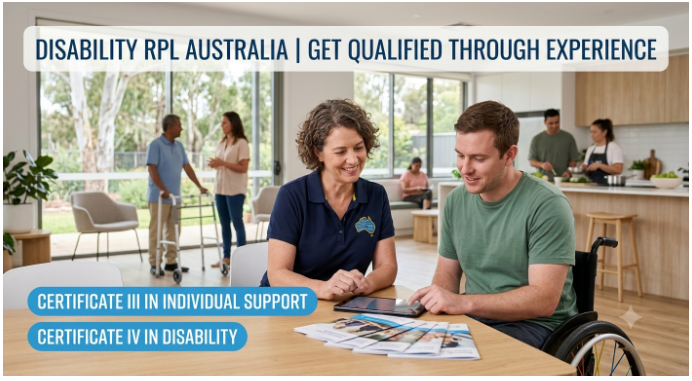
Which Qualification Fits Your Disability Support Experience?
Certificate III in Individual Support
This is the most common entry point for disability RPL and suits workers providing direct, hands on personal care and daily living support.
Typical candidates include:
Personal care support workers assisting with showering, dressing, and mobility Individual support workers helping clients with meal preparation and household tasks Disability support workers providing community access and social participation support Workers transitioning from informal or family caregiving roles into paid employment
Core competency areas usually include facilitating the empowerment of people with disability, supporting independence and wellbeing, supporting daily living needs, and working within a person centred support framework. This qualification also covers areas shared with aged care, reflecting the genuine overlap between disability support and aged care service delivery across the broader community services sector.
Certificate IV in Disability Support
This qualification suits workers with broader responsibility, including those who support more complex needs, contribute to care planning, or take on coordination and mentoring duties.
Typical candidates include:
Disability support workers managing complex behaviour support plans Workers contributing to individualised support and care plan development Senior support workers mentoring newer staff or overseeing shift handovers Workers supporting clients with high physical or complex support needs
Core competency areas usually include facilitating individualised plans, providing person centred services, implementing and monitoring behaviour support strategies, and supporting community participation and social inclusion. Workers at this level are often the ones a provider relies on for complex cases, even before they hold the formal credential to match.
NDIS Requirements and Why a Qualification Matters
Working in the NDIS sector increasingly comes with formal expectations around worker quality and competency, even where a specific qualification is not always a strict legal mandate for every role.
NDIS workforce requirements are shaped by the NDIS Quality and Safeguards Commission, which expects providers to demonstrate that their staff are appropriately skilled, screened, and supported to deliver safe, quality care. While not every frontline disability support role legally requires a Certificate III or Certificate IV, providers increasingly prefer or require an NDIS compliant qualification as a baseline, particularly for roles involving complex support, behaviour support, or supervisory responsibility.
For NDIS service provider staff qualifications more broadly, holding a recognised credential supports a provider's ability to meet NDIS Practice Standards during audits, strengthens funding applications, and improves a worker's employability across multiple providers rather than being limited to organisations with lower entry requirements.
For workers already employed as an NDIS support worker, disability RPL offers a practical way to formalise existing competency without stepping away from rostered shifts to attend a full time course. Given the workforce shortages discussed earlier, providers have a strong incentive to support existing staff through this pathway rather than lose them to competitors during a lengthy period of study.
How Disability RPL Works Step by Step
Step One: Free Skills Assessment
The process begins with a conversation, not a classroom. An RPL consultant reviews your current role, the types of support you provide, your years of experience, and any training or certificates you already hold, to determine whether Certificate III or Certificate IV is the realistic target. This step is free and carries no obligation.
Step Two: Evidence Collection and Portfolio Preparation
This is the stage where your real world experience is translated into assessment ready evidence. You will be guided through gathering documentation such as:
Employment records confirming your role and duration in disability support Position descriptions outlining your specific duties Written references from supervisors, coordinators, or team leaders Examples of support plans, progress notes, or incident reports you have contributed to Training records, including manual handling, medication administration, or NDIS worker orientation modules Rosters or shift records demonstrating consistent, ongoing experience
You do not need a perfectly organised history. Most candidates already have far more usable evidence sitting in old shift notes, emails, and training certificates than they realise, once a consultant helps them look properly.
Step Three: Assessment by a Registered Training Organisation
A qualified assessor reviews your evidence against the units of competency required for your target qualification. This often includes a structured conversation, sometimes called a professional discussion, where the assessor asks you to talk through specific examples of supporting a client through a difficult situation, contributing to a care plan, or responding to an incident.
Step Four: Qualification Issued
Once your evidence and discussion demonstrate the required competencies, the RTO issues your nationally recognised disability support qualification. This certificate is valid across every Australian state and territory and is recognised by NDIS providers, aged care providers, and community services organisations nationwide.
What Evidence Counts Toward Disability RPL?
Strong evidence portfolios for disability RPL typically draw from a combination of direct and supporting evidence.
Direct Evidence of Disability Support Experience
Employment contracts or letters confirming your role and duration Position descriptions outlining your specific support duties Care plans, support plans, or progress notes you have contributed to Incident reports or behaviour support documentation you have completed Rosters or timesheets confirming consistent hours in a support role
Supporting Evidence
Written references from supervisors, team leaders, or care coordinators Training certificates, including manual handling, first aid, or medication competency NDIS worker orientation module completion records Examples of communication with families, allied health professionals, or support coordinators Any short courses or professional development completed while working
Workplace Evidence for RPL in Practice
The strongest portfolios tell a clear, consistent story. Rather than a disconnected pile of documents, your evidence should show that you have genuinely supported clients with daily living, contributed to their independence and wellbeing, and exercised judgement in real situations, particularly where behaviour support or complex needs were involved. An experienced consultant will help you frame your work history this way, rather than leaving you to guess what an assessor is looking for.
How Long Does Disability RPL Take?
Most candidates complete the full disability RPL process within four to eight weeks, depending on the qualification level and how quickly evidence can be gathered.
Skills assessment typically takes one to three business days Evidence preparation typically takes one to four weeks RTO assessment and review typically takes two to four weeks
This is significantly faster than completing the same qualification through traditional classroom delivery, which can take six to twelve months when studied alongside full time shift work.
Disability RPL Versus Traditional Study
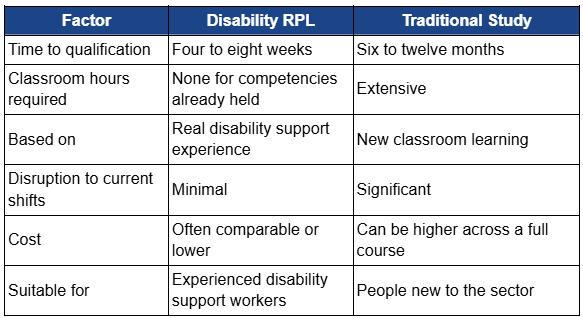
A qualification through work experience makes far more sense for someone who has already spent months or years supporting clients than repeating theory on topics they live out every shift.
Who Should Consider Disability RPL?
Experienced Disability Support Workers
If you have spent a year or more providing personal care, daily living support, or community access support, you are likely a strong candidate for Certificate III level RPL.
Senior or Specialised Support Workers
If you contribute to care plans, manage complex behaviour support, or mentor newer staff, your experience is likely closer to Certificate IV level.
Workers Transitioning From Aged Care or Community Services
Many disability support workers move between aged care and disability support, and a Certificate III in Individual Support already supports both sectors, while transferable evidence from one setting often strengthens an application in the other.
Family and Informal Carers Moving Into Paid Work
People who have provided informal or family caregiving and are now moving into paid disability support roles can often draw on that prior experience as part of their evidence, particularly where it has been recent and substantial.
Skilled Migrants With Overseas Care Experience
Migrants with genuine disability or community care experience from overseas can apply for RPL in Australia, with their international background assessed and converted into an Australian recognised qualification.
NDIS Support Workers Seeking Career Progression
If you are aiming for a senior support role, a coordination position, or simply want stronger job security across multiple providers, a formal qualification opens doors that informal experience alone often cannot.
The Business and Career Case for a Formal Qualification
Disability Support Career Progression
Many providers reserve senior, complex care, or supervisory roles for staff holding a Certificate IV, even when less qualified staff are performing similar work informally. A recognised qualification turns demonstrated capability into a documented case for progression.
Improved Employment Prospects
A nationally recognised qualification widens the pool of providers you can work for, rather than limiting you to organisations with lower entry requirements. Given current workforce shortages across the sector, qualified workers are in a strong position to negotiate hours, pay, and conditions.
Professional Recognition
Holding a Certificate III or Certificate IV signals to clients, families, and colleagues that your support is grounded in recognised competency standards, not only goodwill and informal experience, however genuine that experience may be.
Compliance and Provider Confidence
For NDIS providers facing increasing regulatory scrutiny from the NDIS Quality and Safeguards Commission, a workforce holding formal qualifications strengthens their position during audits and supports stronger funding and service agreements.
Wage and Career Stability
Given the scale of projected workforce shortfalls in the care and support sector, with projections suggesting a shortfall approaching 285,000 workers across aged care, disability, and veterans care by 2049, qualified disability support workers are positioned for long term demand and career stability that the broader labour market increasingly cannot offer in comparable roles without formal training.
Common Mistakes Candidates Make With Disability RPL
Underestimating Their Own Experience Level
Many workers assume they only qualify for Certificate III when their actual responsibilities, particularly around behaviour support or care planning, already reflect Certificate IV level work.
Submitting Evidence Without Context
A stack of shift notes or rosters with no explanation of how they relate to specific competencies slows an assessor down. Evidence should always be connected clearly to the unit it supports.
Waiting for a Perfect Portfolio
Some candidates delay starting because they assume their documentation needs to be flawless. In most cases, gaps can be addressed through a professional discussion or a supplementary reference, and a good consultant will flag these early rather than letting them stall the process.
Overlooking NDIS Specific Evidence
Workers sometimes forget to include NDIS worker orientation module completions, screening checks, or NDIS specific training records, all of which can strengthen a portfolio and demonstrate sector specific competency.
Disability RPL Eligibility Requirements
Eligibility for disability RPL generally depends on a combination of the following factors.
At least 12 months of genuine disability support, aged care, or community services experience The ability to provide documentation such as employment records, references, or training certificates Current or recent work in a support role, rather than experience from many years in the past with no recent practice A general understanding of person centred support, daily living support, and workplace safety relevant to the sector
A free skills assessment remains the most reliable way to confirm your specific eligibility, since individual circumstances vary considerably across casual, part time, and full time work histories.
How RPL Institute Australia Supports Disability RPL Candidates
RPL Institute Australia works with Registered Training Organisations across the country to guide disability support workers through the entire RPL process, from the first conversation through to a qualification in hand.
Our team begins with a free, no obligation skills assessment to confirm whether Certificate III in Individual Support or Certificate IV in Disability Support is the right fit for your experience. We then help you gather and organise the evidence you already have, including shift records, references, and training certificates, rather than asking you to create new documentation from scratch. Once your portfolio is ready, we coordinate directly with our RTO partners to keep your assessment moving until your qualification is issued.
Our fee structure is based on eligibility and qualification level, so you are not paying for training you do not need. Given the urgent shortage of qualified disability support workers across Australia, our goal is simply to help you formalise the skills you are already using every shift, supporting both your career and the sector that increasingly depends on workers like you.
Conclusion
If you have spent years supporting people with disabilities, assisting NDIS participants, or working in community support services, your experience may already qualify you for a nationally recognised credential.
Disability RPL provides an opportunity to convert workplace experience into formal qualifications without repeating training you have already mastered through practical work.
Whether you are seeking a Certificate III in Individual Support or a Certificate IV in Disability Support, Recognition of Prior Learning can help you gain professional recognition, improve employment opportunities, and advance your career within Australia's growing disability sector.
By obtaining a recognised disability support qualification, you can strengthen your professional profile while continuing to make a positive difference in the lives of the people you support.
Frequently Asked Questions
-
Disability RPL is the process of using Recognition of Prior Learning to assess a person's existing disability support skills and work experience against the competency requirements of a nationally recognised qualification, such as the Certificate III in Individual Support or Certificate IV in Disability Support.
-
The process starts with a free skills assessment to confirm your eligibility and the right qualification level. You then gather an evidence portfolio, an assessor from a Registered Training Organisation reviews it against competency standards, and your qualification is issued once you demonstrate the required competencies.
-
Yes. Recognition of Prior Learning is specifically designed to convert genuine, demonstrated work experience into the same competency outcomes a classroom based course would deliver. If your evidence shows you have already developed the required skills on the job, repeating that training is not required.
-
Generally, eligibility depends on having at least 12 months of genuine disability support, aged care, or community services experience, along with documentation such as employment records, references, or training certificates. A free skills assessment is the most reliable way to confirm your specific eligibility.
-
Yes. Workers with broader responsibility, including those contributing to care planning, managing behaviour support strategies, or mentoring other staff, are often well suited to Certificate IV level RPL rather than Certificate III.
-
The underlying process is the same. NDIS support workers are assessed against the same nationally recognised qualifications, though their evidence often includes NDIS specific documentation such as worker orientation modules, screening checks, and behaviour support plans relevant to NDIS participants.
-
Most candidates complete the full process within four to eight weeks, depending on the qualification level and how quickly evidence can be gathered. This compares to six to twelve months for completing the same qualification through traditional study.
-
Yes. Skilled migrants with genuine overseas disability or community care experience can apply for RPL in Australia. Their international work history is considered during assessment, with some candidates needing to demonstrate familiarity with Australian specific standards, such as NDIS requirements and person centred support frameworks.
-
Yes. Qualifications issued through RPL by a Registered Training Organisation carry the same standing under the Australian Qualifications Framework as qualifications completed through traditional classroom delivery, and are recognised by employers and providers across every Australian state and territory.
-
Costs vary depending on the qualification level, the number of competency units involved, and individual circumstances. Fees are generally based on eligibility and are often comparable to or lower than the cost of completing the same qualification through a full course. A personalised quote is provided after the free skills assessment.
-
If a gap exists, your assessor or consultant will usually identify an alternative form of evidence, such as a professional discussion, a practical demonstration, or an additional reference, to address the missing competency. Incomplete evidence does not automatically disqualify an application.
-
Yes. The Certificate III in Individual Support already covers both aged care and disability support contexts, and many workers move between the two sectors. Genuine experience in one setting can often support an application that reflects skills relevant to the other, particularly where daily living support and person centred care overlap.