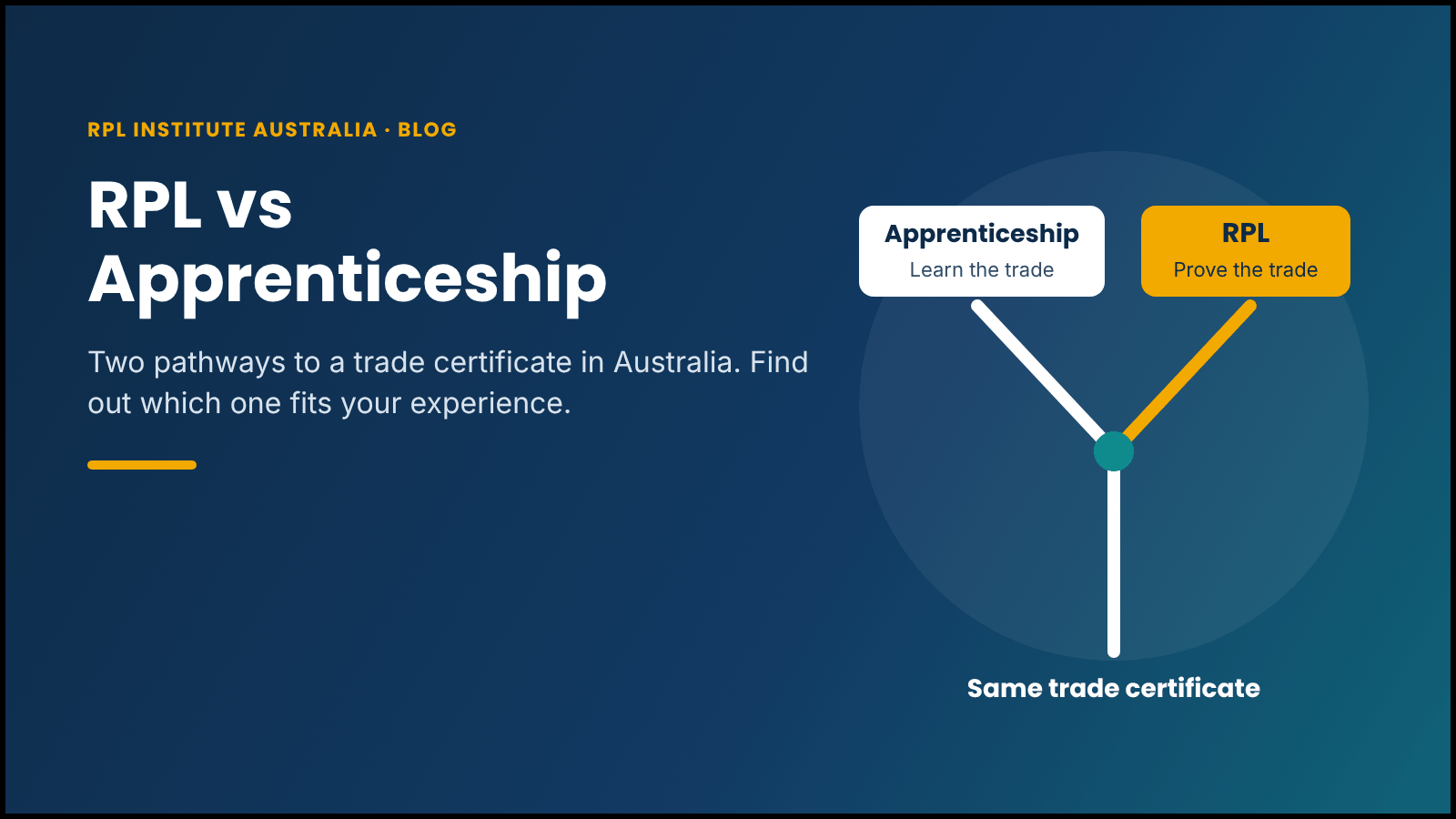
The main difference between RPL and an apprenticeship is where you start. An apprenticeship is for people who are learning a trade: you work for an employer, attend training and build skills over several years. Recognition of prior learning (RPL) is for people who already have the skills: an assessor checks your experience against a qualification and awards it once you prove you are competent.
Both can lead to the same nationally recognised trade certificate. The right choice depends on how much experience you already have, whether you need to earn while you learn, and whether your trade requires a licence. This guide compares the two pathways side by side so you can decide which one suits your situation.
Key takeaways
An apprenticeship teaches you a trade from the ground up. RPL recognises a trade you already know.
A full-time apprenticeship often takes three to four years. RPL is usually much quicker for experienced workers.
Apprentices are paid while training. RPL applicants pay assessment fees but usually keep their current job.
Both pathways lead to the same nationally recognised qualification when delivered by a genuine RTO.
Licensed trades, such as electrical and plumbing, have extra rules that RPL alone may not satisfy.
What Is an Apprenticeship in Australia?
An Australian apprenticeship is a formal training arrangement that combines paid work with structured training. You sign a training contract with an employer, who agrees to teach you the trade on the job, and you complete off-the-job training with a registered training organisation (RTO), often a TAFE.
According to the Fair Work Ombudsman, an apprenticeship leads to a trade qualification and often takes three to four years to complete full-time. Apprenticeships are competency-based, which means you can finish sooner if you show competence earlier, and part-time apprenticeships take longer.
Apprenticeships are not only for school leavers. Fair Work defines anyone who starts an apprenticeship at 21 or older as an adult apprentice, and adult apprentices are paid at different rates from junior apprentices. That is why searches for a mature age apprenticeship are common among career changers.
What an apprenticeship gives you
Paid work from day one, with pay rates set by the relevant award.
Supervision and mentoring from a qualified tradesperson.
A structured path through every unit of the qualification.
The supervised hours many licensed trades require.
What Is RPL?
RPL, or recognition of prior learning, is a formal assessment process. Instead of training you, an RTO assesses the skills and knowledge you already have against the units of competency in a qualification. If your evidence shows you are competent, the units are granted. If a few units are missing, you complete short gap training.
An RPL qualification is the same qualification as one earned through an apprenticeship or classroom course. It has the same title and national code, and it is issued under the same national standards.
RPL suits people who have worked in a trade for years without formal papers. That includes tradespeople who learned on the job, workers who never finished an apprenticeship, and migrants with overseas trade experience.
RPL vs Apprenticeship: The Key Differences at a Glance
The table below summarises how the two pathways compare on the factors that matter most.
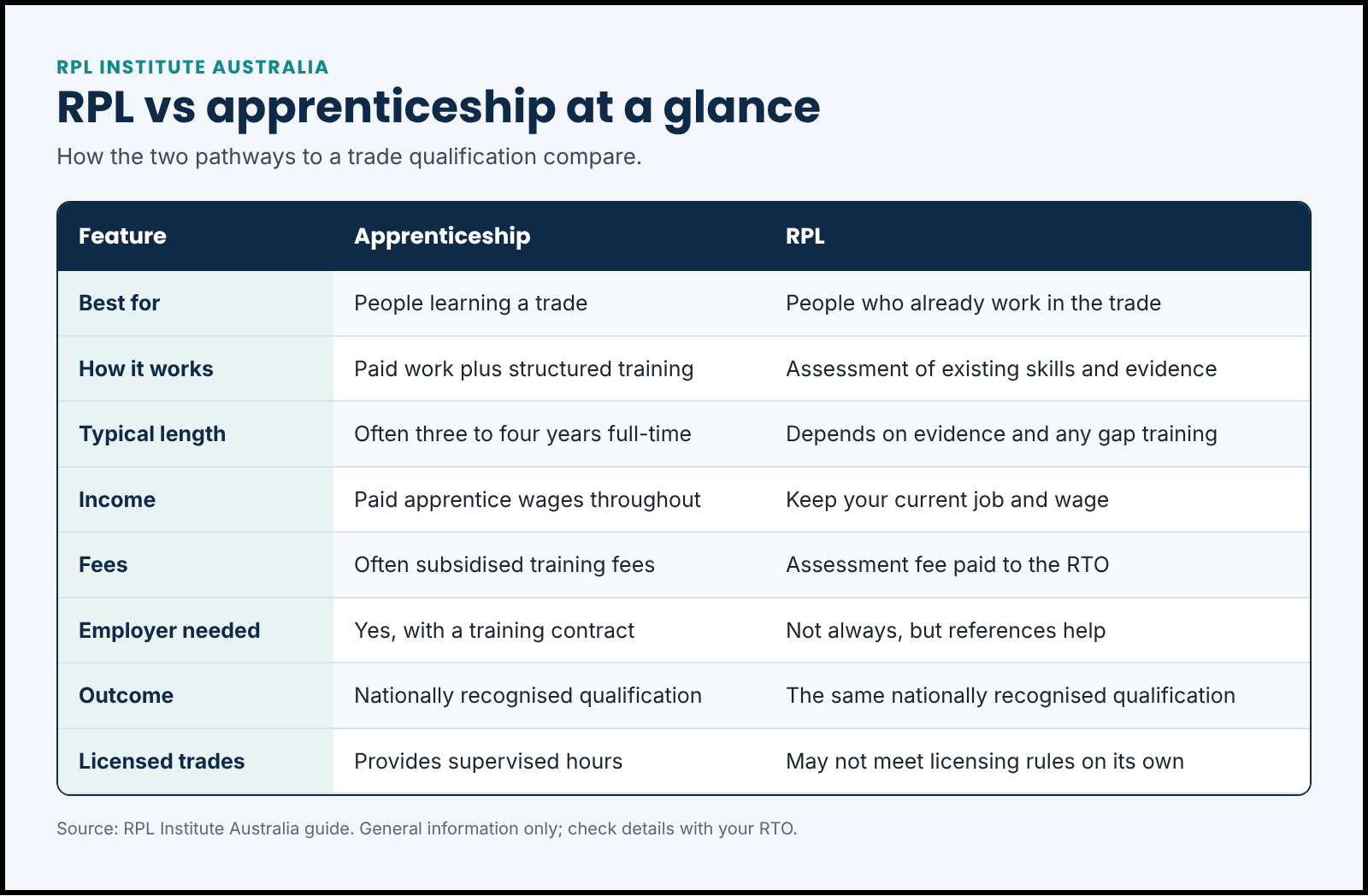
The short version is this: an apprenticeship builds skills, while RPL proves skills you already have. If you are new to a trade, RPL is not an option yet because there is nothing to assess. If you have years of experience, an apprenticeship may mean repeating training you do not need.
How Long Does Each Pathway Take?
Time is often the deciding factor, especially for experienced workers who want a qualification without putting their career on hold.
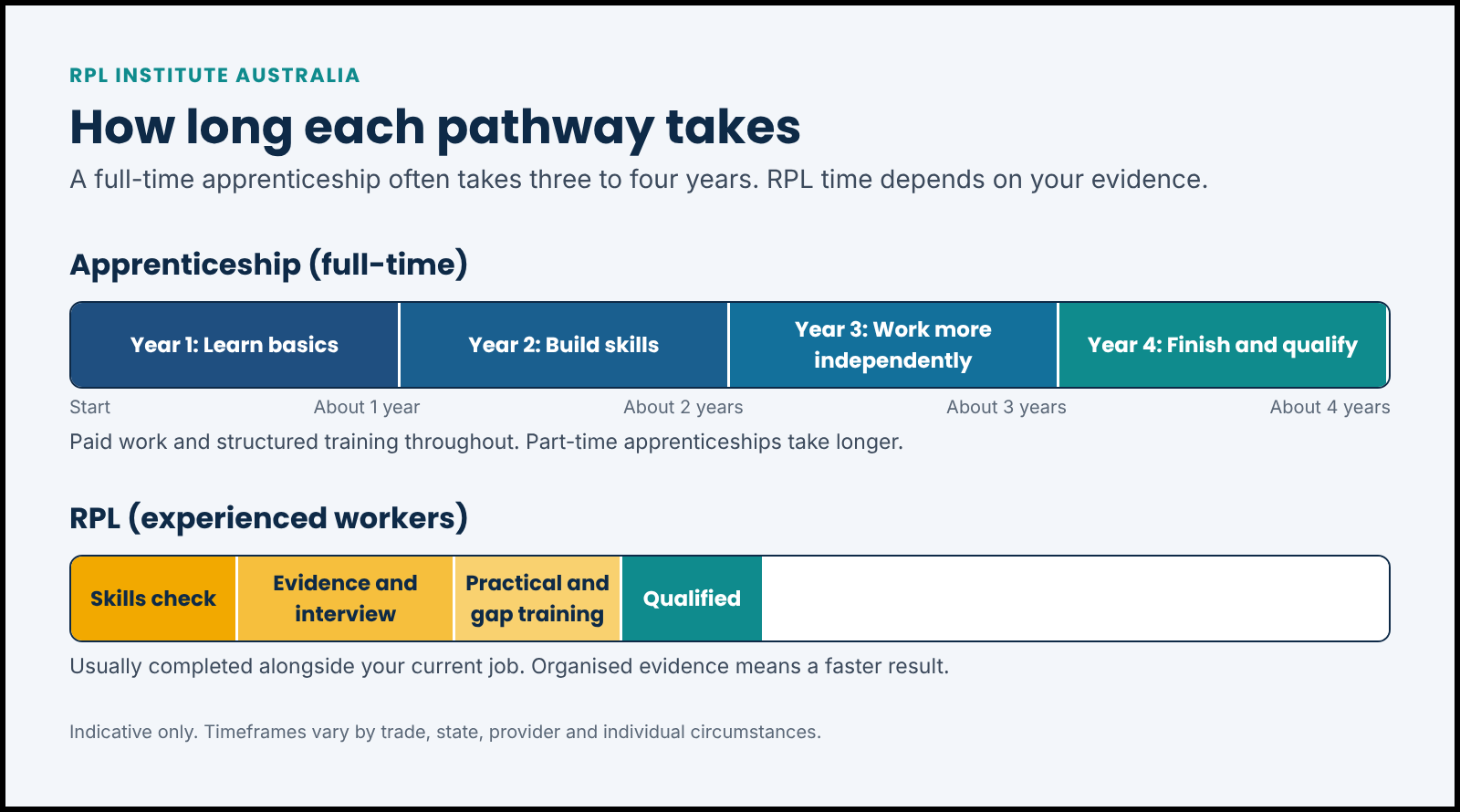
Apprenticeship timeframes
Most trade apprenticeships are set at around three to four years full-time. However, finishing within that time is not guaranteed. According to NCVER, the six-year completion rate for trade apprentices who started in 2019 was 58.7 per cent. NCVER also notes that a growing share of apprentices are taking longer than the traditional four years to finish.
That does not mean apprenticeships are a poor choice. Completion rates vary by trade, and electrician completion rates rose to 71.7 per cent for the same cohort. It does mean the timeframe depends on your employer, your training provider and your own circumstances.
RPL timeframes
RPL has no fixed term. The time it takes depends mainly on how quickly you can collect your evidence and how many units, if any, need gap training. Applicants with organised references, photos and a supervisor who can confirm their skills often move through faster than those who need to track down old employers.
Because RPL is an assessment, not a training program, you generally do not need to step away from paid work while you complete it.
Cost and Income: Earning While You Learn vs Paying for Assessment
The money works very differently in each pathway, so it is worth looking at both sides: what you pay and what you earn.
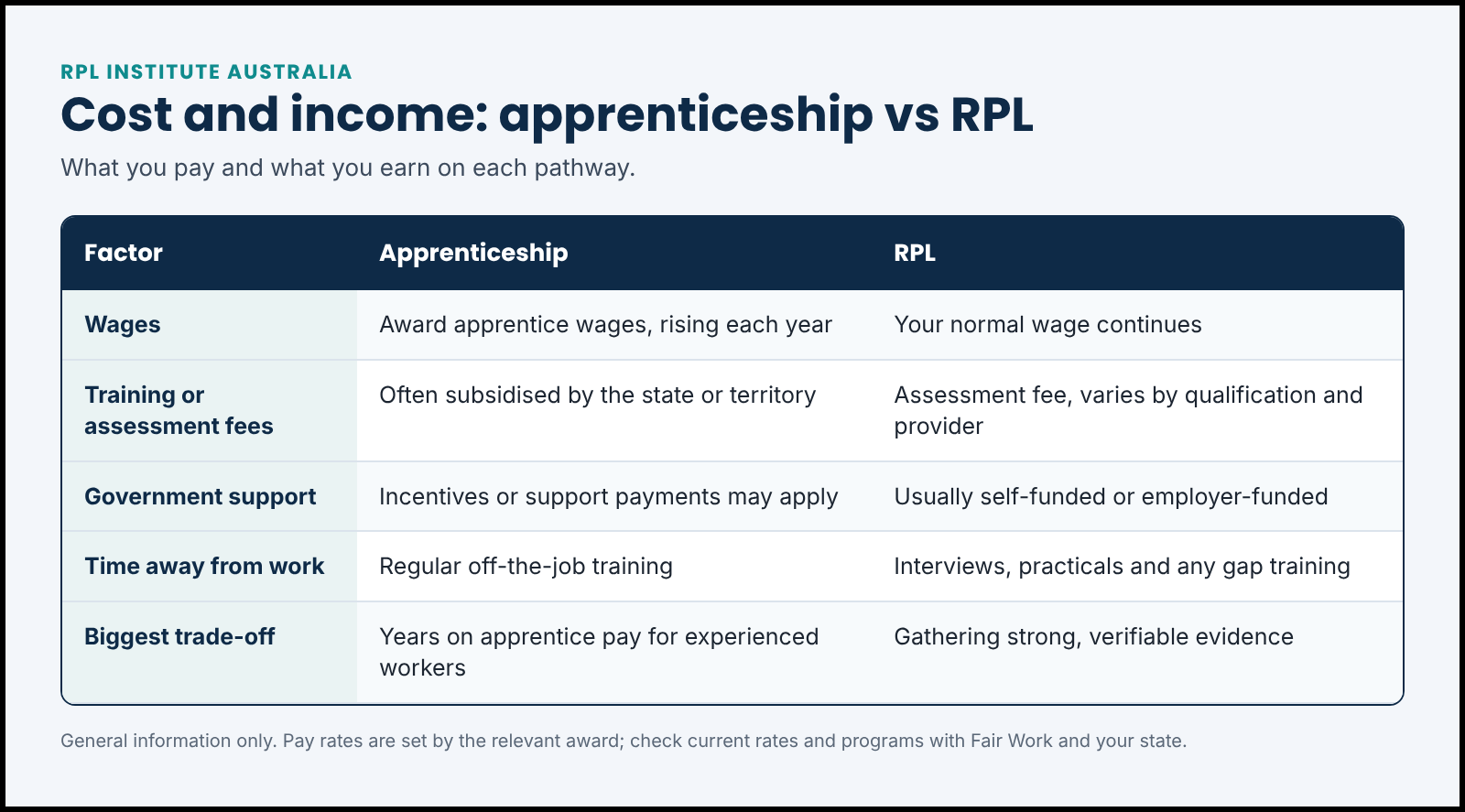
Apprentices earn wages throughout their training, set by the award for their trade and year of apprenticeship. Adult apprentices are paid at different rates from junior apprentices, and government incentives or support payments may also be available depending on the trade and current programs. Training fees are often subsidised by the state or territory government.
RPL is generally a paid assessment, and the fee varies with the qualification and the provider. You are not paid to complete it, but you also do not take a pay cut. Most applicants keep their current job and wage while their evidence is assessed. For more detail on pricing, read our guide to RPL certificate cost.
For an experienced tradesperson already earning a full wage, starting an apprenticeship can mean several years on apprentice pay. That gap is often the main reason experienced workers choose RPL.
Who Should Choose an Apprenticeship?
An apprenticeship is usually the right choice if you are starting a trade, not formalising one you already have. It suits:
School leavers who want to enter a trade with paid training and support.
Career changers with little or no trade experience, including people looking at a mature age apprenticeship.
People entering licensed trades that require a set amount of supervised work, such as electrical work.
Anyone who wants a mentor, structured feedback and a clear plan from beginner to qualified tradesperson.
Apprenticeships also offer something RPL cannot: a guaranteed learning environment. If you have never used the tools or worked on a real site, the hands-on years of an apprenticeship are how you become safe and competent.
Apprenticeship vs traineeship
You may also see traineeships advertised. A traineeship works in a similar way to an apprenticeship but usually leads to a qualification in a non-trade field, such as business, hospitality or IT. Fair Work notes that a full-time traineeship often takes one to two years. Like apprenticeships, traineeships combine paid work and training.
Who Should Choose RPL?
RPL is usually the better choice when you already do the work and need the qualification to match. It suits:
Experienced tradespeople without papers, who learned their trade on the job.
Former apprentices who did not finish, but kept working in the trade afterwards.
Migrants with overseas trade experience, who need an Australian trade qualification.
Workers moving up, such as leading hands who want a Certificate IV to apply for supervisor roles.
Small business owners who need a qualification for contracts, insurance or tender requirements.
RPL respects the time you have already spent learning your trade. Instead of repeating years of training, you show the assessor what you can do. Our guide to the RPL process explains each step in detail.
Pros and Cons of Each Pathway
Neither pathway is better in every situation. Weighing the advantages and drawbacks honestly helps you choose with confidence.
Apprenticeship pros
You are paid from the first day, with pay rising as you progress.
You learn every part of the trade with a qualified mentor beside you.
You build the supervised hours that many licensed trades require.
Training fees are often subsidised by state and territory governments.
Apprenticeship cons
It usually takes three to four years full-time.
Apprentice wages can be a big drop for experienced workers.
You need an employer willing to sign a training contract with you.
Your progress depends partly on your employer's work and support.
RPL pros
It recognises skills you already have, so you avoid repeating training.
It is usually much faster for experienced workers.
You can keep your current job and wage while being assessed.
It suits people with overseas, informal or unfinished trade experience.
RPL cons
You need strong, verifiable evidence, which can take effort to gather.
You pay assessment fees rather than earning wages for training.
It is not available to people who have not yet worked in the trade.
It may not satisfy licensing rules on its own in regulated trades.
What Evidence Do You Need for Trade RPL?
Because RPL replaces training with assessment, the quality of your evidence decides the outcome. Assessors look for proof that is valid, current, sufficient and authentic. In practice, that usually means a mix of the following.
Employment references. Letters from employers or clients that list your role, the type of work, the dates and roughly how many hours you worked. A reference that names specific tasks, such as framing, formwork or fit-out, is far more useful than a general letter.
Photos and videos of your work. Before, during and after shots of jobs you completed. For trades, this is often the strongest evidence you can provide, especially if it shows you using tools and following safe work practices.
Workplace documents. Job sheets, quotes, invoices, safe work method statements, site inductions and training records. These show that you have worked in real Australian conditions.
A third-party report. Many RTOs ask a supervisor or experienced tradesperson to confirm, in writing, that you can perform specific tasks to the required standard.
A practical assessment. The assessor may watch you complete a task at a workplace or ask you to submit a video of you doing the work.
If you completed part of an apprenticeship earlier, bring your training records too. Units you already finished may count toward the qualification.
Can You Combine RPL and an Apprenticeship?
Yes. RPL and apprenticeships are not always separate choices. Many apprentices apply for RPL or credit for units they already have, which can shorten the formal training part of the apprenticeship.
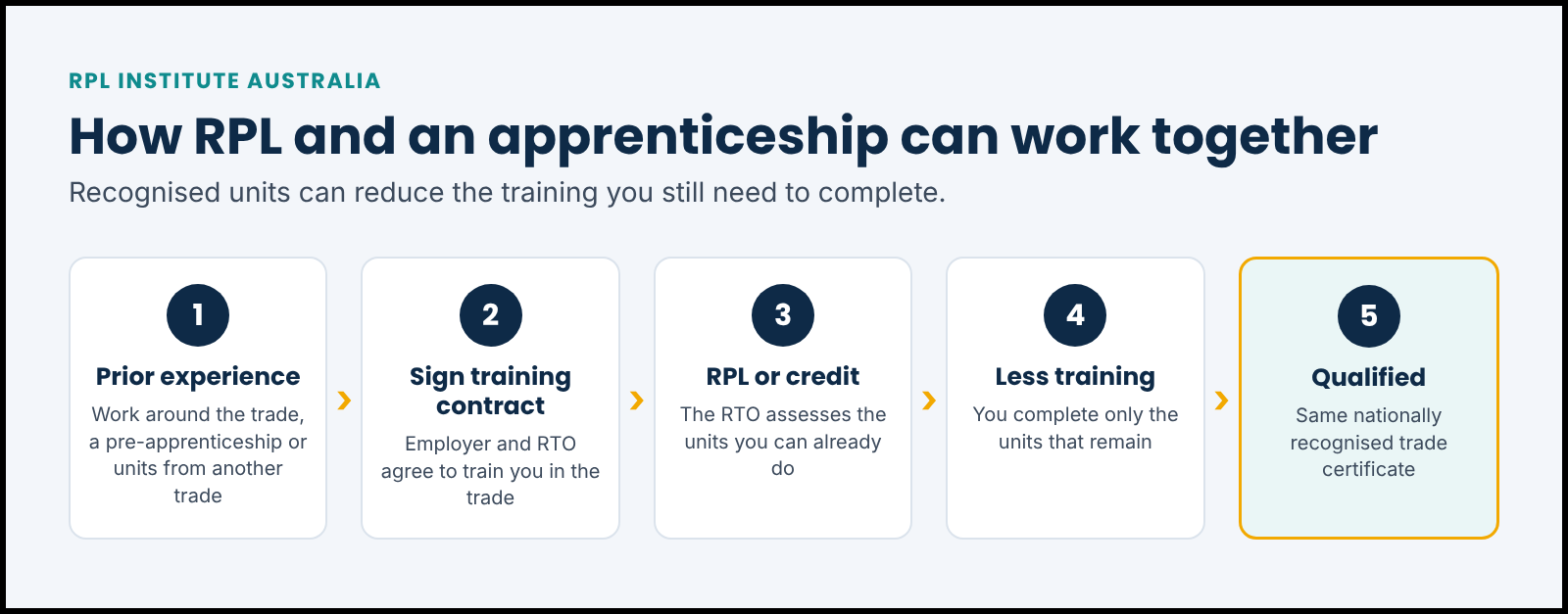
This is common for:
Mature age apprentices who have worked around the trade before signing up.
Pre-apprenticeship graduates, who may have completed units that count toward the full qualification.
Workers switching trades, where some general units, such as workplace safety, carry across.
If you are about to sign a training contract, ask the RTO whether your experience can be assessed for RPL first. Recognised units can reduce the training you need to complete. Your employer and the state training authority will decide whether the length of the apprenticeship itself can change.
Getting a Trade Certificate Without an Apprenticeship
Many people search for a trade qualification without an apprenticeship, and RPL is the main legitimate way to do it. Whether it works for you depends on your trade.
Non-licensed trades
In trades such as carpentry, painting, tiling, landscaping and many construction roles, RPL can lead directly to a Certificate III when your evidence is strong. These trades usually need a practical assessment, references from people who supervised your work and photos or videos of completed jobs.
Licensed trades
Electrical work, plumbing and gas fitting are regulated by state and territory licensing bodies. A qualification on its own does not let you work unsupervised. Licensing rules often require supervised work under a training contract, a final licensing assessment, or both. In electrical work especially, RPL options can be very limited.
If you work in a licensed trade, check the requirements with your state regulator before choosing a pathway. The qualification may only be one part of what you need.
Building licences
Becoming a licensed builder usually involves a higher qualification, years of relevant experience and a separate application to the state building authority. RPL can help with the qualification part, but it does not replace the licensing process.
Common Myths About RPL and Apprenticeships
A lot of confusion comes from things people hear on site or read online. Here are the myths that come up most often.
Myth: RPL is a lesser qualification. It is not. When a genuine RTO assesses you properly, you receive the same qualification as an apprentice who completed the same units. Employers see the same qualification title and code.
Myth: You can buy an RPL certificate without being assessed. You cannot get a genuine one this way. The national regulator, the Australian Skills Quality Authority (ASQA), has cancelled thousands of qualifications from providers that skipped proper assessment. A qualification that can be cancelled is not worth paying for.
Myth: Apprenticeships are only for teenagers. Adult and mature age apprentices are common, particularly among career changers. Many employers value the reliability and life experience older apprentices bring.
Myth: RPL means no training at all. Many applicants complete some gap training for units their evidence does not fully cover. That is normal, and it usually takes far less time than a full course.
Myth: Once you have the qualification, you can work in any trade. Licensed trades still need a licence from the state or territory regulator. The qualification is one requirement, not the whole picture.
What Happens After You Qualify?
Whichever pathway you choose, the qualification opens doors. NCVER's apprentice and trainee outcomes data shows that 94.8 per cent of trade apprentices who completed their training were employed afterwards. For RPL applicants, the qualification often leads to better roles with an employer they already work for, such as leading hand, supervisor or estimator.
A trade qualification can also be a stepping stone. Many tradespeople later use a Certificate IV or Diploma in building and construction to move into site management, estimating or running their own business. Experience you build after qualifying can be recognised again through RPL for the next qualification.
Which Pathway Fits Your Situation?
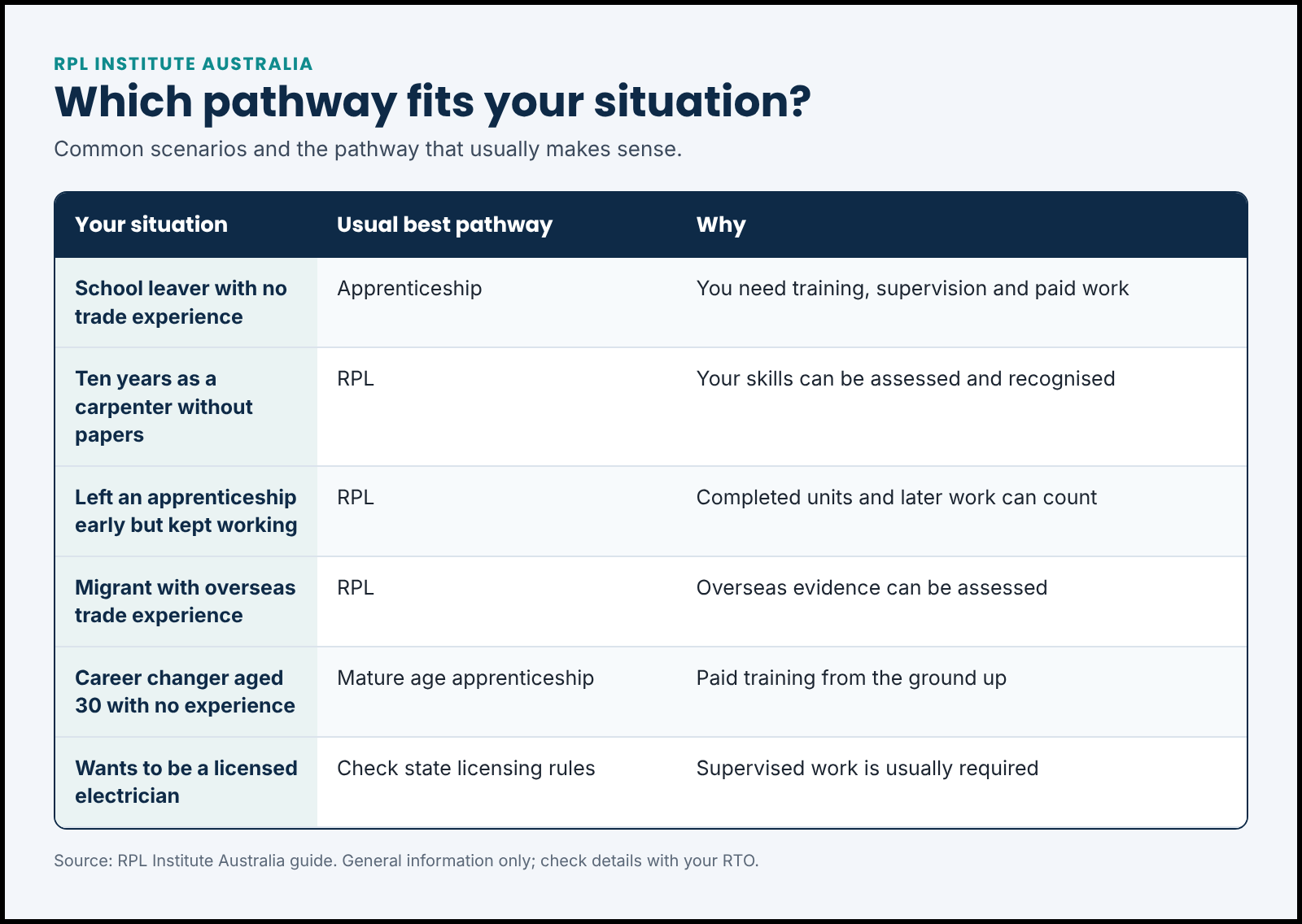
Real situations rarely fit neatly into one box. The table below shows which pathway usually makes sense for common scenarios.
Questions to ask yourself
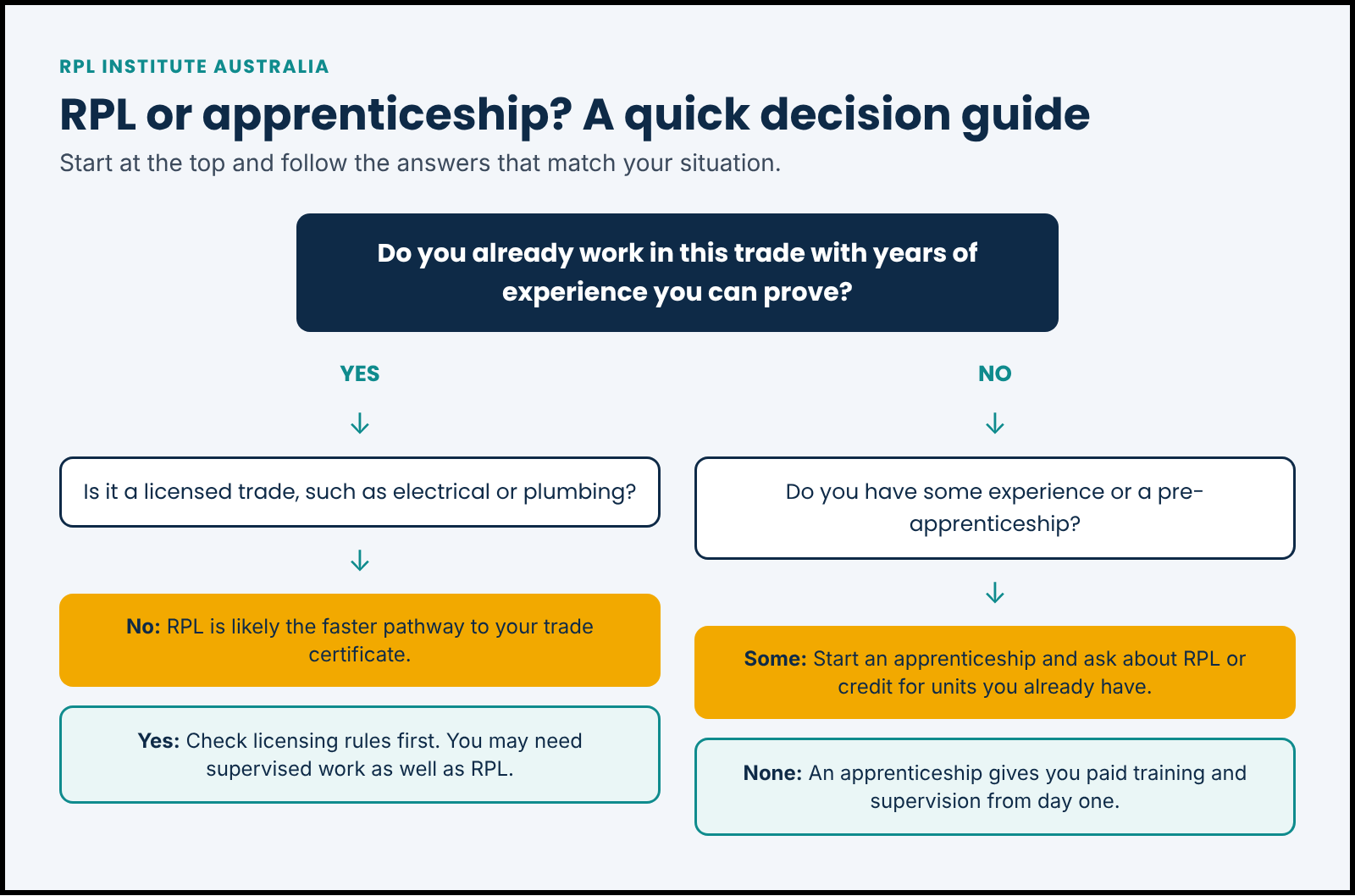
Do I already do this work? If yes, RPL is worth exploring. If no, an apprenticeship is the starting point.
How many years of experience can I prove? RPL depends on evidence. Most qualifications need solid, recent, verifiable experience.
Can I afford to take apprentice wages? If you support a family on a full wage, the cost of switching to apprentice pay matters.
Does my trade need a licence? Check licensing rules first. They may require supervised hours that only an apprenticeship can provide.
What is the qualification for? A promotion, a contract or a job application may need a qualification quickly. A licence may need more.
The Bottom Line on RPL vs Apprenticeship
Both pathways lead to the same nationally recognised qualification, and both have value. An apprenticeship is the proven way to learn a trade from scratch with pay and support. RPL is the fair way to recognise a trade you already know, without repeating years of training.
The worst choice is the one that does not match your experience. Starting an apprenticeship after ten years in the trade can waste time and income. Choosing RPL with little real experience can lead to a failed assessment or, worse, a qualification from a provider that did not assess you properly. Take time to compare both options, talk to an RTO and your state training authority, and choose the pathway that fits your real skills, your current income needs and your long-term career goals.
If you are unsure which pathway suits you, a free skills assessment can show whether your experience lines up with a qualification.
Frequently Asked Questions
What is the main difference between RPL and an apprenticeship?
An apprenticeship trains you in a trade over several years while you work. RPL assesses skills you already have and awards the qualification once you prove you are competent.
Is an RPL trade certificate the same as one from an apprenticeship?
Yes. A trade certificate gained through RPL from a genuine RTO is the same nationally recognised qualification, with the same title and code, as one earned through an apprenticeship.
How long does an apprenticeship take in Australia?
Most full-time trade apprenticeships take three to four years. Part-time apprenticeships take longer, and competency-based progression can sometimes shorten the term.
How long does RPL take compared with an apprenticeship?
RPL is usually much faster because it assesses existing skills. The time depends on how quickly you provide evidence and whether you need gap training.
Can I get a trade qualification without doing an apprenticeship?
In many non-licensed trades, yes. RPL can lead to a Certificate III if you have enough verifiable experience. Licensed trades may still need supervised work.
Can I do RPL during an apprenticeship?
Yes. Apprentices can apply for RPL or credit for units they already have. Recognised units reduce training, and any change to the apprenticeship term is decided separately.
Can I become an electrician through RPL?
Electrical licensing is tightly regulated. RPL options are limited, and most states require supervised work and a final licensing assessment, so check with your state regulator first.
What is an adult apprentice?
Fair Work defines an adult apprentice as someone who starts an apprenticeship at 21 or older. Adult apprentices are paid at different rates from junior apprentices.
Do I get paid during RPL?
No. RPL is an assessment, not employment. Most applicants keep working in their current job while their evidence is assessed, so their income continues.
Who should not choose RPL?
RPL is not suitable if you have little or no experience in the trade. In that case, an apprenticeship or traineeship will give you the training and supervision you need.