
If you have moved to Australia with years of work experience but no Australian qualification, recognised prior learning (RPL) can turn that experience into a nationally recognised certificate or diploma without starting a course from scratch. A registered training organisation (RTO) assesses your skills against an Australian qualification. If you meet the standard, you receive the same qualification as someone who studied it in a classroom.
For many new migrants, this is the fastest legitimate way to get a local credential that employers understand. This guide explains how RPL works for migrants, which careers it suits, what evidence you need from overseas and in Australia, and how to avoid the shortcuts that can cost you money and your qualification.
Key takeaways
RPL assesses what you can already do. It is not a course, and it does not replace a migration skills assessment.
Overseas work experience can count as evidence, as long as it is relevant, recent enough and can be verified.
Common fast-track pathways include construction, hospitality, logistics, community services, IT and business.
Only a registered training organisation listed on training.gov.au can issue a genuine Australian qualification through RPL.
Licensed trades usually need extra steps after the qualification, such as a state licence or gap training.
What Is Recognised Prior Learning for New Migrants?
Recognised prior learning, usually called recognition of prior learning or RPL, is a formal assessment process used across Australia's vocational education and training (VET) system. It checks the skills and knowledge you gained through work, life and earlier study against the units of competency in an Australian qualification.
For a new migrant, the important point is that RPL looks at what you can do, not where you learned it. A chef who trained on the job in Kathmandu, a forklift operator from Manila or a team leader from Johannesburg may already have much of what an Australian Certificate III or IV requires. RPL gives an assessor a structured way to confirm that and close any small gaps.
If you are new to the process, our guide to recognition of prior learning explains the basics in plain English.
What RPL is not
RPL is not a shortcut around assessment. You still need to prove your skills with evidence, and the assessor still has to be satisfied. It is also not the same as having an overseas degree formally recognised, and it is not a migration skills assessment for a visa. Those are separate processes run by different bodies, which we compare below.
Why Overseas Experience Often Goes Unused in Australia
Many migrants arrive highly skilled but struggle to use those skills in their first few years. According to the Australian Bureau of Statistics, 69 per cent of recent migrants held a non-school qualification before arriving, yet only around 40 per cent of those applied to have it recognised for work in Australia.
The result is a well-known skills gap. Research by CEDA found that nearly a quarter of permanent skilled migrants were working in a job beneath their skill level. The same research found that recent migrants trained in a licensed field but not working in it earn at least 20 per cent less than similar Australian-born workers.
There are many reasons for this, including English confidence, local networks and visa conditions. A missing Australian credential is one of the easiest to fix. Employers often filter job ads by qualification, and a Certificate III, Certificate IV or Diploma on your résumé tells them your skills meet a national standard they recognise.
What is the Difference Between RPL, Skills Assessments and Overseas Qualification Recognition?
New migrants often hear three terms used as if they mean the same thing. They do not, and choosing the wrong process can waste months.
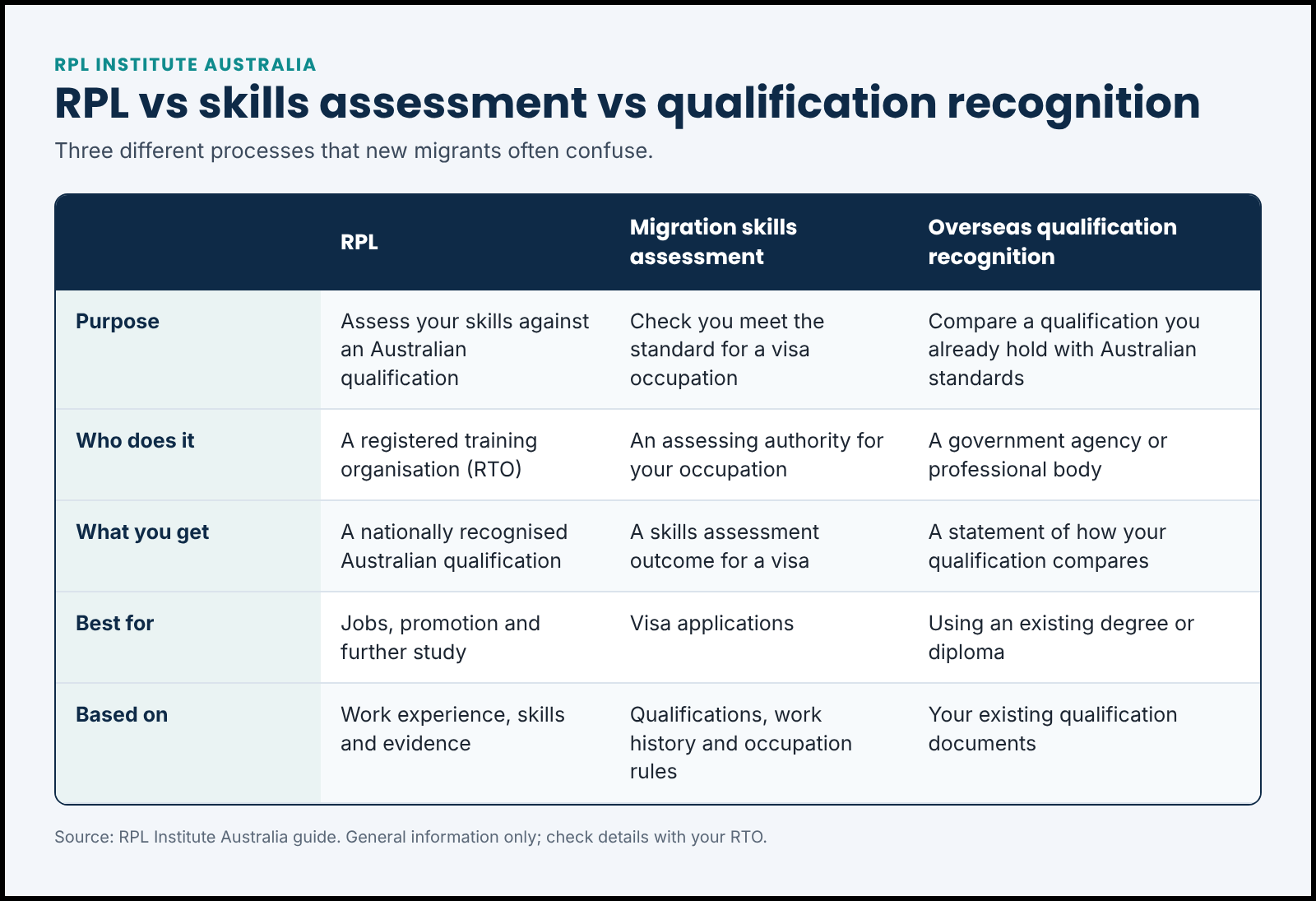
In short, overseas qualification recognition compares a qualification you already hold. A skills assessment for migration checks whether you meet the requirements for a visa occupation. RPL assesses your skills against an Australian qualification so you can be issued that qualification.
Some people need more than one. For example, you might arrive on a skilled visa after a migration skills assessment, then use RPL later to gain a higher Australian qualification for a promotion. If you are still planning a visa application, check the skills assessment rules for your occupation with the relevant assessing authority before relying on an RPL qualification.
Fast-Track Career Options for New Migrants Through RPL
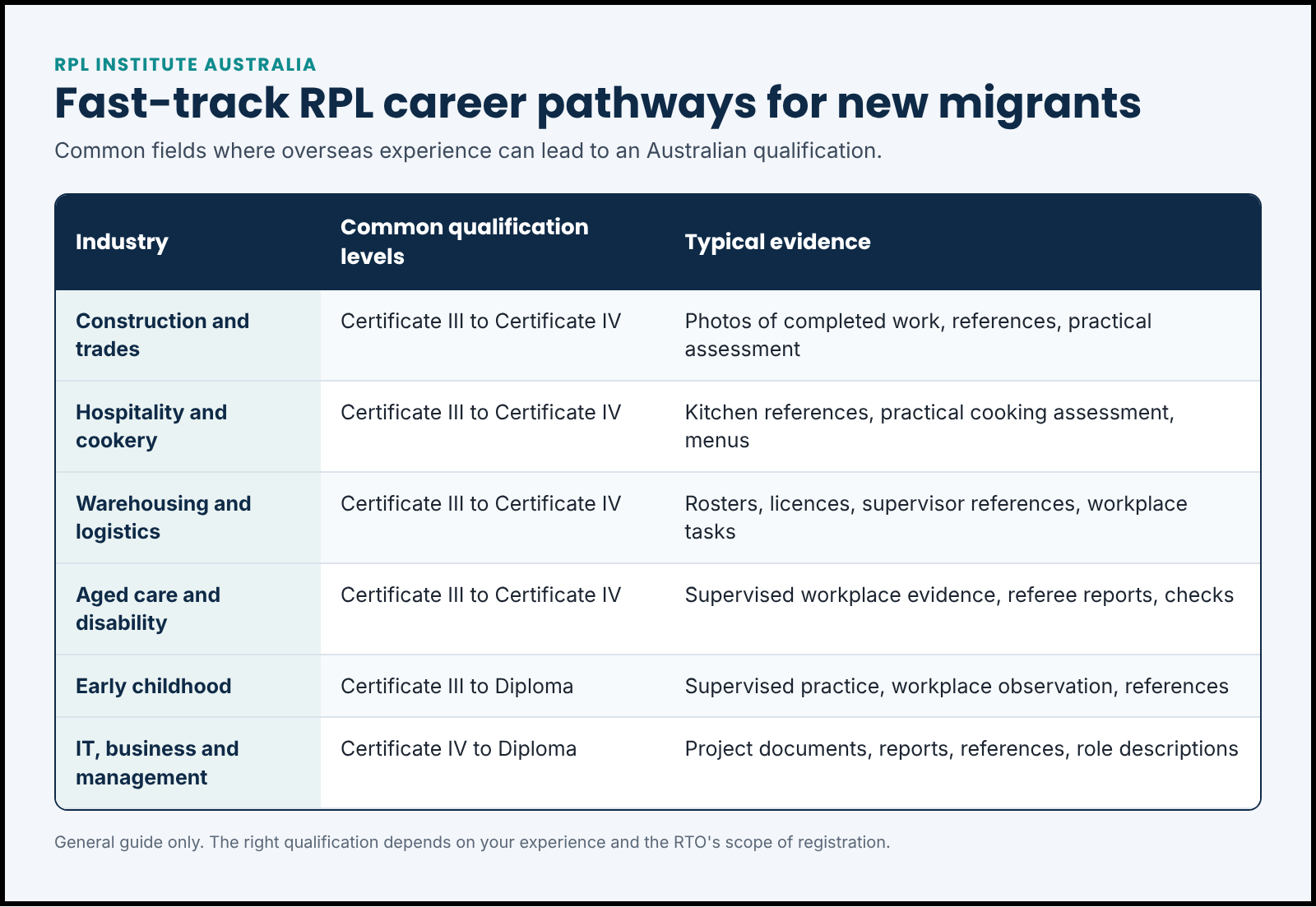
RPL works best in industries where skills are learned on the job and assessed through practical evidence. These are the pathways where migrants most often find a good fit.
Construction and trades
Carpentry, wall and floor tiling, painting, concreting and civil construction are common RPL pathways. Many migrants have worked in these trades for years overseas. RPL can lead to a Certificate III, which helps you get site work, subcontract or move toward running your own crew.
Trades that need a licence, such as electrical and plumbing work, follow stricter rules. The qualification is usually only one step, and the state or territory licensing body decides whether you can work unsupervised.
Hospitality and commercial cookery
Kitchen staff, cooks and supervisors with strong overseas experience often look at commercial cookery and kitchen management qualifications. These are also areas where regulators have found non-genuine RPL, so choose your provider carefully and expect a practical assessment.
Warehousing, logistics and transport
Warehouse operators, inventory staff and team leaders can often show their skills quickly through workplace evidence. Our guide to warehouse and logistics RPL covers the common qualifications in this field.
Community services, aged care and early childhood
Care work is one of the largest employers of migrants in Australia. Aged care, disability support and early childhood qualifications can be gained through RPL when you have relevant, verifiable work experience. Most require supervised workplace evidence, and some roles need extra checks such as a working with children check.
IT, business and management
Migrants with years of experience in IT support, networking, administration or team management may qualify for a Certificate IV or Diploma. Our guide to RPL for software and IT professionals explains this non-degree pathway.
How an Australian qualification changes your options
Migrants already play a large part in several of these industries. AI Group analysis of ABS data found that in 2025, recent migrants made up 21 per cent of food trades workers and 17.2 per cent of cleaners. Many people in these roles have the skills to move into supervisor, leading hand or specialist positions, but are held back because they have no local paperwork to show for it.
An Australian qualification can help you:
Pass the qualification filter on job ads and recruitment platforms.
Apply for supervisor, team leader and coordinator roles that list a Certificate IV or Diploma as essential.
Meet award or enterprise agreement classifications, which sometimes link pay rates to qualification levels.
Satisfy industry or client requirements, such as a minimum qualification for working in aged care or on certain building sites.
Move into further study, using the qualification as an entry point for a higher qualification later.
None of this is guaranteed, of course. Employers still look at English, references and attitude. But the qualification removes one barrier that often stops experienced migrants getting an interview at all.
Real-World Examples: How Migrants Use RPL
These examples are illustrative, but they reflect the situations RPL assessors see every week.
The experienced cook working as a kitchen hand
Arjun ran a busy restaurant kitchen overseas for six years. In Australia, he took a kitchen hand job to get started. With references from his former employer, photos of his dishes and a supervisor at his current workplace willing to confirm his skills, he applied for a cookery qualification through RPL. A practical assessment in a commercial kitchen and a few short gap units on Australian food safety requirements were enough to finish. The qualification gave him the paperwork to apply for cook roles.
The site supervisor without local paperwork
Maria managed small residential builds in her home country for nearly a decade. In Australia she worked as a labourer while learning local codes. RPL helped her gain a construction qualification that matched her experience, which supported her move into a leading hand role. She understood that becoming a licensed builder would need further steps through her state regulator.
The team leader moving into management
Samuel led a warehouse team of 15 people overseas and now works in a distribution centre in Melbourne. His overseas references, rosters he had built and performance reports he had written made a strong case for a leadership and management qualification. His Australian manager confirmed he was already doing the job day to day.
In each case, the person already had the skills. RPL simply turned those skills into a qualification that Australian employers could see and trust.
Can You Use Overseas Work Experience for RPL?
Yes. Overseas work experience can be used for RPL, provided it is relevant to the qualification, recent enough to reflect current practice and can be checked. The assessor needs to be confident the evidence is genuine and that it shows you can work to Australian standards.
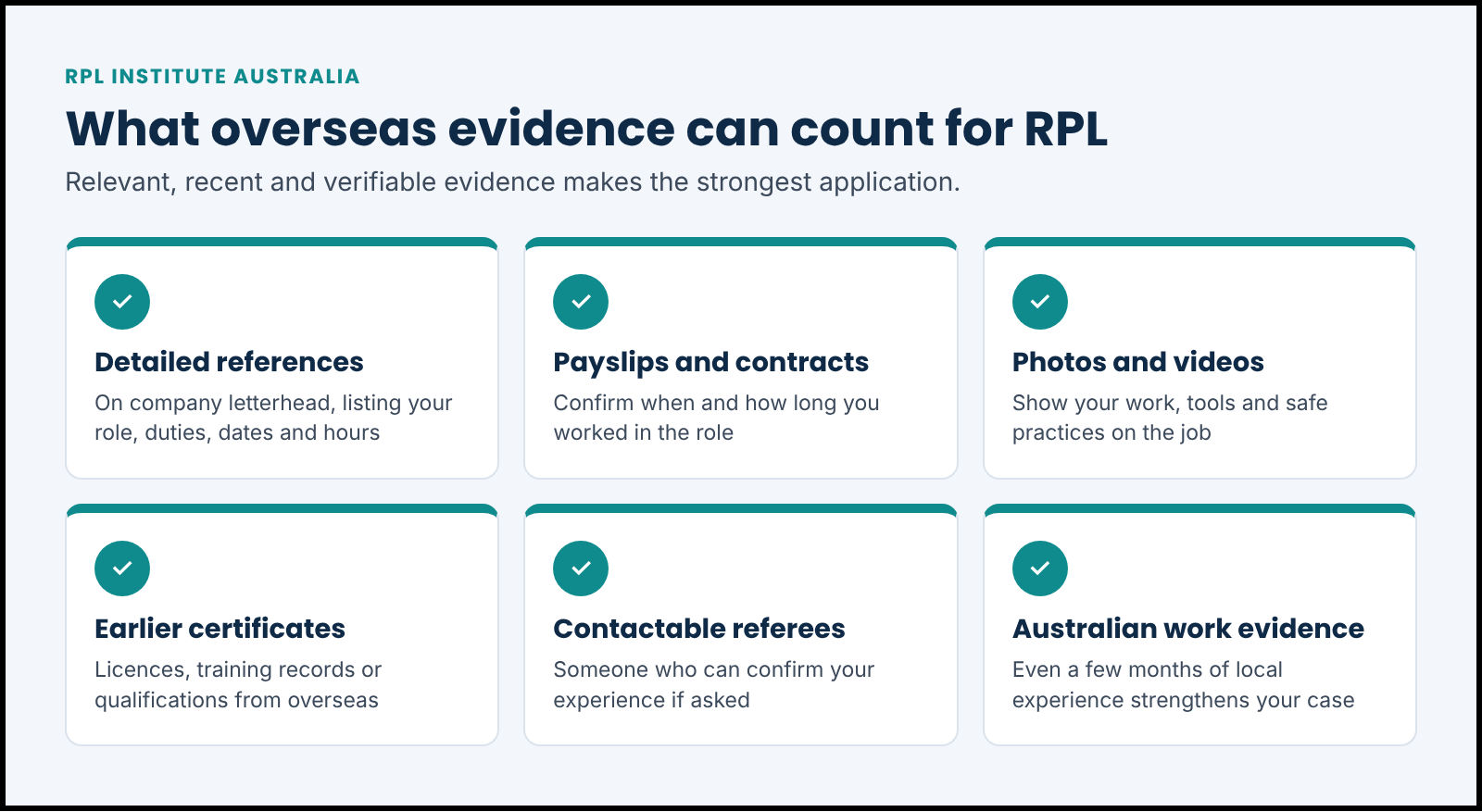
Strong overseas evidence usually includes:
A detailed employment reference on company letterhead, listing your role, duties, dates and hours.
Payslips, employment contracts or tax records that confirm the dates.
Photos or videos of your work, especially for trades and hospitality.
Earlier certificates, licences or training records, even if they are not formally recognised in Australia.
A referee who can be contacted to confirm your experience.
Documents in a language other than English will usually need a certified translation. Many RTOs ask for NAATI-certified translators, so check this before you pay for translation.
Assessors also need to see that you can apply your skills in an Australian setting. That might mean a practical observation, a workplace task, or questions about Australian safety laws, codes and work practices. Even a few months of local work experience can make your application much stronger.
How the RPL Process Works for New Migrants
The steps are the same for migrants as for anyone else, but each one has a few points worth knowing. For a fuller walkthrough, read our step-by-step guide to the RPL assessment.
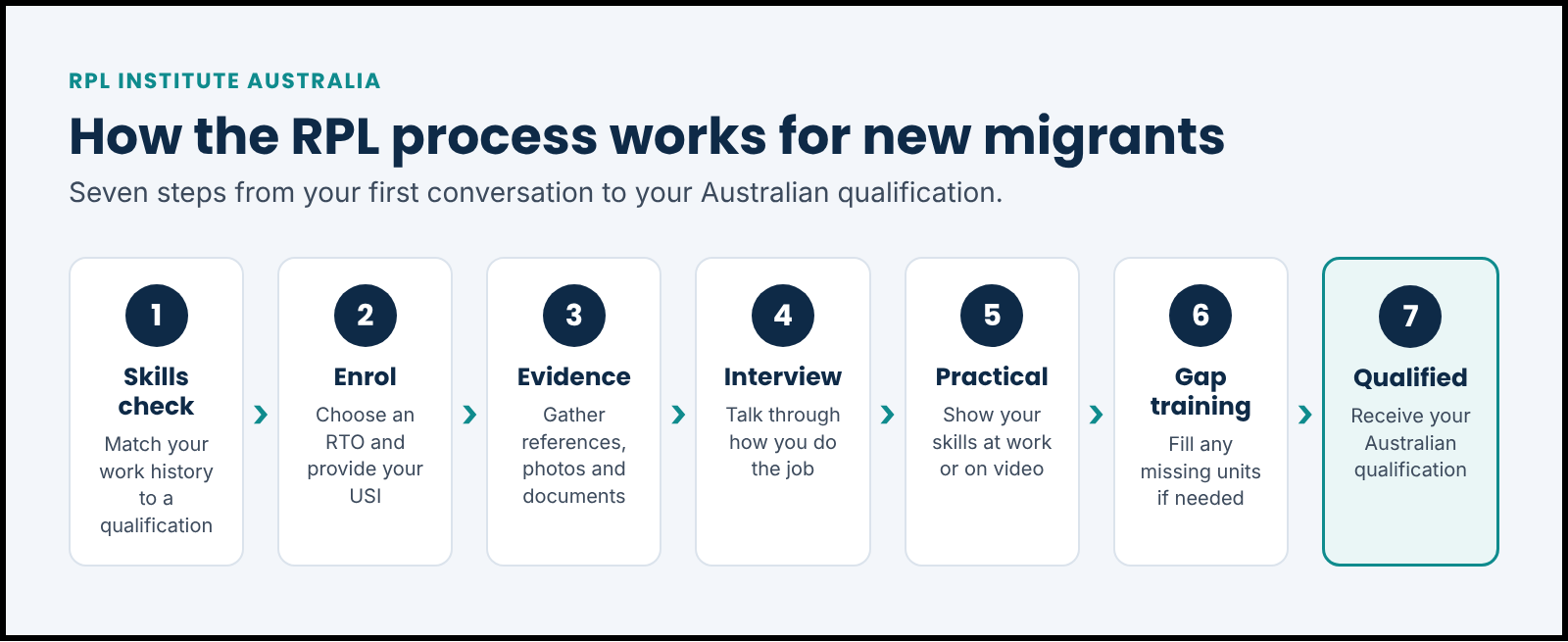
Initial skills check. Share your work history with an RPL adviser to find the qualification that best fits your experience.
Enrolment with an RTO. You enrol with a registered provider and create or supply your Unique Student Identifier (USI).
Evidence portfolio. You gather references, photos, documents and examples of your work, both overseas and in Australia.
Competency conversation. An assessor interviews you about how you do the job and may ask you to explain Australian requirements.
Practical assessment. You may be observed at work or complete a practical task, often by video or at a workplace.
Gap training, if needed. If a few units are not covered by your evidence, you complete short training to fill the gaps.
Qualification issued. Once every unit is assessed as competent, the RTO issues your qualification or statement of attainment.
What New Migrants Need Before Applying
A little preparation saves time and stops your application stalling halfway.
A Unique Student Identifier
Everyone doing nationally recognised training in Australia needs a USI. It is free, takes a few minutes to create, and stays with you for life. Migrants can usually create one once they are in Australia using their passport and visa details.
Identity and visa documents
Have your passport, visa grant notice and proof of address ready. Your visa conditions matter too. Some temporary visas limit study or training, so check your conditions before enrolling.
English, literacy and numeracy
There is no single English test for RPL, but RTOs must confirm you can meet the language, literacy and numeracy demands of the qualification. Many do this with a short pre-enrolment check. You do not need perfect English, but you must be able to communicate safely at work.
Your work history, written down
Before you speak to anyone, write a simple timeline of every job, the main tasks and the dates. It helps the adviser match you to the right qualification and makes your evidence easier to organise.
RPL Costs and Timeframes for Migrants
Price is one of the first questions migrants ask, and the honest answer is that it depends on the qualification, the provider and how much gap training you need. Our guide to RPL certificate cost explains typical price ranges and what is usually included.
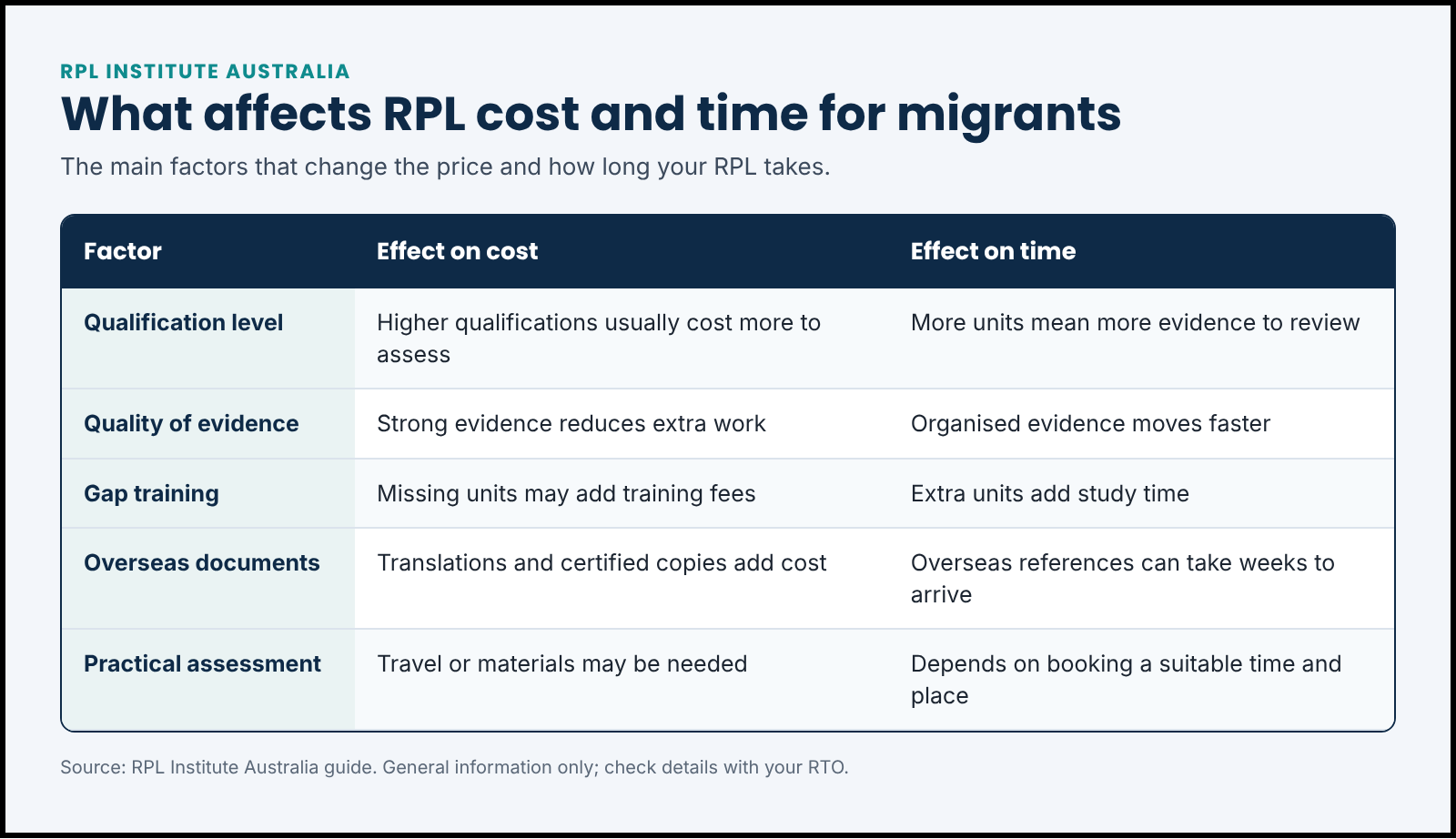
Timeframes depend mostly on how quickly you can supply evidence. Applicants with organised documents and contactable referees move faster. Applicants who need overseas references posted, translated or verified may wait longer, so start collecting early.
Be wary of anyone promising a qualification within days, regardless of your evidence. A genuine assessment takes as long as it takes to check your skills properly.
Tips to Strengthen Your RPL Application
A few simple habits make a noticeable difference to how smoothly your assessment goes.
Contact former employers early. Overseas references can take weeks to arrive, especially if a company has closed or changed management. Ask now, even before you choose a provider. A clear reference listing duties, dates and hours is worth more than a short letter that only confirms you worked there.
Keep evidence from your current job. If you work in Australia, save rosters, job sheets, training records and any positive feedback. Ask your supervisor whether they would be willing to act as a referee. Local evidence shows the assessor that you understand Australian workplace practices.
Be honest about gaps. If you never did one part of the job, say so. Assessors can arrange gap training for missing units, but evidence that looks inflated can slow everything down or lead to a rejected application.
Learn the Australian terms. Safety rules, equipment names and job titles often differ from what you used overseas. Reading the unit descriptions on training.gov.au before your interview helps you explain your skills in the language the assessor expects.
Keep copies of everything. Store your documents, translations and assessment records in one folder. You may need them again for future study, a licence application or a job interview.
Mistakes New Migrants Should Avoid
New arrivals are sometimes targeted by agents selling fast qualifications. In recent years, the national regulator, the Australian Skills Quality Authority (ASQA), has cancelled thousands of qualifications issued by providers that did not assess students properly. Students who paid for those qualifications lost them, even when they had not done anything wrong themselves.
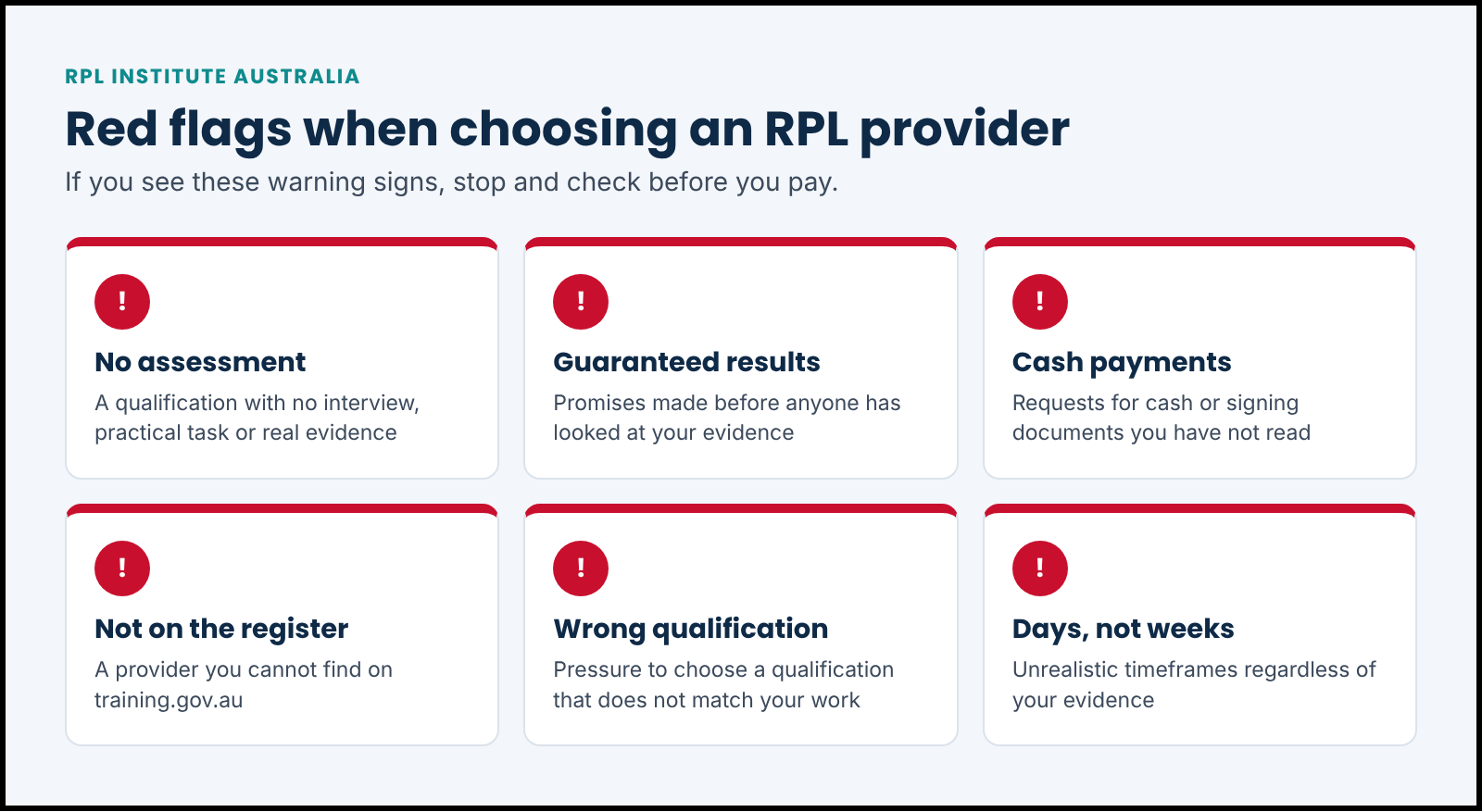
Watch for these warning signs:
Promises of a qualification with no assessment, no practical task or no interview.
Guaranteed outcomes before anyone has looked at your evidence.
Agents who ask you to pay cash or sign documents you have not read.
A provider you cannot find as a current RTO on the national register.
Pressure to choose a qualification that does not match your actual experience.
A legitimate RPL provider will ask detailed questions, request real evidence and explain what happens if you are not yet competent in some units.
Is RPL Right for You? A Quick Self-Check
RPL is likely to suit you if you can answer yes to most of these questions:
Do you have at least two to three years of relevant work experience, overseas or in Australia?
Can you get references or documents that confirm your roles and dates?
Is there an Australian qualification that closely matches the work you do?
Do you want a qualification for employment, promotion or further study, rather than for a visa alone?
Are you prepared to complete a practical assessment or short gap training if needed?
If you answered yes to most, a free skills assessment is a sensible next step to see which qualification fits your experience. Bring your work timeline so the adviser can match your experience more accurately.
Frequently Asked Questions
Can new migrants apply for RPL in Australia?
Yes. New migrants can apply for RPL with a registered training organisation, provided they meet the RTO's enrolment requirements and their visa conditions allow them to undertake training.
Does overseas work experience count for RPL?
Yes. Overseas work experience counts when it is relevant to the qualification and can be verified through references, payslips, contracts, photos or a contactable referee.
Is an RPL qualification the same as a skills assessment for a visa?
No. An RPL qualification is a nationally recognised Australian qualification. A skills assessment for migration is a separate check done by an assessing authority for a visa occupation.
Can RPL help me get permanent residency?
RPL does not grant a visa or permanent residency. A relevant Australian qualification may support your career, but visa decisions depend on Department of Home Affairs and assessing authority rules.
Do I need an English test for RPL?
There is no standard English test for RPL. RTOs check that you can meet the language, literacy and numeracy demands of the qualification, often through a short pre-enrolment assessment.
Do my overseas documents need to be translated?
Usually, yes. Documents not in English normally need a certified translation, and many RTOs ask for a NAATI-certified translator.
How long does RPL take for migrants?
It depends on the qualification and how quickly you can provide evidence. Applicants with organised references and contactable referees finish faster than those waiting on overseas documents.
Can I become a licensed electrician or plumber through RPL?
RPL can contribute to the qualification, but licensed trades also need a licence from the relevant state or territory regulator, which may require extra training or supervised work.
Is an RPL qualification different from a studied qualification?
No. A qualification gained through RPL from a genuine RTO is the same nationally recognised qualification as one earned through a full course, with the same title and the same national code.
How do I check if an RPL provider is legitimate?
Search the provider's name or RTO code on training.gov.au, confirm the qualification is on its scope of registration, and avoid anyone promising a qualification without assessment.